Disclaimer: Quantzee indicators are analytical software tools designed to assist your own analysis. This content is for educational purposes only and does not constitute investment advice. Do your own research. Trading involves risk of capital loss. Quantzee is not a registered investment advisor.
Quantum Algo (quantum-algo.com) is a Smart Money Concepts (SMC) indicator suite for TradingView, sold as Matrix at $19 a month, Atlas at $39 and Zeno at $79. The detail most “alternative” pages miss is that the $19 plan does not include the SMC layer. That starts on Atlas, and the signals, risk tools and the Gravity Zone sit on Zeno. Quantzee is a six-indicator suite sold once for $59.99, with the Pine Script source emailed to you.
Quantum Algo is a good product to look at, and it has changed a lot this year. It now has three plans, a free academy, a library of free open-source scripts, a public track record, a bot and a signals add-on. A lot of what is written about it online, including an earlier version of this page, is out of date.
I wrote this on 2026-11-06 after reading Quantum Algo’s own pricing, terms, how-it-works, track-record, documentation, editorial policy and comparison pages, plus the results that rank for “quantum algo alternative”, “quantum algo review” and “quantumalgo”. I have not paid for Quantum Algo and I have not run its invite-only scripts. So I cannot tell you how its signals perform on your chart. I can tell you what it costs, what each plan includes and what its published numbers do and do not show. A list of what I could and could not read is near the end.
⚡ Key Takeaways
- Quantum Algo lists three plans: Matrix $19 a month, Atlas $39, Zeno $79. The Smart Money Concepts layer is not in Matrix. It starts on Atlas.
- Over three years the monthly plans add up to $684 (Matrix), $1,404 (Atlas) and $2,844 (Zeno). Quantzee is $59.99 once, so the Matrix plan passes it in month four and Atlas in month two.
- Quantum Algo's 75% win rate is 120 wins out of 160 closed signals. 117 of those were recorded when they closed, not posted beforehand. With 160 trades the real figure could sit anywhere from about 68% to 81%.
- Quantum Algo says its signals are confirmed on candle close. That is a claim on its own site, and the script is invite-only, so you cannot read the code. Test it on Bar Replay.
- It has real strengths Quantzee does not match: a free 80-lesson academy, free open-source scripts, a public track record and an automation bot. Quantzee has none of these.
- Neither company offers a trial or refunds. Both say all sales are final.
Which “Quantum Algo” do you mean?
The name is crowded. Searching “quantumalgo” also returns an MT4 expert advisor called Quantum Algo Trading, a Whop trading community, a site called quantumalgotrading.ai and another called quantumalgosystems.com. None of them are the product on this page.
This page is about the TradingView indicator suite at quantum-algo.com, run by Quantum Algo LLC in the United States. If you meant the volume and currency-strength suite from quantumtrading.com, that is a different company, and I cover it in the Quantum Trading Indicators review.
Best Quantum Algo alternatives in 2026: 7 compared
The right alternative depends on what you want to change. Some traders want the same SMC tools for less. Others want signals instead of zones, or a different vendor entirely. Here is where the common options sit. Prices are list prices checked on each vendor’s own page, and they change without notice.
| Tool | What it is | Price | Fit |
|---|---|---|---|
| Quantzee | 6 premium TradingView indicators, Pine source emailed | $59.99 once, no renewal | Signals and SMC in one set of scripts, no monthly bill. No backtester, bot or academy |
| Quantum Algo | SMC suite, academy, bot, track record | $19, $39 or $79 a month | SMC depth, education and automation. SMC layer starts at $39 |
| LuxAlgo | Large multi-platform library | Four paid tiers, $24.99 to $119.99 a month, plus a free tier | Breadth. See our LuxAlgo alternative page |
| FluxCharts | Toolkits plus backtesters | $119.99 a month or $719.88 a year | Backtesting. See our FluxCharts review |
| EzAlgo | AI-branded signal overlay | See full comparison | Simple buy and sell labels |
| ValorAlgo | Market-structure and support/resistance focus | See full comparison | Structure-first traders |
| AlgoAlpha | Large indicator library, crypto-leaning | See review and pricing | Library-style, three plans and free scripts |
If you want the same SMC approach for less, look at Quantum Algo’s own Atlas plan and its free open-source scripts before you pay anyone. If you want zones plus signals with no recurring bill, Quantzee is built for that. If you want backtesting, FluxCharts and LuxAlgo are the ones with real backtesters.
Is Quantum Algo worth it in 2026?
For the right trader, yes. Quantum Algo does one thing, Smart Money Concepts, and wraps it in more support than most vendors give. The academy is free and needs no account. The scripts in its free library are open source under the MIT license. The track record page links each public call to a TradingView idea. Few competitors do all of that.
It is a weaker fit if you want one clean buy or sell signal and nothing to interpret. SMC tools mark zones and structure. You still decide what to do with them. That is a feature if SMC is how you already trade. It is a cost if you were hoping the indicator makes the decision.
The other thing to check is which plan you need. If your reason for buying is order blocks, fair value gaps and liquidity, the plan that carries them is Atlas at $39 a month, not Matrix at $19. Start the maths from $39, not $19.
Quantum Algo pricing explained
Here are the plans as listed on quantum-algo.com/pricing on 2026-11-06.
| Plan | Monthly | What it adds |
|---|---|---|
| Matrix | $19 | Basic overlay, TradingView alerts, multi-timeframe signal validation, market zones. No SMC layer |
| Atlas | $39 | Everything in Matrix, plus the advanced filtering dashboard, the Smart Money Concepts layer, an overbought/oversold oscillator, a backtesting suite and priority email support |
| Zeno | $79 | Everything in Atlas, plus the Zeno oscillator, Institutional Gravity Zone, Gold (XAU) Scalper, Zeno Stocks, live premium signals, built-in risk management, a 60+ strategy library, AI backtesting, a dedicated account manager and multi-account licensing |
Add-ons on the same page: Premium Signals on their own at $29 a month, and QuantumBot (automatic trade execution on your exchange) at $199 a month, or $79 a month billed yearly.
About the prices. The pricing page shows each plan with a crossed-out higher number (Matrix $23.75, Atlas $48.75, Zeno $112.86) and a “20% off” or “30% off” badge. I use the lower figure, because that is what the checkout charges and it matches the “from $19 a month” the vendor has quoted on its comparison pages since at least April. Zeno also has a yearly deal at $499 for 12 months, labelled a sale and “47% off”. On the track-record page the yearly Zeno offer reads $59 a month billed annually instead, so the vendor’s own pages do not agree. Check the checkout before you rely on either number.
Terms. There is no free trial. The terms page says all sales are final: no refunds, trials or money-back guarantees on any plan, monthly or annual, and no prorated refunds. You can cancel in one click and keep access until the period ends. Payment is by card, PayPal or crypto.
For how these prices compare with the wider market, and the TradingView plan underneath, see affordable TradingView indicators.
What it costs over three years
| Option | Month 1 | 12 months | 36 months |
|---|---|---|---|
| Quantum Algo Matrix | $19 | $228 | $684 |
| Quantum Algo Atlas | $39 | $468 | $1,404 |
| Quantum Algo Zeno (monthly) | $79 | $948 | $2,844 |
| Quantum Algo Zeno (yearly sale price) | $499 | $499 | $1,497 |
| Quantzee | $59.99 | $59.99 | $59.99 |
Three Matrix payments come to $57, so the fourth is the one that takes the total past $59.99. Atlas passes it in month two and Zeno in month one. This is only a cost comparison. It does not say which tool earns more, and a cheaper tool that does not fit how you trade costs more in the end. Our page on whether indicator subscriptions pay for themselves walks through the break-even maths.
What you get: the free tools, the academy and the bot
This is the biggest gap in most comparisons, including my earlier version of this page. The paid plans are only part of Quantum Algo.
The free academy. 80 lessons covering Smart Money Concepts and ICT ideas, free and with no account needed, according to its own site. An earlier version of this page said 81. The lesson count on its site today is 80.
The free open-source scripts. The free-indicators page lists 24 scripts, published under the MIT license in Pine Script v6. They include a Smart Money Concepts Engine with a 0 to 100 confluence score, order blocks with a volume split, fair value gaps with inversion, liquidity sweeps, institutional key levels, an Optimal Trade Entry plus Silver Bullet tool, session ranges, a volume profile, an anchored VWAP, a SuperTrend and a trend-state indicator. If you only want to learn SMC and see the tools working, you can load these on a free TradingView account without paying anything.
The bot. QuantumBot sends Zeno signals to your exchange as orders. The site describes it as running on Bybit with a trade-only API key, so withdrawals are off and the stop sits on the exchange. It is a separate $199 a month product. Quantzee has no equivalent.
The invite-only part. The paid script is invite-only. After purchase you give your TradingView username and get access. You can use it, but you cannot read its code.
What it does not tell you. Its how-it-works page shows a chart where signal accuracy rises from 42% on a single timeframe to 89% once multi-timeframe, SMC and adaptive filters are added. The footnote says it is backtested on BTC, EUR/USD and SPY from 2022 to 2025 and does not guarantee future results. There are no trade counts, no costs and no out-of-sample split behind it, so I would not use that chart to decide anything.
The 75% track record: what it counts
Quantum Algo’s headline claim is a 75% win rate across 160 closed Zeno signals, with a 2.3 to 1 planned reward-to-risk. An earlier version of this page quoted 73.8% over 240 BTCUSDT trades. That is out of date. The current figure is different and broader.
The track-record page splits the 160 like this:
| Part of the record | Trades | Wins | Losses | Win rate |
|---|---|---|---|---|
| Public TradingView ideas, posted before the outcome | 43 | 32 | 11 | 74% |
| Premium Zeno signals, recorded when they closed | 117 | 88 | 29 | 75% |
| Total | 160 | 120 | 40 | 75% |
Three things are worth knowing before you lean on it.
- Most of the record is not time-stamped in advance. The page says the 117 premium signals are recorded with their result when they closed (totals as of 2026-07-22). Only the 43 public ideas carry a TradingView timestamp from before the outcome. The first group is checkable. The second is the vendor’s own log.
- 160 trades is a small sample. A 75% result on 160 trades has a margin of roughly seven points either way, so the true rate could be anywhere from about 68% to 81%. That is before you consider that the 160 spread across crypto, forex, gold, stocks and indices.
- Win rate is not profit. The record is kept in R, which is multiples of the amount risked. It lists a planned 2.3 to 1 reward-to-risk, but a plan is not an outcome, and the R totals on the page are filled in by script, so they showed blank when I read it. I did not see a realised average R I could check.
None of this means the record is fake. It means it is partial evidence, a good deal more than most vendors give, and still the vendor’s own account. The vendor’s comparison pages call it “the only verifiable track record in the category”. I would read “only” as marketing.
Does Quantum Algo repaint? How to test it
Quantum Algo says every signal is confirmed on candle close and will not change afterwards. That is a claim on its own site, repeated in its documentation, and I have no reason to doubt it. I also cannot check it, because the script is invite-only. An earlier version of this page said Quantum Algo had not published a non-repainting statement. That was wrong.
You can check any indicator yourself in about ten minutes, and it works the same way for Quantum Algo, Quantzee or anything else:
- Add the indicator to a chart and pick a liquid market and a timeframe you actually trade.
- Turn on Bar Replay and go back a few days. Step forward one bar at a time.
- Screenshot or note every signal and zone as it appears.
- Let the replay finish, then compare with the same period loaded normally. Signals that vanished, moved or appeared on bars that were already closed are repainting.
- Order blocks and fair value gaps are drawn back to an earlier candle by design. That is fine, as long as the zone only appears once the confirming candle has closed. If it shows up on the earlier bar during replay, it is looking ahead.
Our repainting test guide has the full steps. For the zone question in particular, how five order block rules mark the chart shows how the same name can mean different candles in different tools.
What users say about Quantum Algo
I want to be careful here, because I could not read any independent user review for this product.
Quantum Algo’s own home page shows testimonials with first names and social handles, a 4.9 star average and a count of 2,400 or more active traders. Those are on the vendor’s site, so they are not independent evidence. I tried Reddit and Trustpilot and could not load either, so I have only their search snippets. The search results for “quantum algo review” are mostly the vendor’s own pages, plus results for other products with similar names: Ray Algo, SMRT Algo, One Shot Algo and others.
An earlier version of this page had quoted user comments. I could not trace them to a source, so I have removed them. If you have a real thread, a Trustpilot page or a video worth reading, send it over and I will add it with a link.
What I can say is that the criticisms I would expect for any SMC suite apply here. The method needs practice. Zones and signals need judgement. The plan you start with may not be the plan with the features you wanted. The second one is easy to see in the table above.
Quantum Algo pros and cons
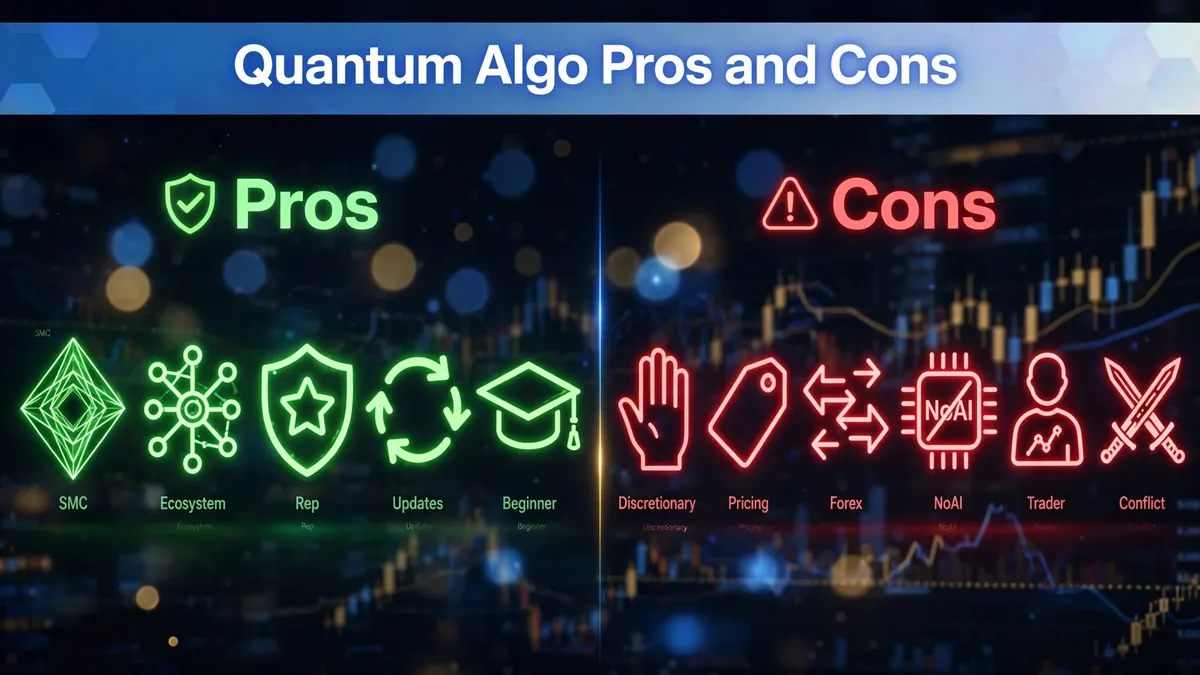
Pros:
- A broad free layer: an 80-lesson academy and a library of open-source scripts you can read
- A public track record, with 43 calls timestamped before the outcome
- A clear plan ladder, and a one-click cancel
- Works on all TradingView markets, with a stocks indicator for Nasdaq and S&P 500 names
- Optional automation through QuantumBot
- An editorial policy and a corrections log, which is rare in this category
Cons:
- The $19 plan has no SMC layer, which is the reason most people look at it
- Costs add up: $684, $1,404 or $2,844 over three years, depending on plan
- Most of the track record is logged by the vendor when trades close, not posted in advance
- The paid script is invite-only, so you cannot read how it works
- No trial and no refunds on any plan
- Its comparison pages are written to sell. One says there is “no scenario” where LuxAlgo is the right choice for an SMC trader, which no honest comparison would claim
Quantum Algo vs LuxAlgo vs Quantzee
| Quantum Algo | LuxAlgo | Quantzee | |
|---|---|---|---|
| Price | $19, $39 or $79 a month | Four paid tiers, $24.99 to $119.99 a month | $59.99 once |
| Free option | 80-lesson academy and open-source scripts | Free tier | None |
| Trial or refund | None, all sales final | 30-day money-back on paid plans | None, all sales final |
| Method | SMC: order blocks, FVGs, liquidity, structure | Broad library, SMC is one module | Signals plus an SMC toolkit |
| Script access | Invite-only | Not checked | Pine Script source emailed |
| Backtester | Atlas and Zeno | Has a Backtesting Assistant and a Quant strategy builder, check which tier | None |
| Bot or automation | QuantumBot, $199 a month | Custom alerts to a bot or broker | None, alerts only |
| Public track record | Yes, partly time-stamped in advance | Not that I found | None |
| Education | Free academy | Docs and library | Setup guides |
LuxAlgo prices are from its pricing page on 2026-11-06. Our own LuxAlgo alternative page still carries older tier prices, so use the vendor page when you decide.
Where Quantzee fits, and where it does not
Quantzee is a suite of 6 premium TradingView indicators sold for $59.99 once, with no renewal. Signals are calculated on closed bars: once a candle closes and a signal prints, it does not move. A few components confirm a fixed number of bars after a swing forms, which is how pivot detection works and is the honest trade-off for signals that do not redraw. You get the Pine Script source after purchase, so you can read how it works and run the Bar Replay test above. There is no trial, so I would not ask you to take my word for it before you pay.
Here is how it lines up with Quantum Algo:
| Quantum Algo | Closest Quantzee tool | Honest note |
|---|---|---|
| SMC layer (Atlas): order blocks, FVGs, liquidity, structure | SMC Toolkit Pro | Dual-leg BOS and CHoCH structure, auto order blocks and fair value gaps, equal-high and equal-low liquidity with sweep detection, premium and discount zones, 14 alerts. Different rules to Quantum Algo’s, so zones will not match one for one |
| Signals and overlay | AI Adaptive Quant Toolkit and SuperTrend Pro+ | Both give entry markers. Different methods again |
| Oscillator (Atlas, Zeno) | Adaptive AI Oscillation Engine and MACD Pro+ | Smart Money Flow, Hyper-Wave momentum and divergence detection in one, and a graded MACD with a divergence engine in the other. Different tools, not copies |
| Backtesting suite, AI backtesting | None | Quantzee has no backtester. Use TradingView’s strategy tester or our backtest guide |
| QuantumBot, signals add-on | None | Quantzee gives alerts only |
| Academy, free scripts, track record | None | Quantzee has none of these |
If the academy, the open scripts or the bot are why you are looking at Quantum Algo, do not switch. Stay, or start with the free scripts.
If you want signals and SMC zones in one set of scripts that you own, for one payment, Quantzee is the other end of the range: see the indicators or pricing. Quantzee is also paid-only, with no free tier, no trial and no refunds, so be sure before you buy. Our legal page on refunds gives the reasons.
If you do switch, in 10 minutes
- Cancel Quantum Algo from your dashboard. Access continues until the end of the period you already paid for, so there is no need to rush.
- On your TradingView chart, remove the Quantum Algo indicators (right-click each one, then Remove).
- Add a Quantzee indicator: paste the Pine Script source from your email into the Pine Editor and save it. Your layout and drawings stay as they are.
- Re-create your alerts with the alarm-clock icon, choosing the Quantzee condition in place of the old one.
- Run Bar Replay on the new signal for a few sessions before you trade it live.
Who should use which?
| If you are… | Best choice |
|---|---|
| New to SMC and want to learn it | Quantum Algo’s free academy and free scripts first |
| An SMC trader who wants the layer and a public record | Quantum Algo Atlas |
| Someone who wants a bot that executes signals | Quantum Algo with QuantumBot |
| Someone who wants signals plus SMC and no monthly bill | Quantzee |
| Trading on a tight budget over several years | Quantzee, or the free Quantum Algo scripts |
| Someone who needs a built-in backtester | Quantum Algo Atlas or higher, or FluxCharts or LuxAlgo |
| Someone who wants to read the indicator source | Quantzee, or Quantum Algo’s open-source library |
| Weighing several suites at once | Our Zeiierman alternative, Market Cipher review and SMRT Algo review pages |
Verdict
Quantum Algo is a serious product with real strengths: the free academy, the open-source scripts, the public record and the bot. The weak spots are that the SMC layer is behind the $39 plan, the cost builds up over years, most of the track record is the vendor’s own log, and the paid script cannot be read.
If you are thinking of it for the first time, do three things. Use the free scripts and academy first. Start on Atlas if SMC is the point, not Matrix. And run the Bar Replay test before you commit to a year.
If you want a set of scripts you own, for one payment, Quantzee is the simpler deal, and you give up the academy, bot and backtester to get it.
How I checked, and sources
I wrote this on 2026-11-06. I used only normal page loads, web search results and public pages. I did not try to get round bot checks, so where a site blocked me or timed out I used search snippets and say so.
- Read in full: Quantum Algo’s home page, pricing page, terms (refund section), how-it-works, track-record, documentation, free-indicators library, comparison hub, Quantum Algo vs LuxAlgo page, editorial policy and corrections log, and LuxAlgo’s pricing page.
- Read, but not about Quantum Algo: Pineify’s LuxAlgo alternatives page, which I used for the point about stating the rule behind an order block or fair value gap.
- Snippet only (page would not load, or was not opened): the Reddit search for Quantum Algo, SimpleAlgo’s TradingView indicator guide, the Trustpilot results (SMRT Algo, Smart Algo, Trade Algo, Ray Algo pages), the r/TradingView thread “Does anyone think LuxAlgo is worth it?”, the YouTube videos in the results, and the pages for similarly named products (quantumalgo.org, quantumalgotrading.ai, quantumalgosystems.com, the Whop review and the Ladder EA review).
- Not done: I have not paid for Quantum Algo, run its paid scripts, or recorded a Bar Replay test of it. No repaint result is claimed.
- Prices: list prices, with the crossed-out and sale prices noted where they appear.
Sources, all checked 2026-11-06:
- Quantum Algo home page
- Quantum Algo pricing
- Quantum Algo terms (refund policy)
- Quantum Algo: how it works
- Quantum Algo: track record
- Quantum Algo: documentation
- Quantum Algo: free indicators
- Quantum Algo: comparison hub
- Quantum Algo vs LuxAlgo
- Quantum Algo: editorial policy
- Quantum Algo: corrections log
- LuxAlgo pricing
- Pineify: LuxAlgo alternatives
- Investopedia: smart money
Related Quantzee comparisons: LuxAlgo alternative, FluxCharts review, Quantum Trading Indicators review, Market Cipher review, Best TradingView indicators 2026, Smart Money Concepts, audited.
Frequently Asked Questions
Explore Quantzee Indicators
- AI Adaptive Quant Toolkit — self-tuning signals, overlays & dashboard — no repainting
- SMC Toolkit Pro — order blocks, fair value gaps, liquidity sweeps and structure on one chart
- SuperTrend Pro+ — volatility-adjusted trend signals
View all indicators · See pricing
Related Articles
- EliteSignals Alternative — the same comparison for the EliteAlgo suite, including its new AI Optimizer and Lifetime plan
- LuxAlgo Alternative
- Market Cipher Review
- FluxCharts Review
- Quantum Trading Indicators Review — a different company with a similar name
- EzAlgo Alternative — another AI signal overlay to weigh against Quantum Algo’s SMC tools
- ValorAlgo Alternative — for a straight comparison against a market-structure and support/resistance focused competitor
- Zeiierman Alternative — another SMC and order-flow indicator suite in the same category
- AlgoAlpha review and pricing — a comparison against a larger indicator library