Disclaimer: Quantzee indicators are analytical software tools designed to assist your own analysis. This content is for educational purposes only and does not constitute investment advice. Do your own research. Trading involves risk of capital loss. Quantzee is not a registered investment advisor. Analytical software, not investment advice.
AlgoAlpha, also written Algo Alpha, is a good product. I want to say that first, because most “alternative” pages start by running the rival down. It ranks for “best TradingView indicators 2026”, its free scripts are all over YouTube, and its paid suite has a real backtester inside it. If you are shopping around, the reason is usually one of three things: the monthly bill, a wish for finished signals instead of a library, or a worry about repainting.
This page covers all three. I look at what AlgoAlpha gives away for free and where that stops, what the paid tiers cost today, how to test any indicator for repainting yourself, and who should skip Quantzee altogether. Where I could not check something, I say so.
Short answer
AlgoAlpha is a real, well-built TradingView suite. Its paid plans run $28.72 to $79.32 a month (billed annually), and it also gives away some open-source indicators on TradingView. Pick AlgoAlpha if you want a big script library, the Atlas AI backtester or Echo automation. Pick Quantzee if you want six finished, closed-bar signals for one payment of $59.99, with the Pine Script source emailed to you. Quantzee has no free tier, no trial and no refund, no backtester and no automation, so read the "who should not buy" section before you pay.
⚡ Key Takeaways
- AlgoAlpha's cheapest paid plan (Indicators, billed annually) is $28.72/month, or $344.64 a year, and it renews. Quantzee is $59.99 once, about what AlgoAlpha's cheapest plan charges in two months. Over three years the gap at list prices is about $974 against the cheapest tier.
- AlgoAlpha has free, open-source indicators on TradingView. Quantzee has no free tier and no trial. That is a real advantage for AlgoAlpha when you are still deciding.
- AlgoAlpha has no platform-wide non-repainting guarantee that I could find, though its own guide treats bar-close behaviour as a test criterion. Quantzee commits all 6 indicators to confirmed bar-close data. Whichever you pick, run the Bar Replay test described below on your own chart.
- AlgoAlpha has things Quantzee does not: Atlas AI backtesting, Echo automation, 140+ scripts. If you need those, Quantzee is the wrong tool.
AlgoAlpha Alternatives in 2026 (Quick Comparison)
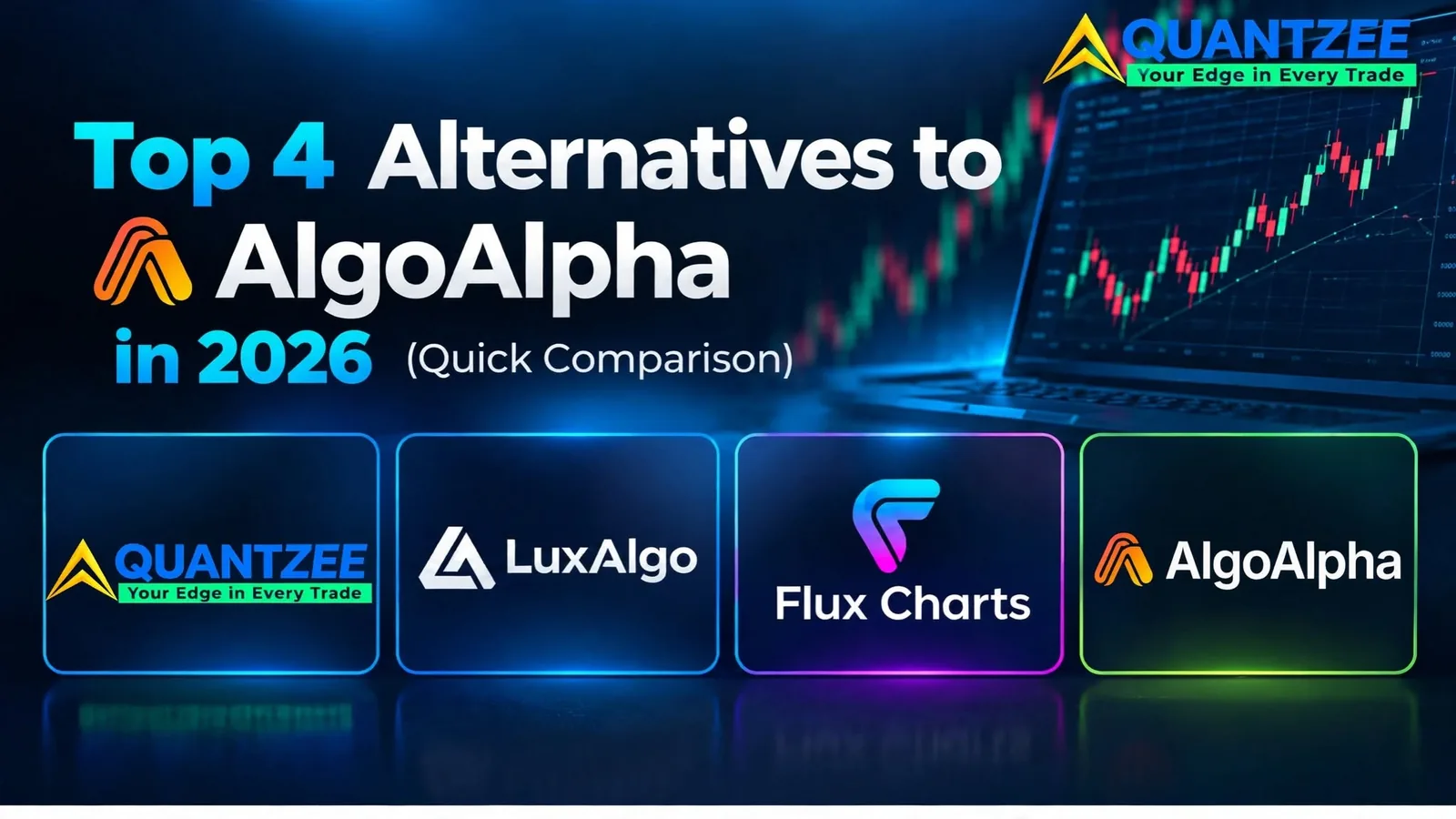
If you are comparing AlgoAlpha against the whole field and not just one rival, this is the shortlist I would use. Prices are list prices checked on 2026-11-06 from each vendor’s own page, not sale or promo prices. Where a vendor’s page would not load for me, the row says so.
| Rank | Tool | Category | List price | Free option | Notes |
|---|---|---|---|---|---|
| 🏆 1 | Quantzee | AI signal indicators (TradingView) | $59.99 once, Pine source emailed, no renewal | None: no free tier, no trial, no refund | 6 finished closed-bar indicators. No backtester, no automation |
| 2 | AlgoAlpha | Indicator library + AI backtester + automation | $28.72 to $79.32/mo, billed annually | Free open-source indicators on TradingView | 140+ scripts, Atlas, Echo. Monthly-billing prices not shown on the page |
| 3 | LuxAlgo | Indicator suite + AI backtesting | Essential $24.99/mo, Premium $39.99/mo, Ultimate $59.99/mo, AI Ultra $119.99/mo (billed monthly) | Free plan. 30-day money-back on the first payment of paid plans | Annual billing is cheaper in year one, and renewals go back near the monthly rate |
| 4 | Zeiierman | Order-flow / structure indicator suite | $95.20/mo billed monthly. Yearly plan shown as $37.99/mo | No trial shown | The page also shows a promo code, which I ignore. Total for the yearly plan is not stated, so my 3-year figure below is $37.99 x 12 x 3 |
| 5 | Lune | Indicator suite (4 indicators) | $79/mo, one plan | No trial found | Its pricing page returned a 403 to me on 2026-11-06. The $79 comes from our Lune review, taken from a cached copy on 2026-10-27 |
| 6 | Big Move Algo | Indicator subscription (Version 3 / 3 Plus) | Version 3: $97/mo monthly or $768/yr. Version 3 Plus: $139/mo monthly or $948/yr | No trial shown. 14-day money-back guarantee | A 50% promo on Version 3 was showing. I ignore it. It also names Quantzee in its own AlgoAlpha-alternatives article |
| 7 | FluxCharts | Indicator suite | See our review | See review | Its pricing page did not load for me, so I did not re-check it |
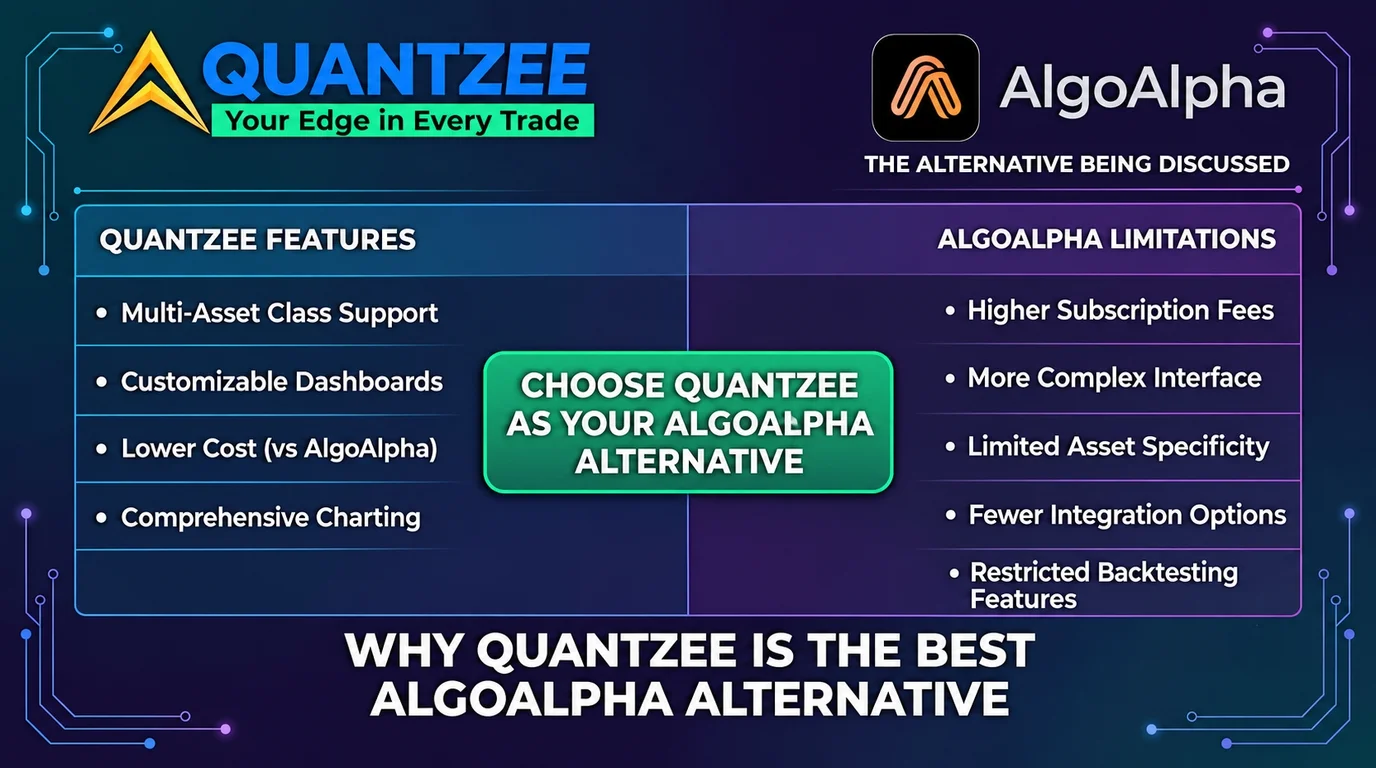
Quantzee tops this list on price over time and signal clarity. It is $59.99 once, against $28.72 to $79.32 every month at AlgoAlpha. It is also the only one here with no free way in and no backtester, and I cover that honestly further down.
If you landed here from a different comparison, these cover the neighbours: Quantum Algo alternative, AlphaTrend alternative and ValorAlgo alternative.
What is AlgoAlpha?
AlgoAlpha (algoalpha.io) is a TradingView indicator suite that has positioned itself as a premium toolkit for serious traders. It ranks consistently for competitive search terms around best TradingView indicators and professional-grade analysis tools, which reflects both the quality of its products and the strength of its content and SEO strategy heading into 2026.
On the day I checked (2026-11-06), AlgoAlpha’s TradingView profile showed 147 scripts and about 100.6K followers. AlgoAlpha’s own site talks about “97k+ active traders”, which is a different measure, so do not mix the two numbers. Either way, it is one of the larger communities around a paid indicator suite on the platform. Its offerings span trend detection, momentum analysis, market structure, volume and order flow, and liquidity concepts — the kind of multi-dimensional toolbox that experienced traders value when they want to go beyond a single oscillator or trend line.
The company has built a following among forex and equity traders globally, and its presence in best-of lists for 2025 and 2026 suggests it has maintained product quality over time. For traders who value community reputation and brand credibility alongside feature depth, AlgoAlpha is a name that comes up frequently.
You can explore AlgoAlpha’s published scripts on TradingView to see how their indicators are positioned in the public library, and review their full documentation on GitBook to understand the technical methodology behind each tool.
AlgoAlpha’s Free Indicators: What They Cover and Where They Stop
A big share of the people searching for AlgoAlpha are not shopping for the paid suite at all. They found a free script on YouTube or Reddit and want to know what else is there. That is fair, and I would start there too, because it costs nothing.
AlgoAlpha publishes a set of free indicators on its TradingView profile. The names that come up most are Trend Tracer, Zero Lag Trend Signals, Range Filtered Trend Signals and Reversal Signals. Here is what I could confirm about each, and what I could not.
| Free script | What it does, from its TradingView description | My status |
|---|---|---|
| Trend Tracer | A two-stage trend model: a mid-price band built from the highest high and lowest low, then two SuperTrend passes, with a gradient fill that uses RSI of the price-to-trail distance to show stretched or cooled-off price | Read on TradingView, 2026-11-06 |
| Zero Lag Trend Signals (MTF) | A zero-lag EMA with ATR-based volatility bands, labelled open-source | Seen in search results, not opened in full |
| Range Filtered Trend Signals | A Kalman filter to smooth price, a SuperTrend on the filtered line and a volatility range filter, with trend-change alerts. Labelled open-source | Seen in search results, not opened in full |
| Reversal Signals | Described in YouTube titles as a free reversal finder | Script page not loaded. Treat the details as unverified |
AlgoAlpha’s docs also list a Free Resources section with a Crypto Trend Forecast, a Crypto Sentiment Meter and a TradingView Indicators page. The TradingView Indicators page itself only points you back to the profile.
Where the free tools stop. They are single scripts. You get a trend tool or a reversal tool, but not Atlas (the AI backtester), not Echo (the automation), not the Smart Signals Assistant, and not the Signals plan. The paid suite is delivered as invite-only scripts on TradingView. In other words, the free scripts are a decent sample of how AlgoAlpha thinks about trend, and the paid plans are a different product.
What Quantzee offers by comparison: nothing free. Quantzee has no free tier and no trial. I know that is a weaker position when you are comparing, and I would rather say it here than let you find out at checkout. The reason is simple. The Pine Script source is emailed to you the moment you pay, and source code cannot be un-sent, so there is no trial and no refund. If you want to try before you buy, AlgoAlpha’s free scripts are the honest place to do it. Run them on your own charts, see whether you like the style, then decide.
AlgoAlpha’s Core Algorithm Architecture
Most comparison articles describe AlgoAlpha in vague terms — “professional grade,” “sophisticated,” “multi-dimensional.” If you are considering switching from or to AlgoAlpha, you need to understand what is actually running under the hood. Here is a documented technical breakdown of AlgoAlpha’s core algorithm types.
Momentum Concepts
AlgoAlpha’s Momentum Concepts is their multi-layered momentum analysis framework. It operates on three distinct time horizons simultaneously, which is the core of its multi-timeframe design:
Momentum Impulse Oscillator — The long-horizon component. Designed to identify trending vs. ranging market conditions and surface underlying market bias. It uses adjustable trend impulse thresholds, meaning the sensitivity of “strong trend” vs. “weak trend” classification can be tuned by the trader. The calculation foundation is standard momentum mathematics (rate of change with smoothing), but the three-layer combination is what gives it depth beyond a single oscillator.
Scalper’s Momentum — The short-horizon component. Designed for fast-moving setups with noise reduction built into the signal path. The key feature here is adjustable smoothing parameters, which control how much price noise gets filtered before a signal is registered. In practice, this means fewer but higher-confidence entries compared to a raw momentum oscillator.
Hidden Liquidity Flow Analysis — An order-flow supplement to the momentum readings. This component attempts to surface hidden liquidity — situations where excess liquidity is building or being absorbed — and identifies potential squeeze conditions (periods of compressed volatility before a directional move). It is conceptually similar to a volume-weighted momentum overlay but framed around liquidity rather than raw volume.
Squeeze Momentum Oscillator
AlgoAlpha’s Squeeze Momentum Oscillator is built on the intersection of two concepts: volatility compression (squeeze) and directional momentum. The calculation method uses an Exponential Moving Average (EMA) of the Average True Range (ATR) compared against a high-low price EMA to derive the squeeze value.
In plain terms: when the ATR-EMA expands beyond the price-range EMA, the indicator signals that momentum is building in a post-squeeze environment. When ATR compresses, it identifies the squeeze itself. This is a well-established methodology in technical analysis — similar in concept to John Carter’s TTM Squeeze — but AlgoAlpha’s implementation has been tuned with their own parameter sets and visual output.
Institutional Liquidity and Price Action Concepts
AlgoAlpha also publishes an institutional-focused toolkit covering:
- Trend Lines — Algorithmically drawn trend lines based on pivot detection logic, with settings for sensitivity and line extension
- Liquidity Zones — Identification of price levels where institutional order flow is concentrated, based on previous swing highs/lows and volume clusters
- Market Structure — Break of Structure (BOS) and Change of Character (ChoCH) detection, which are standard concepts from the Smart Money Concepts (SMC) framework that has become popular in retail institutional-style trading
What AlgoAlpha’s Architecture Tells You
Three observations matter for making a comparison decision:
-
The methodology is classical TA with sophisticated layering. AlgoAlpha’s momentum, squeeze, and liquidity tools are built on established mathematical foundations — EMA, ATR, pivot detection, momentum rate of change. The sophistication is in the combination and the visual presentation, not in machine learning or adaptive logic that self-tunes.
-
There is no published adaptive learning component. Unlike systems that use market-condition classifiers to adjust signal sensitivity, AlgoAlpha’s indicators use manually-tunable parameters. You adjust them; the indicator does not adjust itself.
-
The 140+ script count reflects breadth, not a unified system. AlgoAlpha’s library is a collection of individual tools rather than an integrated suite designed to produce a single composite trading signal. This is a feature for experienced traders who want to pick specific tools, but it means you need to know which tools to combine and how.
Why Traders Are Looking for AlgoAlpha Alternatives in 2026
Professional-grade does not always mean the right grade for your specific situation. Several patterns emerge in the feedback from traders who move away from AlgoAlpha in search of alternatives.
Cost relative to emerging market budgets. AlgoAlpha’s premium positioning is reflected in its pricing, which places it in a tier that is genuinely unaffordable for traders working with smaller accounts, or traders in markets where disposable income for tooling is limited. These traders face a compounding problem: many premium indicator suites are built and priced for Western forex and equity markets, meaning the cost is high and the relevance to their actual instruments — global index and derivatives markets — is limited.
The AI gap. AlgoAlpha’s indicators are sophisticated from a traditional technical analysis standpoint, but the core signal logic is rooted in classical TA methodology rather than machine learning. This is not a flaw in itself — many excellent systems are built on classical TA. But traders who specifically want adaptive, data-driven signals that evolve with market conditions, rather than fixed-formula overlays that apply the same logic regardless of regime, will find that AlgoAlpha does not fully deliver on that front. The momentum impulse oscillator’s “adjustable thresholds” require manual tuning by the trader — the indicator does not auto-adapt.
Non-repainting clarity. I could not find a platform-wide non-repainting guarantee from AlgoAlpha. Its own guide does treat bar-close behaviour as a criterion when it judges indicators, which is a good sign, but it is not a promise about its own scripts. Traders who have been burned by repainting indicators, and in the TradingView world that is a lot of people, often keep looking for a clearer statement. Whether you need one is something you can test, and I show how below.
System coherence. With 140+ scripts, AlgoAlpha is a library, not a unified trading system. Experienced traders who know how to select and layer tools benefit from this breadth. Newer traders, or traders who want a cohesive buy/sell system rather than a toolkit they have to assemble themselves, often find the choice paralysis counterproductive.
Global markets relevance. AlgoAlpha’s indicators are built primarily for the global forex and equity context. Index-options expiry dynamics, intraday volatility patterns, and other global-markets-specific timing considerations are not part of their design intent.
AlgoAlpha Pros and Cons
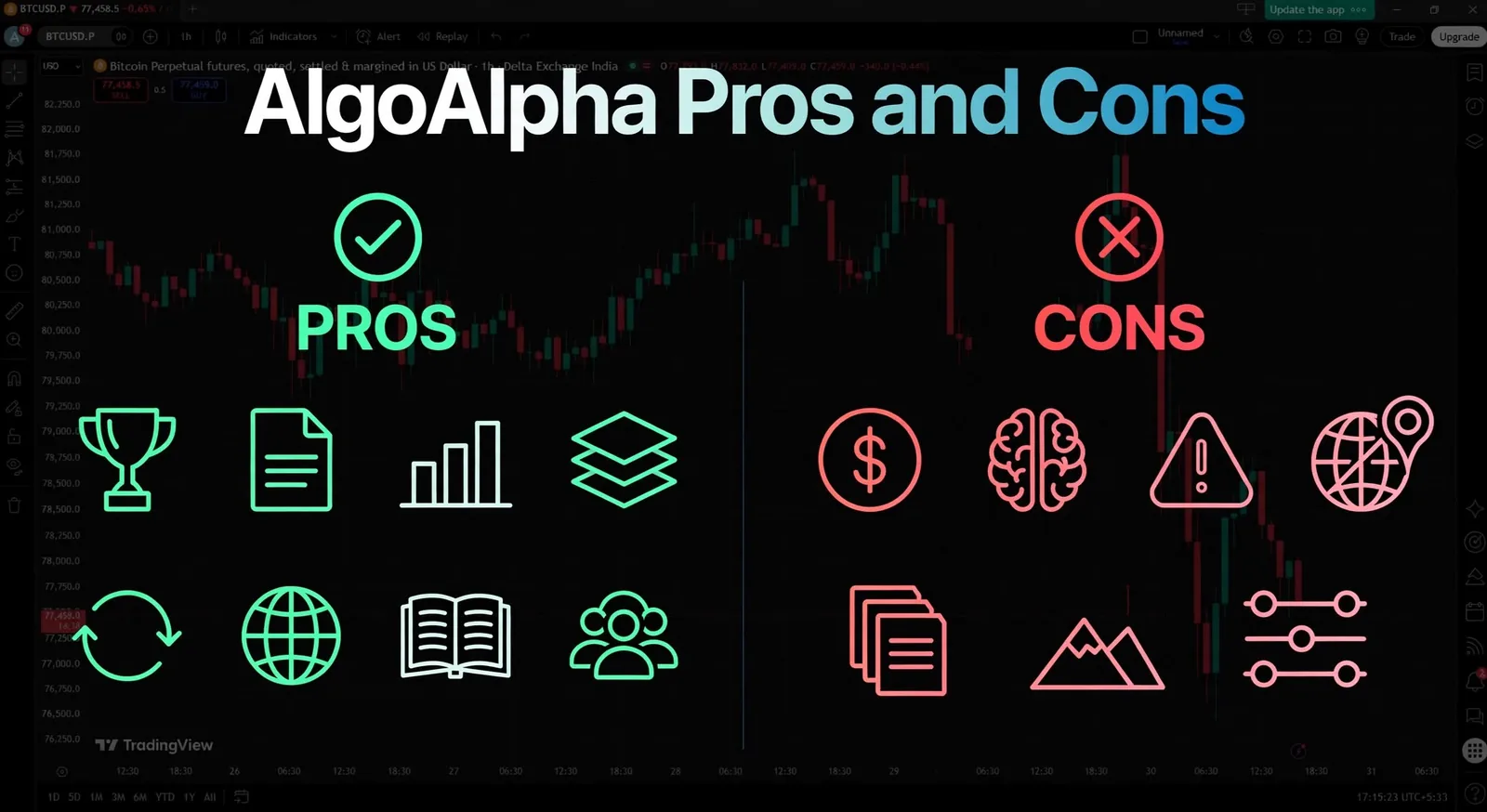
Pros:
- Strong brand reputation and credible community presence
- 140+ published scripts covering a wide range of methodologies
- Well-designed, clean indicator visuals
- Covers multiple technical analysis dimensions — trend, momentum, structure, liquidity, order flow
- Free open-source indicators on TradingView to try before paying
- Regular updates and active development
- Broad TradingView compatibility across asset classes
- Detailed GitBook documentation for most indicators
- Active community and support
Cons:
- Premium pricing ($28.72-$79.32/month depending on tier) that may not suit smaller account traders or emerging market users
- Signal logic is rooted in classical TA rather than adaptive machine learning
- No platform-wide non-repainting guarantee that I could find (test each script yourself)
- Limited optimisation for global market instruments (index options, expiry-day strategies)
- 140+ scripts means significant choice work — not a plug-and-play unified system
- Sophisticated tools can have a steeper learning curve for newer traders
- Manual parameter tuning required — indicators do not self-tune to market conditions
AlgoAlpha Pricing (2026)
AlgoAlpha runs a three-tier model. The figures below are read straight from algoalpha.io/pricing and are the annual-billing rates.
| Plan | Price (billed annually) | Includes |
|---|---|---|
| Indicators | $28.72/mo ($344.64/yr) | Smart Signals Assistant, Momentum Concepts, Institutional Liquidity & PA, Backtest Strategy Builder, Atlas AI backtesting, indicator screeners |
| Signals | $64.37/mo ($772.44/yr) | Scalping + swing signals for crypto, Echo™ automation, Atlas backtesting, Discord community |
| VIP Bundle (best value) | $79.32/mo ($951.84/yr) | Everything in both plans above |
Prices checked 2026-11-06 on algoalpha.io/pricing. The page marks the yearly rates “Save 57%” and “Save 56%”, so these are discounted annual rates, and I cite them because they are the only prices the page shows. It has a Monthly toggle, but the monthly-billed figures did not appear in the page content I could read, so I am not guessing them. Check the toggle before you buy. The page mentions no free trial for the paid plans and no money-back guarantee. It says you can cancel anytime and sends refund questions to checkout or to support on Discord.
For context, Quantzee’s complete suite, all 6 indicators, is one payment of $59.99, with the Pine Script source emailed to you. No renewal, no expiry.
AlgoAlpha’s cheapest tier costs about as much in two months as Quantzee costs in total, and the VIP Bundle costs more in a single month. The question is not whether AlgoAlpha is good. It is. The question is whether what you get is worth a recurring bill for the way you trade, and keeps being worth it every year.
What Users Say About AlgoAlpha
-
“One of the better-built indicator suites on TradingView:” The signal quality is genuinely solid and the visual design is clean. If you’re looking for professional-grade tools this is one of the better options available. That said, it’s not cheap and you need to know how to use it. (via community review, 2026)
-
“Great for equity and forex traders, less useful for global instruments:” Works very well on the pairs I trade. I did try it on the index and the results were mixed. I don’t think it’s optimised for market structure. (via r/IndiaInvestments, 2025)
-
“The learning curve is real:” There is a lot of functionality here. For experienced traders that is a feature. For beginners, it can be overwhelming and lead to analysis paralysis. (via forum review, 2025)
-
“Wish there was a more explicit non-repaint policy:” I’ve tested several of the indicators and they seem stable, but I’ve never seen a formal statement about non-repainting the way some other tools offer. As someone who has been stung by this before, that lack of clarity bothers me. (via Trustpilot reviews for AlgoAlpha, 2026)
What Traders Ask About AlgoAlpha
Reading around Reddit, YouTube and Trustpilot, the same few questions come up again and again. These are themes in my own words. I am not quoting anyone, and some of these sources I could only see through search snippets, as noted.
“Free or paid, and is the free stuff enough?” This is the loudest theme. Most YouTube hits for AlgoAlpha are tutorials on the free scripts, with titles around reversals, “zero lag” trend signals and range-filtered trend signals, several with tens of thousands of views. I saw those titles and view counts in search results only. I could not open the videos or read transcripts. The official channel is youtube.com/@AlgoAlpha.
“LuxAlgo or AlgoAlpha, which one?” A small r/TradingView thread asks exactly that. The mirrored copy I could read, a Reddit snapshot, has only a handful of comments. One reply doubts AlgoAlpha is any better, and suggests simple tools like VWAP bands with MACD instead. Reddit itself was blocked for me, so I could not read the original. One thread is not a verdict, and it is worth reading yourself.
“Is it worth paying for?” The AlgoAlpha Trustpilot page showed 4.1 out of 5 from 7 reviews on 2026-11-06, mostly dated January and February 2026. Six were 5-star and one was 3-star. Reviewers talk about the tools being more capable than free ones, friendly support and a useful Discord. The single critical review says the signals are not highly accurate on their own and need to be fitted to your own strategy. Trustpilot itself notes the company has not recently invited reviews, and seven is a small sample.
“Does it repaint?” Searchers ask this about nearly every TradingView suite, and AlgoAlpha is no exception. The honest answer is in the repaint section below: test it yourself.
“Free download, GitHub, cracked version?” These show up as related searches. I answer them in their own section further down.
“Is Algo Alpha the same as algoalpha.co?” No. That one is a different company, covered in the FAQ.
Meet Quantzee: A Better AlgoAlpha Alternative
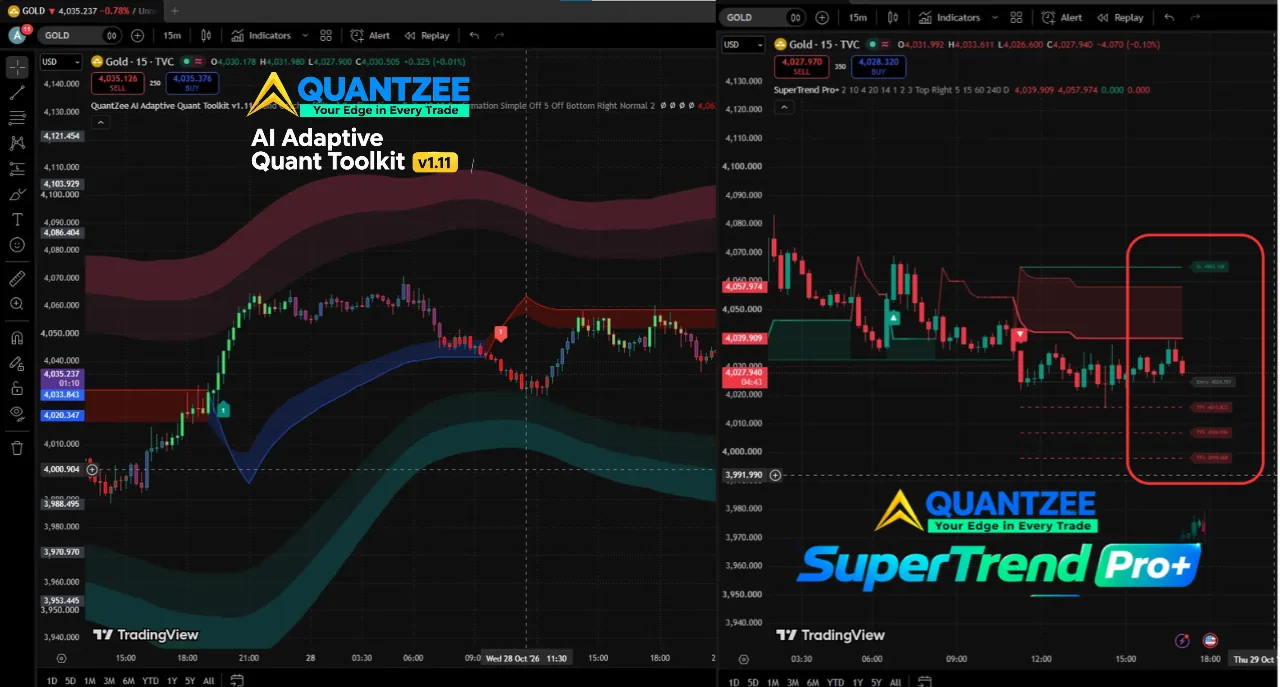
Quantzee’s entire product philosophy is built around three principles that directly address the gaps traders identify with AlgoAlpha: AI-first signal generation, verified non-repainting, and accessible pricing that opens the door for traders at every account size.
The AI-first approach is not cosmetic. Quantzee’s indicators use machine learning models trained on substantial historical datasets to identify high-probability signal conditions. The AI Adaptive Quant Toolkit, for example, self-tunes its parameters based on current market conditions rather than applying fixed settings to a changing environment. This is the practical difference between an indicator that was calibrated for one market regime and an indicator that adapts as volatility, trend strength, and market structure shift.
Where AlgoAlpha’s Momentum Impulse Oscillator requires the trader to manually adjust trend impulse thresholds for different market conditions, Quantzee’s Adaptive AI Oscillation Engine uses market-condition classifiers to adjust signal sensitivity automatically. The trader does not need to reconfigure the indicator when the market transitions from a trending to a ranging environment — the system detects the shift and recalibrates internally.
The SuperTrend Pro+ indicator addresses the multi-timeframe gap in a different way: rather than running separate short-horizon and long-horizon components that the trader must reconcile, SuperTrend Pro+ synthesises volatility-adjusted trend signals from a dual-SuperTrend confluence check into a single, unambiguous directional signal. One signal, confirmed by multiple layers — not three separate oscillators to interpret.
The non-repainting commitment is explicit and technical. Every signal generated by a Quantzee indicator is locked to the bar on which it appears. No retroactive updating, no signals that look clean in hindsight but were not there in real time. This design choice has direct consequences for how you evaluate system performance — your win rate in backtesting reflects what you would actually have seen in live conditions, which is the only useful form of backtesting.
Does AlgoAlpha Repaint? How to Test It Yourself
Repainting matters more than most features, because it decides whether a backtest tells you anything. A repainting indicator can show a 70% win rate on history and do far worse live, because the signals you see in hindsight were never on the chart in real time.
What AlgoAlpha says about it
I could not find a platform-wide non-repainting guarantee from AlgoAlpha. Its own indicator guide lists bar-close (non-repainting) behaviour as something it checks when it judges indicators, which tells you the company knows the issue. That is different from a promise about each of its own scripts. The GitBook docs give settings for individual indicators, but no single policy statement. Most TradingView publishers are the same, so this is not an accusation. It just means you cannot take it on trust, either way.
The three-point Bar Replay test
This is the test I use on any indicator, and it works on AlgoAlpha’s free scripts without paying anyone.
- Open bar. Load the indicator on a liquid symbol and a short timeframe. Start Bar Replay a few hundred bars back and let it run at the slowest speed. Watch the forming candle. Note any signal that appears, flips or vanishes before the bar closes. An open-bar signal that disappears is a warning sign.
- Bar close. Pause right after the candle closes and screenshot the signal state, including any labels, arrows and trend colour. This is the “what would I have seen live” record.
- Reload. Exit replay, reload the page and look at the same bars in normal view. If a signal moved, vanished or appeared where your screenshot shows nothing, the indicator repaints.
Two extra habits help. Repeat it on at least two symbols and two timeframes. And look hardest at multi-timeframe scripts, since higher-timeframe data is the classic place where repainting hides. Bar Replay is a good screen, not a lab-grade proof, so use it to decide whether a script deserves more of your time.
Our own recorded test
Not published yet. We have not recorded this test on AlgoAlpha’s scripts, and this page does not claim a result for any of them. When the test is done, the date, symbol, timeframe, screenshots and plain result will go here, whatever the result is.
Quantzee’s approach
Quantzee’s commitment is at the code level:
- All signal computations use confirmed bar data only. Calculations run on closed candles, not live intra-candle price movement.
- Once a candle closes and a signal is plotted, the signal is fixed. No later price action changes it.
- This applies to all 6 indicators in the suite. There is no mix of repainting and non-repainting tools.
You get the Pine Script source when you buy, so you can read how that is done and run the same three-point test on your own charts. There is no trial, so I would not ask you to take my word for it before you pay. If that is a dealbreaker, test AlgoAlpha’s free scripts first to learn the method, then decide.
Multi-Market Support Comparison
| Market | AlgoAlpha | Quantzee |
|---|---|---|
| Forex (major pairs) | Yes | Yes |
| Global Equities | Yes | Yes |
| Crypto | Yes | Yes |
| Futures | Yes | Yes |
| Major Global Indices | General TA tools, not optimised | Full support |
| Index Options / Expiry-Day Trading | No dedicated tools | Full support |
| Weekly Options Expiry | No coverage | Built-in expiry-day logic |
For traders outside the region, both platforms cover the major global markets adequately. For derivatives traders — the largest growing segment of retail option sellers — Quantzee’s dedicated global market support is a structural advantage that no amount of parameter tweaking in an AlgoAlpha indicator can replicate.
AlgoAlpha vs Quantzee at a Glance
| AlgoAlpha | Quantzee | |
|---|---|---|
| Signals | Library of 140+ tools plus scalping/swing signals on the Signals plan (crypto) | 6 finished indicators, buy/sell signals on the chart |
| AI | Smart Signals Assistant and Atlas AI strategy discovery. Core indicators are classical TA with manual settings | Adaptive logic that adjusts its own parameters |
| Automation | Echo™ scalping and swing automation (Signals and VIP plans) | None |
| Backtester | Yes: Atlas and Backtest Strategy Builder (from the Indicators plan) | None. Use TradingView’s own Bar Replay |
| Repaint stance | No platform-wide guarantee that I could find. Bar-close behaviour is a criterion in its own guide. Test each script | Closed-bar signals only, all 6 indicators. Test it yourself once you own it |
| Source code | Free scripts are open-source on TradingView. The paid suite is invite-only | Pine Script source emailed with purchase |
| Free access | Free open-source indicators | None. No free tier, no trial, no refund |
| Price | $28.72 to $79.32/mo, billed annually | $59.99 once |
AlgoAlpha vs Quantzee: Feature Comparison
| Feature | AlgoAlpha | Quantzee |
|---|---|---|
| Signal generation approach | Classical TA-based with layered complexity | Machine learning / AI-adaptive |
| Core algorithm type | EMA/ATR-based with momentum layering | Adaptive ML models, self-tuning |
| Non-repainting guarantee | No platform-wide guarantee found; bar-close behaviour is a criterion in its guide | Yes: closed-bar signals only, all 6 indicators |
| Pricing (2026) | $28.72-$79.32/month depending on tier, billed annually | $59.99 once, no renewal (full suite) |
| Free tier | Free open-source indicators on TradingView | No free tier and no trial. One $59.99 purchase |
| global market support | Limited — no dedicated index-options/expiry tools | Yes — index options, expiry-day |
| Number of indicators | 140+ scripts (individual tools) | 6 indicators as unified suite |
| In-platform backtester / screener | Yes — Atlas AI backtesting, Backtest Strategy Builder, and indicator screeners included from the Indicators tier up | No — Quantzee focuses on signal clarity, not building/testing your own strategies; use TradingView’s own Bar Replay to verify signals instead |
| Adaptive signal logic | Manual tuning required | Yes — self-tuning AI parameters |
| System coherence | Library of tools (user assembles system) | Unified suite (pre-assembled system) |
| Documentation | Detailed GitBook | Setup guides included |
| Best suited for | Experienced TA traders who want to build custom systems | All levels, systematic traders |
Being upfront about the gap: AlgoAlpha’s Atlas AI backtester and strategy builder are real, useful tools for traders who want to design and test their own systems — Quantzee doesn’t compete on that ground and doesn’t pretend to. If building and backtesting your own strategy logic is the job you need done, AlgoAlpha’s Indicators tier ($28.72/mo) does something Quantzee cannot — though it is worth noting you receive Quantzee’s Pine Script source, so you can modify the logic yourself if that is closer to what you actually want. If you want ready-to-use signals without assembling or testing anything yourself, that’s Quantzee’s whole design.
Pricing Analysis: Is AlgoAlpha Worth the Premium?
Here is the maths on three years of ownership, at list prices. The AlgoAlpha, LuxAlgo and Big Move Algo rows use each vendor’s own yearly or monthly price. Zeiierman’s yearly total is not stated on its page, so I multiplied its $37.99/mo by 12. Lune is $79/mo from a cached copy, as noted above.
Prices checked 2026-11-06 on algoalpha.io/pricing (and the other vendors’ pages on the same day, except Lune).
| Tool and plan | Per year | 3-year total | Versus Quantzee ($59.99) |
|---|---|---|---|
| Quantzee, all 6 indicators | $59.99 once | $59.99 | n/a |
| AlgoAlpha Indicators | $344.64 | $1,033.92 | +$973.93 |
| AlgoAlpha Signals | $772.44 | $2,317.32 | +$2,257.33 |
| AlgoAlpha VIP Bundle | $951.84 | $2,855.52 | +$2,795.53 |
| LuxAlgo Premium (list $39.99/mo) | $479.88 | $1,439.64 | +$1,379.65 |
| Zeiierman (yearly, $37.99/mo x 12) | $455.88 | $1,367.64 | +$1,307.65 |
| Lune ($79/mo) | $948.00 | $2,844.00 | +$2,784.01 |
| Big Move Algo Version 3 | $768.00 | $2,304.00 | +$2,244.01 |
The year-one story is simple. AlgoAlpha’s cheapest tier is $344.64 and Quantzee is $59.99, so Quantzee costs about 83% less in year one. Against the VIP Bundle it is about 94% less. Year two, AlgoAlpha bills again and Quantzee does not.
What the extra money buys at AlgoAlpha is real: 140+ scripts, a big community, a respected brand, and from the Indicators plan up an AI backtester and strategy builder that Quantzee does not have. With Signals or VIP you also get Echo automation.
What Quantzee gives you for less is a pre-assembled suite of 6 closed-bar indicators with adaptive logic, and the source code to keep. It does not give you a backtester, automation or a free way to try it.
The decision rule: if you are an experienced classical TA trader who wants to build and backtest custom systems from a large library, and the budget is there, AlgoAlpha earns its price. If you want finished signals, no recurring bill and the Pine source, Quantzee costs about 83% less than AlgoAlpha’s cheapest year.
140+ individual scripts, one Quantzee philosophy. AlgoAlpha ships 140+ scripts, and most traders use two or three, then spend time working out which two or three suit them. Quantzee ships exactly 6, each doing one job: trend, momentum, structure, oscillation and adaptive signal generation. Nothing to browse. One way in, $59.99 paid once, against AlgoAlpha’s $344.64 to $951.84 every year depending on tier.
AlgoAlpha Smart Signal Assistant Alternative
AlgoAlpha’s Smart Signals Assistant is the entry point into its Indicators plan — an AI-assisted layer that surfaces trade ideas across the Momentum Concepts and Institutional Liquidity & PA toolkits. It’s a genuinely useful triage tool if you’re working across AlgoAlpha’s full script library and want the assistant to point you toward which of the 140+ tools is relevant right now.
Quantzee doesn’t need an assistant to point you at the right tool, because there isn’t a library to search — each of the 6 indicators is purpose-built and already tells you what it’s for. If what you actually want from Smart Signals Assistant is “just tell me the signal,” Quantzee’s AI Adaptive Quant Toolkit and AI TrendPulse do that directly, without the intermediate step of the assistant recommending which other tool to open next.
AlgoAlpha Backtester Alternative
AlgoAlpha’s Atlas AI backtesting and Backtest Strategy Builder (included from the Indicators tier, $28.72/month billed annually) are real, capable tools for traders who want to design a rules-based strategy and test it against historical data before risking capital. This is a genuine category AlgoAlpha competes in and Quantzee does not — Quantzee has no built-in backtester or strategy builder.
If backtesting your own custom logic is the job you need done, AlgoAlpha’s tooling is the more direct fit — don’t switch away from it for that use case. What Quantzee offers instead is a different kind of verification: every signal in the suite is non-repainting by design, once you own the indicator you can confirm that yourself with TradingView’s free Bar Replay tool, and you hold the Pine Script source so you can read the logic directly. That’s not a substitute for a strategy backtester — it’s a different question (“is this signal trustworthy?”) rather than (“would this strategy have been profitable?”).
AlgoAlpha vs LuxAlgo vs Quantzee
A three-way comparison for traders deciding between the three most-searched premium TradingView indicator suites:
| AlgoAlpha | LuxAlgo | Quantzee | |
|---|---|---|---|
| Cheapest paid plan | $28.72/mo (Indicators, billed annually) | $24.99/mo (Essential, billed monthly) | $59.99 once, the only plan |
| Top plan | $79.32/mo (VIP Bundle) | $119.99/mo (AI Ultra, billed monthly) | $59.99 once (there is no higher tier) |
| Number of tools | 140+ individual scripts | 3 core toolkits + Quant AI + LUCID backtesting | 6 indicators, unified suite |
| Signal approach | Classical TA, manually tuned | Adaptive threshold classifier (proprietary) + SMC/ICT | AI-adaptive (K-Means, dual-SuperTrend confluence, Ehlers filters), self-tuning |
| Non-repainting guarantee | No platform-wide guarantee found | Closed-bar signals non-repaint; open-bar signals recalculate | Yes, all 6 indicators, closed-bar only |
| In-platform backtester | Yes: Atlas AI + Strategy Builder | Yes: LUCID (Ultimate tier) | No |
| Pine Script AI generation | No | Yes — Quant AI agent | No |
| Free tier | Free open-source indicators | Yes, a free plan | No. One-time paid plan only |
| Best for | Traders who want a large script library to build custom systems | Traders who want SMC/ICT overlays + AI strategy backtesting | Traders who want ready-made, non-repainting signals without assembling or testing anything themselves |
LuxAlgo prices above are its list prices as shown on 2026-11-06. It also offers 30-day money-back on the first payment of paid plans, and annual billing is cheaper in year one.
AlgoAlpha vs LuxAlgo, which is cheaper? On entry plans, LuxAlgo Essential ($24.99/mo billed monthly) is cheaper per month than AlgoAlpha Indicators ($28.72/mo, but that is the annual rate). Compare like with like before you decide: AlgoAlpha’s page did not show its monthly-billed price. Both cost far more than Quantzee over time.
The honest read: AlgoAlpha and LuxAlgo both compete on breadth and configurability — more tools, more tiers, more to build yourself. Quantzee competes on the opposite axis — fewer, pre-built, verifiably non-repainting signals for a single $59.99 payment, source code included. If you want a system to build and backtest, look at AlgoAlpha or LuxAlgo Ultimate. If you want signals you can use immediately, Quantzee is built for exactly that.
When AlgoAlpha Is the Better Pick, and When Quantzee Is
AlgoAlpha is the better pick when:
- You want to test your own strategy rules. Atlas and the Backtest Strategy Builder do that, and Quantzee has no backtester.
- You want automation. Echo handles scalping and swing automation on the Signals and VIP plans, and Quantzee has none.
- You like a big toolbox and enjoy choosing and combining tools. 140+ scripts is a lot to work with.
- You want to try before you spend. The free open-source indicators let you do that.
- You trade crypto and want its signal service and Discord community.
Quantzee is the better pick when:
- You want finished buy/sell signals and do not want to assemble a system from a library.
- You hate recurring bills. $59.99 once, no renewal, nothing to cancel.
- You want the Pine Script source in your inbox, so you can read and change the logic.
- You want closed-bar-only signals as a design rule across the whole suite.
- You are newer to indicators and a short, clear toolset beats choice paralysis.
Either can work when you are an experienced swing trader on equities or forex using classical TA. The difference then comes down to whether you value the library and backtester, or the one-off price.
Who Should Not Buy Quantzee
I would rather lose a sale than sell you the wrong tool. Skip Quantzee if any of these is you:
- You need a backtester or strategy builder. Quantzee does not have one. AlgoAlpha’s Atlas, LuxAlgo’s LUCID and TradingView’s own strategy tester all do something Quantzee does not.
- You want automation. There is no Echo-style automated execution. Quantzee puts signals on your chart and you act on them.
- You want a huge library. Quantzee has 6 indicators. If you want 140 scripts to experiment with, that is AlgoAlpha.
- You want to try before you buy. There is no free tier, no trial and no refund. If you cannot commit $59.99 without a trial, use AlgoAlpha’s free scripts first.
- You want SMC order-block tooling as the core of your method. Quantzee has an SMC Toolkit Pro, but if order blocks are your whole approach, compare it against specialised suites before buying.
Fake Downloads, Cracked and Leaked Indicators: Why to Avoid Them
“AlgoAlpha free download” and “AlgoAlpha GitHub” show up as related searches, and some pages happily answer them. Do not follow them to a cracked copy. There are three reasons.
First, the free part is already free. The free scripts are public on TradingView and need no invite, and the open-source ones can be read line by line. You do not need a leak for those.
Second, the paid suite is delivered as invite-only scripts after you subscribe. I found no authorised GitHub copy or download page. A file that claims to be one is either a modified copy, stale code or something worse, and you cannot tell which.
Third, a modified or old copy is the last thing you want when you are trusting signals with real money. You would not know if the logic had been changed, and nobody supports it when it breaks.
A few “official access” look-alike pages exist, and some are affiliate-style pages with no link to the company. The safe routes are the vendor’s own site, algoalpha.io, and its TradingView profile. The same goes for Quantzee: the only place to buy is quantzee.com. Anyone selling it elsewhere is not selling you the real thing.
What People Are Saying About Quantzee
“Quantzee indicators are worth every penny. Reliable, well-built, and gives real clarity.”
— Neil Richards ⭐⭐⭐⭐⭐
“Quantzee has helped me tremendously as a beginner trader. Everything feels simple and practical.”
— Ben Mathew ⭐⭐⭐⭐⭐
“Non-repainting signals and adaptive trend logic helped filter bad trades in forex.”
— Jason Smith ⭐⭐⭐⭐⭐
“Clear AI trend signals and automatic entries make trading much easier.”
— Tim Spencer ⭐⭐⭐⭐⭐
“Quantzee changed the way I trade. Finally something that actually works.”
— Marcus Freeman ⭐⭐⭐⭐⭐
Conclusion
AlgoAlpha is a well-constructed product that has earned its place in the upper tier of TradingView indicator suites. For experienced traders who are comfortable with classical technical analysis frameworks, want to build custom systems from a large library of tools, and have the budget for a paid tier ($28.72 to $79.32 a month, billed annually), it is a credible choice. The free scripts are also a fair way to see whether you like its style first. The brand’s reputation, the depth of its GitBook documentation, and the quality of its momentum and liquidity toolkits are genuine strengths.
But for traders who want AI-first signal logic that adapts to market conditions without manual retuning, closed-bar-only signals they can test with Bar Replay once they own them, genuine support for global market instruments including the index expiry-day dynamics, and a price point that does not require a substantial account to justify — Quantzee is the more rational choice.
My practical suggestion: try AlgoAlpha’s free scripts first and learn the Bar Replay test on them. If you then want finished signals and a single payment, look at the Quantzee indicators and decide. The suite is $59.99, once. There is no trial or refund, so be sure first.
Educational disclaimer: All indicator comparisons in this article are for analytical and educational purposes only. Neither AlgoAlpha nor Quantzee constitute investment advice. Past backtest performance does not guarantee future results. Trading involves risk. Always conduct your own analysis and consult a qualified financial advisor before making trading decisions.
How We Checked, and Sources
I wrote this on 2026-11-06 after reading AlgoAlpha’s pricing page and docs, its TradingView profile, its Trustpilot page, and each rival’s pricing page. I only used normal page loads and web search. I did not try to get round bot checks, so where a site blocked me I used search snippets and say so.
- Read in full: AlgoAlpha pricing, LuxAlgo pricing, Zeiierman pricing, Big Move Algo homepage pricing, AlgoAlpha’s Trustpilot page and TradingView profile.
- Blocked or not loaded: Lune’s pricing page (403), Big Move Algo’s /pricing path (404), FluxCharts pricing (404), Reddit (blocked), Slashdot and SourceForge (blocked), the AlgoAlpha docs site (502 once).
- Snippet-only: YouTube video titles and view counts, and the Reddit thread, which I read only through a mirrored snapshot.
- Not done: I have not recorded a Bar Replay test on AlgoAlpha or Quantzee for this page. No repaint result is claimed.
- Prices: list prices, never sale or promo prices. I did not guess any figure I could not read.
Sources, all checked 2026-11-06 unless noted:
- AlgoAlpha pricing
- AlgoAlpha TradingView profile (147 scripts, about 100.6K followers)
- AlgoAlpha user manual (GitBook)
- AlgoAlpha on Trustpilot (4.1 from 7 reviews)
- LuxAlgo pricing
- Zeiierman pricing
- Big Move Algo
- Lune: price from our Lune review, cached 2026-10-27
- Reddit thread snapshot (mirror), June 2026
- AlgoAlpha on YouTube
Related Quantzee comparisons: LuxAlgo alternative, Zeiierman alternative, Lune review, Quantum Algo alternative, AlphaTrend alternative, ValorAlgo alternative.
Explore Quantzee Indicators
$59.99 once, source code emailed. No free tier or trial:
- AI Adaptive Quant Toolkit — self-tuning signals, overlays & dashboard — no repainting
- SuperTrend Pro+ — volatility-adjusted trend signals
View all indicators · See pricing
Related Articles
- LuxAlgo Alternative
- Zeiierman Alternative
- Lune Review
- FluxCharts Review
- Market Cipher Review
- Quantum Algo Alternative
- AlphaTrend Alternative
- ValorAlgo Alternative
- AI Signals Alternative — comparing AlgoAlpha’s 140+ scripts against an external, higher-priced AI signal service
- EzAlgo Alternative — another AI-branded script suite worth cross-checking against AlgoAlpha’s 140+ scripts