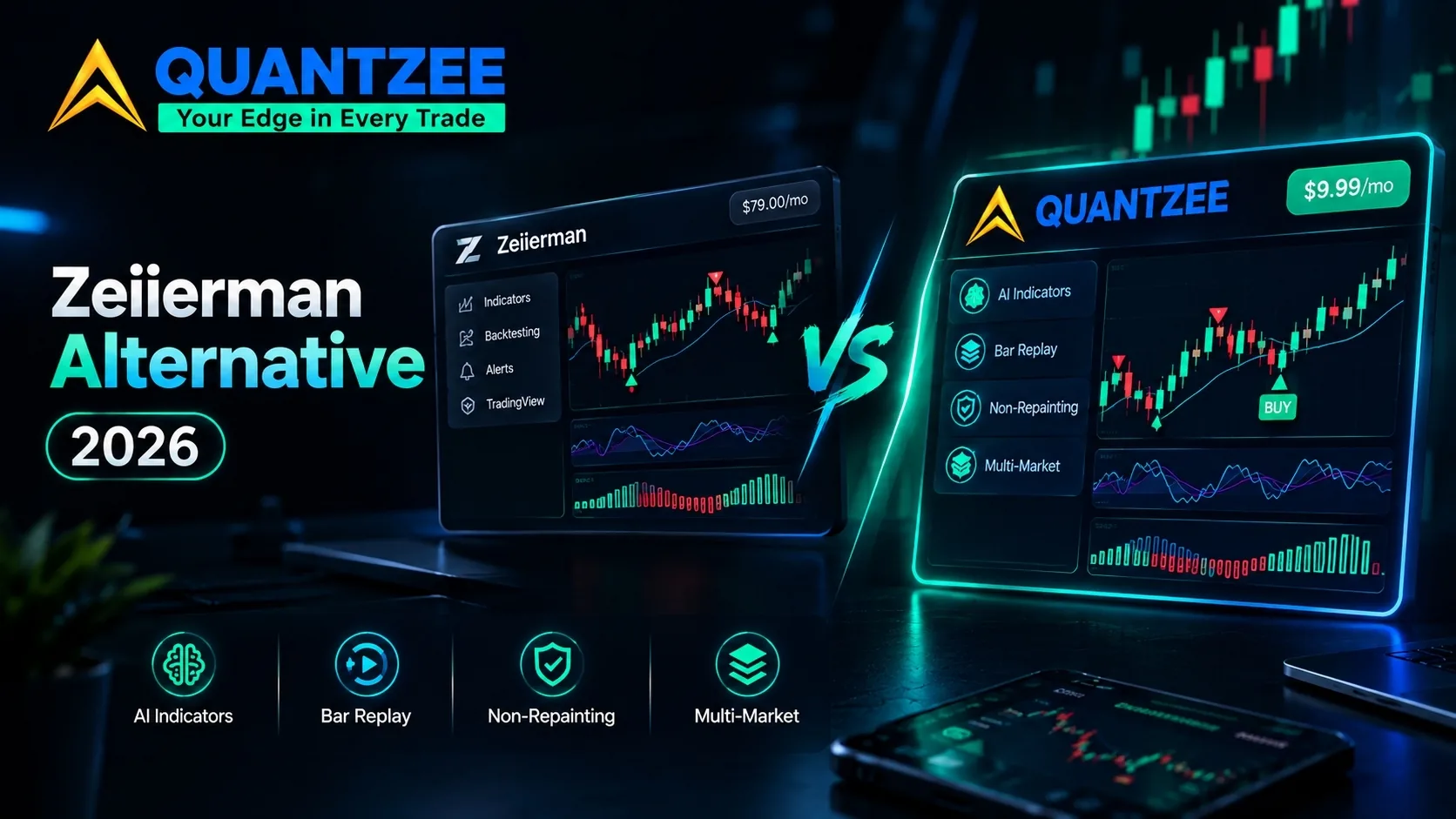
If you spend any serious time in TradingView’s indicator ecosystem, you have almost certainly come across Zeiierman. With a large TradingView following built over years of publishing sophisticated analytical tools, the creator has earned genuine respect in the trading community — and for good reason. Zeiierman’s indicators are mathematically rigorous, visually polished, and backed by real professional experience at a hedge fund. This is not a case of an indicator creator who got lucky with a flashy chart overlay. The quality is real.
So this comparison is not about dismissing Zeiierman. It is about something more nuanced: the difference between an analytical research framework and a signal-first trading system. Zeiierman gives you tools to study and interpret the market — sophisticated tools that reward experienced technical analysts who want to build understanding. Quantzee gives you a pre-built AI system designed for signal clarity: buy signals, sell signals, and adaptive logic that tells you when to act, not when to think.
For the right trader, both serve a genuine purpose. This article breaks down exactly what Zeiierman offers, what its technical methodology looks like under the hood, where its model creates friction for certain traders, and why Quantzee has emerged as the go-to alternative for traders who want a complete, affordable, signal-ready suite — particularly in global markets.
⚡ Key Takeaways
- Zeiierman costs ~$49/month with the WIZARD49 discount, or ~$95/month regular — roughly $456/yr on its annual plan. Quantzee is $59.99, paid once: less than two discounted Zeiierman months, and then nothing.
- The Quantzee suite's non-repainting architecture is independently testable on Bar Replay before you pay, and you receive the Pine Script source afterwards; Zeiierman offers no equivalent verification path.
- Zeiierman's 80+ indicators are research instruments requiring active interpretation; Quantzee's 6 indicators generate pre-built AI buy/sell signals designed to reduce interpretation overhead.
- Non-repainting is not explicitly guaranteed across Zeiierman's full 80+ indicator library; Quantzee guarantees non-repainting across all 6 indicators as a design constraint.
You’re not a quant. You don’t need 80 tools. Zeiierman’s suite is genuinely impressive — built by someone with real hedge fund experience, mathematically rigorous, and rewarding if you want to study the market. But most traders don’t want a research library, they want to know whether to buy or sell right now. Cost-per-signal math makes the gap concrete: Zeiierman is $49-95/month for 80+ indicators you have to interpret yourself — that’s roughly $0.61-$1.19 per tool per month, but the real cost is the hours spent learning which of the 80 to use and how to read them. Quantzee is $59.99 once for 6 curated, pre-built signals — about $10 per indicator, paid a single time, and zero interpretation required.
Top 4 Alternatives to Zeiierman in 2026 (Quick Comparison)
If you’re comparing Zeiierman against the field rather than just against one competitor, here’s where it sits relative to the other tools traders in this category most often shortlist:
| Rank | Tool | Category | Starting Price | Notable Limitation / Fit |
|---|---|---|---|---|
| 🏆 1 | Quantzee | AI signal indicators (TradingView) | $59.99 once — Pine source emailed, no renewal | Non-repainting, verifiable on Bar Replay, covers crypto, stocks, forex & commodities |
| 2 | Zeiierman | Premium TradingView indicator library | $49–$95/mo ($37.99/mo annual) | 80+ indicators requiring manual interpretation |
| 3 | LuxAlgo | Related tool in this category | See full comparison | Different feature/price tradeoff — worth shortlisting alongside Zeiierman |
| 4 | AI Signals | Related tool in this category | See full comparison | Different feature/price tradeoff — worth shortlisting alongside Zeiierman |
Quantzee tops this list on price-to-signal-clarity ratio — $59.99 paid once against Zeiierman’s $49–$95 every month, with non-repainting logic you can verify yourself before paying. The detailed, feature-by-feature comparison against Zeiierman specifically follows below.
Table of Contents
- Top 4 Alternatives to Zeiierman in 2026 (Quick Comparison)
- What is Zeiierman?
- Zeiierman’s Technical Methodology
- Why Traders Are Looking for Zeiierman Alternatives in 2026
- Zeiierman Pros and Cons
- Zeiierman Pricing (2026)
- What Users Say About Zeiierman
- Meet Quantzee: A Smarter Zeiierman Alternative
- Zeiierman Smart Money Concepts Alternative
- Zeiierman Lifetime Plan Alternative
- Zeiierman vs Quantzee: Feature Comparison
- Who Should Use Which?
- Conclusion
- FAQs
What is Zeiierman?
Zeiierman is one of TradingView’s most recognised premium indicator creators. The account — viewable at zeiierman.com — has built a large following on TradingView and publishes a broad suite of sophisticated technical and ML-adjacent analysis tools covering momentum, trend detection, volatility analysis, and market structure.
What distinguishes Zeiierman from most indicator creators is the professional background. The creator states on their website that they work at a hedge fund. That context matters: the indicators reflect the analytical rigour you would expect from someone who builds tools for institutional research, not just retail signal-hunting. The indicators are not shortcuts — they are research instruments.
The current offering spans 80+ premium indicators, all bundled under a single subscription at zeiierman.com. These tools were originally published individually on TradingView; the subscription model now gives access to the full library for one monthly price. The indicator lineup covers a genuinely wide range of analytical domains: identifying market phases, tracking momentum shifts, detecting trend changes, managing volatility exposure, and visualising structural levels.
The community around Zeiierman is active and technically engaged. For professional traders who want deep analytical tools that reward study and interpretation, Zeiierman is a legitimate choice. Where the model creates friction — and why traders look for alternatives — is covered in the next sections.
Zeiierman’s Technical Methodology
One of the more interesting things about Zeiierman is that several indicators employ machine learning and statistical techniques that go well beyond conventional rule-based technical analysis. Understanding what these techniques actually do helps you make a more informed choice between a research framework and a signal suite.
Machine Learning RSI
The ML RSI is one of the most technically sophisticated indicators in the Zeiierman library. Rather than transforming price into a simple oscillator, it transforms the RSI itself into a multi-dimensional feature space. The indicator then stores historical RSI behaviour patterns and, at each new bar, searches for analogous historical periods — market conditions that most closely resemble the current state. Those historical analogs then “vote” on probable directional bias, producing a confidence-weighted output rather than a fixed buy/sell threshold.
This is a form of instance-based machine learning — closer to k-nearest neighbour classification than neural networks, but genuinely adaptive in the sense that the indicator’s output shifts as more history accumulates and analogies are found. The tradeoff: interpreting the confidence output requires understanding what the analog-voting model is telling you. It is an analytical signal, not a direct action prompt. (Source: tradingview.com/script/VrTL3VwF)
AI Source Switching Moving Average
This indicator applies multi-dimensional feature space analysis to the problem of price source selection. Most moving averages lock in a price source — typically Close, or sometimes HLC/3. The AI Source Switching MA uses historical analog recognition to adaptively select the price source most likely to produce the cleanest signal under current market conditions.
Rather than fixing which price input drives the average, it uses analog-based intelligence to identify which price source has been most informative during historically similar periods, then weights accordingly. The result is a moving average that adapts its inputs, not just its parameters. (Source: tradingview.com/script/bj0WBYSf)
Machine Learning Momentum Index (MLMI)
The MLMI applies a similar analog-recognition approach to momentum measurement. Rather than computing a fixed lookback momentum value, it attempts to contextualise current momentum against historical momentum patterns to produce a more regime-aware reading. The goal is to distinguish between momentum that is likely to persist and momentum that is likely to mean-revert — the fundamental challenge in any momentum-based strategy.
Range Oscillator
The Range Oscillator uses a clean mathematical formulation for adaptive range detection:
Osc = 100 × (Close − Mean) / RangeATR
Where Mean is a dynamic price average and RangeATR is an ATR-derived range measure. The formula normalises the distance of Close from the adaptive mean by the current volatility range, producing an oscillator that automatically scales to market conditions rather than requiring manual lookback adjustments. In volatile regimes, the denominator expands and the oscillator compresses; in quiet markets, smaller moves register clearly. This is one of the cleaner adaptive oscillator implementations in the TradingView ecosystem.
AI Trend Navigator and BOS Adaptive Structure Average
The AI Trend Navigator and BOS (Break of Structure) Adaptive Structure Average both use adaptive statistical filtering rather than fixed lookbacks. The BOS tool specifically identifies structural breaks — points where the market breaks above or below significant prior structure — and uses adaptive averaging to smooth the structural reference levels dynamically.
Trend Speed Analyzer
The Trend Speed Analyzer adds a velocity dimension to trend analysis by computing wave and speed metrics. Rather than simply identifying whether price is above or below a moving average, it measures how quickly the market is moving through trend phases — accelerating, decelerating, or maintaining speed. This gives context for entries that standard trend indicators miss: the difference between a trend that is just starting to accelerate and one that is entering a deceleration phase is analytically meaningful, but most indicators ignore it.
The Framework in Context
Taken together, Zeiierman’s approach is best described as sophisticated statistical and ML-adjacent analysis: instance-based machine learning for analog recognition, adaptive range and source selection, and structural analysis that goes well beyond rule-based TA. These are genuine research tools. The analytical output they produce requires active interpretation from the trader — which is exactly what makes them valuable to experienced technical analysts and friction-creating for traders who want cleaner signal prompts.
Why Traders Are Looking for Zeiierman Alternatives in 2026
The quality of Zeiierman’s indicators is not the issue. The reasons traders search for alternatives are structural — and they are honest ones worth understanding before you decide which tool fits your situation.
Price. At $49/month with the WIZARD49 discount code (or approximately $95/month at regular pricing), Zeiierman is significantly more expensive than most competitor suites. The annual plan brings the monthly cost down to around $37.99/month. For professional traders with established capital, this is a reasonable expense. For retail traders managing modest accounts, particularly in markets where disposable income for trading tools is genuinely constrained, $49-$95 every month is a serious consideration — and it is a commitment that renews. Quantzee asks for $59.99 once and then never again, so the two are not really the same kind of expense.
Information overload. Having access to 80+ indicators is genuinely impressive — but it also raises a real practical question: how many of them will you actually use, and how long will it take you to learn them? Each Zeiierman indicator is its own distinct analytical framework with its own logic and interpretation requirements. Building proficiency across even a dozen of these tools takes months. For traders who want to get into the market quickly with a cohesive system, 80+ tools can feel more overwhelming than empowering. Quantzee takes the opposite approach: 6 indicators designed as a unified system, where each tool is designed to work with the others.
No explicit non-repainting guarantee across the suite. Repainting — where a signal appears on a bar and then disappears or shifts as new bars form — is one of the most critical quality issues in trading indicators. Zeiierman does not explicitly guarantee non-repainting behaviour across all 80+ indicators. For any indicator that uses lookahead or multi-bar pattern logic, this is a real concern for backtesting integrity. Quantzee guarantees non-repainting across all 6 indicators by design.
No global markets tools. Zeiierman’s indicator suite is built for global markets: US equities, forex, and crypto. Traders working with major global indices, or running options strategies tied to global monthly and weekly expiry cycles, will find nothing in the Zeiierman library that is specifically designed for their market structure. CPR (Central Pivot Range) theory, expiry-day dynamics, and major global indices-specific volatility patterns are outside the scope of what Zeiierman offers.
No money-back guarantee. Zeiierman’s pricing page does not prominently offer a money-back guarantee or free trial. You are committing to the subscription without a risk-free evaluation window.
Zeiierman Pros and Cons
Pros:
- Exceptionally high-quality, mathematically sophisticated indicators
- Large TradingView following built over years — strong credibility and community
- Covers a genuinely wide range of analytical frameworks: trend, momentum, volatility, structure
- Some indicators employ real ML/AI techniques including analog recognition and adaptive source selection
- Visually polished and actively maintained
- Respected by professional and institutional traders
- Works on TradingView’s free plan — no paid subscription required just for access
- Backed by creator with hedge fund professional background
- 80+ indicators available under a single subscription
Cons:
- At $49/month (discounted) or up to $95/month (regular), price is significantly above most alternatives
- 80+ indicators is an overwhelming library for traders who want a cohesive system
- No explicit non-repainting guarantee across the full suite
- Indicators deliver analytical frameworks that require active interpretation, not direct action signals
- No dedicated global markets tools — major global indices, or expiry-day analytics not included
- No free trial or prominently offered money-back guarantee
- High learning curve — each indicator has its own distinct logic and interpretation requirements
- No unified signal system that synthesises across multiple tools into one clear output
Zeiierman Pricing (2026)
Zeiierman has moved to a bundled subscription model that gives access to 80+ indicators for a single monthly price, rather than charging per indicator as in its earlier model.
Current pricing (as of 2026):
- Monthly plan: approximately $95/month at regular price; $49/month with discount code WIZARD49
- Annual plan: approximately $37.99/month (billed annually)
- Lifetime access: one-time fee available (check zeiierman.com for current offer)
TradingView plan requirement: Zeiierman indicators work on TradingView’s free plan. You do not need a paid TradingView subscription to use them. This is an important correction — older discussion online sometimes conflated general TradingView multi-indicator restrictions with Zeiierman-specific requirements.
No money-back guarantee: Zeiierman’s pricing page does not prominently advertise the paid subscription or refund window. Review their terms at zeiierman.com before purchasing.
For context: Quantzee’s full suite of 6 indicators is one payment of $59.99, with the Pine Script source emailed to you.
What Users Say About Zeiierman
-
“Genuinely one of the best indicator creators on TradingView — but the cost adds up” — Professional traders consistently praise Zeiierman’s quality while acknowledging that the price point is a real consideration for smaller accounts. (Source: TradingView community)
-
“The indicators are excellent but there are so many of them — it takes time to really understand what each one is telling you” — A recurring theme from users is the learning investment required to extract value from a library of 80+ tools, each with its own distinct analytical framework. (Source: TradingView community threads)
-
“Great for understanding market structure but the signals need interpretation — I end up doing most of the analysis work myself” — Traders appreciate the analytical depth but note that Zeiierman tools provide research context rather than direct buy/sell signals. Valuable for experienced analysts; demanding for those who want automation. (Source: TradingView community threads)
-
“The quality is there — you can tell this was built by someone who actually trades at an institutional level. I just want something more automated for my day-to-day execution” — Users who want a signal-first, automated system find Zeiierman’s analytical tools require more active interpretation than they need for their workflow. (Source: independent trading communities)
Meet Quantzee: A Smarter Zeiierman Alternative
Quantzee was built to solve a specific problem: giving traders a complete, AI-powered indicator system that works as a unified suite, not as an analytical library you have to interpret, learn, and synthesise yourself. Where Zeiierman gives you sophisticated research instruments, Quantzee gives you pre-built signal logic with one clear purpose — generating high-probability, non-repainting buy/sell signals that adapt to market conditions.
The positioning is deliberately different from Zeiierman’s, not simply cheaper. If you are an experienced technical analyst who wants to build genuine market understanding through rigorous analytical tools, Zeiierman rewards that investment. If you are a trader who wants clear signals, a cohesive system, and lower friction from indicator to trade decision, Quantzee is designed for you.
Verify before you commit. Add any Quantzee indicator to a TradingView chart and run the Bar Replay test to get a real sense of how the Quantzee system works. All 6 indicators come with the one-time $59.99 purchase — no free tier, no trial, and no refund, since the source code is emailed to you immediately.
The AI signal difference. Quantzee’s paid indicators use adaptive machine learning logic that responds to volatility, trend strength, and momentum dynamics in real time. The AI Adaptive Quant Toolkit, Adaptive AI Oscillation Engine, and AI TrendPulse are all built around dynamic logic that adjusts to current market conditions rather than applying fixed parameters. The result is signals that are calibrated to the market regime you are trading in, not the one that existed when the indicator was coded.
Non-repainting by design. Every one of Quantzee’s 6 indicators is built to be non-repainting. Signals that appear on a bar remain fixed as subsequent bars form. This is not a marketing claim — it is a design constraint enforced at development time. For backtesting integrity and real-time trading trust, it is non-negotiable.
No equivalent tool exists in the Zeiierman library. All 6 Quantzee indicators are tested against major global indices price structures and support global market timeframes and expiry cycles.
Works on TradingView’s free plan. Like Zeiierman, Quantzee needs no paid TradingView account. The entire suite runs on TradingView’s free plan — you paste each script into the Pine Editor and it saves into your own account.
Zeiierman Smart Money Concepts Alternative
If you specifically use Zeiierman for Smart Money Concepts analysis rather than its full 80+ indicator library, the comparison narrows considerably — and it’s worth making directly rather than at the “6 vs 80” platform level.
Feature-to-feature mapping: Zeiierman’s SMC tooling vs Quantzee’s SMC Toolkit Pro
| Zeiierman capability | Quantzee’s SMC Toolkit Pro equivalent |
|---|---|
| Structural break identification (BOS-style logic within Zeiierman’s broader framework) | Dual-leg Break of Structure / Change of Character (BOS/CHoCH) detection, purpose-built |
| Adaptive statistical filtering for structure levels | Automatic order block and fair value gap (FVG) mapping |
| Manual interpretation of liquidity zones across separate tools | Equal-high/equal-low liquidity mapping with sweep detection, built in |
| No dedicated premium/discount zone tool | Premium/discount zones with Optimal Trade Entry (OTE), out of the box |
| Alerting configured per indicator, per use case | 14 built-in alert conditions, pre-configured for the SMC structure model |
The honest takeaway: Zeiierman gives you the analytical primitives and expects you to assemble your own SMC read across several of its 80+ tools. SMC Toolkit Pro ships that read pre-assembled — one indicator, not several stitched together.
Zeiierman Lifetime Plan Alternative
Zeiierman lists a one-time lifetime access option alongside its monthly and annual subscriptions (check zeiierman.com for the current lifetime price — it is not consistently published). If you’re specifically comparing lifetime-access options rather than recurring subscriptions, the honest framing is different from the monthly comparison above: a lifetime purchase removes the ongoing cost entirely, which changes the math in Zeiierman’s favor over a long enough holding period.
This is where the two have swapped positions. Zeiierman does offer a lifetime plan, but its price is not published on the pricing page, so you cannot evaluate it without asking.
Quantzee is now nothing but a one-time purchase: $59.99, paid once, with the Pine Script source for all six indicators emailed to you. There is no monthly, quarterly or yearly term to choose between — those were discontinued on 8 October 2026 — and no renewal date, no card on file and no expiry. The retired yearly subscription was priced at the same $59.99, so the figure has not moved; the billing period has. You used to pay it every year, and now you pay it once. You keep the code.
So if what draws you to a lifetime plan is escaping subscription lock-in rather than a specific headline number, Quantzee answers that outright, at a price you can see before you commit.
Disclaimer: Quantzee indicators are analytical software tools designed to assist your own analysis. This content is for educational and informational purposes only and does not constitute investment advice. Do your own research before trading. Trading involves risk of capital loss. Quantzee is not a registered investment advisor. Treat all signals as analytical input, not trading instructions.
Zeiierman vs Quantzee: Feature Comparison
| Feature | Zeiierman | Quantzee |
|---|---|---|
| AI/ML Signals | Yes — ML RSI, AI Moving Averages, analog recognition | Yes — adaptive AI logic + non-repainting signals |
| Signal vs. Analysis | Analysis framework (interpret yourself) | Clear buy/sell signals (act directly) |
| Pricing | $49/mo (discounted) or $37.99/mo annual (~$456/yr) | $59.99 once, no renewal |
| Number of Indicators | 80+ (comprehensive library) | 6 (curated system) |
| Requires Paid TradingView Plan | No — works on free plan | No — works on free plan |
| Non-Repainting Guarantee | Not explicitly guaranteed across all tools | Yes — all 6 indicators guaranteed |
| Global Market Support (major global indices) | Limited | Full support + expiry-day tools |
| Hedge Fund Creator Background | Yes | No — retail trader focused |
Who Should Use Which?
The honest answer is that Zeiierman and Quantzee serve different traders. The choice is not purely about price — it is about what you want from your indicators.
Choose Zeiierman if:
- You are an experienced technical analyst who wants deep research tools to study market structure, momentum behaviour, and adaptive statistical signals
- You enjoy interpreting sophisticated analytical outputs and building your own trading thesis from the data
- You are comfortable with a learning curve and want access to 80+ distinct analytical tools
- You are already profitable and the $37–$95/month cost is proportional to your account size
Choose Quantzee if:
- You want clear, pre-built buy/sell signals without an analytical interpretation layer
- You trade global markets — major global indices, or expiry-day options strategies
- You want a curated, cohesive signal system where each indicator works alongside the others
- You are at the beginner-to-intermediate level and want a system that reduces decision friction
- You want non-repainting guarantees across every indicator you use
- You want to try before you buy — the Quantzee suite’s non-repainting architecture is independently testable
The clearest summary: Zeiierman gives you tools to analyse. Quantzee gives you signals to act on. If you want to build understanding, study Zeiierman. If you want to trade with minimal interpretation overhead, use Quantzee.
Conclusion
Zeiierman earns its reputation. The indicators are technically sophisticated, backed by real hedge fund professional experience, and the ML/AI techniques employed — ML RSI with analog recognition, AI Source Switching MA, the Range Oscillator’s adaptive normalisation formula — are genuine innovations in the TradingView ecosystem. The creator has built a large, technically literate following that is not accidental.
But sophisticated analytical tools and a clear signal suite are different products serving different needs. Zeiierman builds research instruments that reward deep study and active interpretation. Quantzee builds a signal system designed to reduce the gap between analysis and action.
At $59.99 paid once, with 6 non-repainting indicators, full global market support, adaptive AI logic calibrated to current conditions and the source code in your hands, Quantzee offers a materially different value proposition. Not a cheaper version of Zeiierman; a different tool, sold a different way, for a different kind of trader.
If you have been evaluating Zeiierman and want something closer to a pre-built signal system at a fraction of the total cost, Quantzee is the answer. Add any Quantzee indicator and see how the system works on your charts before you buy.
Explore Quantzee Indicators
- AI Adaptive Quant Toolkit — self-tuning signals, overlays & dashboard — no repainting
- SuperTrend Pro+ — volatility-adjusted trend signals
View all indicators · See pricing
Related Articles
- LuxAlgo Alternative
- Market Cipher Review
- 3Commas Alternative
- AI Signals Alternative — for traders comparing Zeiierman’s 80+ indicators against a lower-cost external AI signal service