About this review. Rajeev Gupta is an algorithmic trader and founder of Quantzee. He has evaluated dozens of TradingView indicator suites since 2018 and built Quantzee as a direct response to the gap between what premium products promise and what they deliver at live market conditions. This review is independent and fact-based — pricing, feature claims, and user feedback are sourced and linked throughout.
Disclaimer: This review is for informational and educational purposes only. It does not constitute financial or investment advice. All comparisons are based on publicly available product information. You should conduct your own research before making any purchase decision.
Market Cipher is a $99/month ($600/year) wave/momentum indicator suite for TradingView, built for crypto charting — it’s a well-established, beginner-friendly tool, but its pricing is 5–10x more than modern AI-adaptive alternatives, it has no published machine-learning layer, and multiple documented user reports describe signal behavior that functions like repainting in live trading. Verdict: worth it only for crypto-only, community-driven traders comfortable with the price; not the strongest choice if you trade multiple markets or want AI-adaptive, verifiably non-repainting signals.
Market Cipher at a Glance
| What it is | A paid indicator suite for TradingView — momentum waves, money flow and buy/sell dots in one chart layer |
| Made by | The Market Cipher team, fronted by the crypto YouTube personality known as Crypto Face |
| First widely used | ~2019–2021, through live crypto trading streams |
| Components | Market Cipher A (trend/momentum), B (money flow oscillator — the flagship), SR (support/resistance), DBSI (divergence) |
| Price | ~$99/month, ~$600/year, ~$1,500 lifetime |
| Free version | No official free tier. Unofficial community clones exist on TradingView — see the free-version section |
| Built for | Crypto (Bitcoin, Ethereum, altcoins) first; works on any TradingView chart but is not calibrated for other asset classes |
| Platform | TradingView only (invite-only scripts) |
| AI / adaptive logic | None published — fixed technical-analysis formulas |
| Our verdict | Worth it only for crypto-only, community-driven traders comfortable with the price |
If you want the step-by-step chart-reading side instead of the buying decision, read our separate guide: how to use Market Cipher.
You’ve seen it on crypto YouTube channels and TradingView comment threads. Green dots, red dots, colored waves — Market Cipher looks like it should have all the answers. Thousands of traders have bought it. Some swear by it. Others are quietly searching for something better, or for an honest answer to one question: is Market Cipher actually worth $600 a year in 2026?
This is the single, consolidated Market Cipher review for 2026 — merging what were previously separate articles into one canonical source, so you get the full picture (pricing, technical breakdown, real user feedback, alternative comparison, and verdict) in one place.
What is Market Cipher?
Market Cipher is a paid TradingView indicator suite created by crypto personality Crypto Face. It rose to prominence around 2019–2021 through YouTube live trading sessions where it was used to call entries and exits in real time.
The suite combines several traditional technical analysis signals into a unified visual interface: momentum wave oscillators, money flow readings, RSI-derived buy/sell dots, and VWAP-adjacent levels. The premise is simple — you shouldn’t need to juggle eight indicators. Market Cipher wraps them into one chart layer and tells you what the combined picture looks like.
There are multiple versions: Market Cipher A (momentum and trend), Market Cipher B (the popular money flow oscillator), and newer products like SR (support/resistance levels) and DBSI (divergence-based signal indicator). Most traders use B as the core tool.
It’s a crypto-focused tool. The majority of users trade Bitcoin, Ethereum, and altcoins on Binance or Coinbase. There is no dedicated support for global equity indices or forex-specific calibration — it works technically on any TradingView chart, but the tuning is crypto-first.
One point of confusion worth clearing up: “market cipher” in trading always means this product. It has nothing to do with ciphers in cryptography. And it is not the same thing as VuManChu Cipher, the free TradingView indicator that uses similar WaveTrend logic and is often mistaken for it — we cover that one separately in our VuManChu Cipher comparison.
Who Makes Market Cipher? (Crypto Face)
Market Cipher is sold by the Market Cipher team and is publicly associated with the crypto trader and YouTube personality known as Crypto Face, who used it on live-streamed Bitcoin trading sessions. That association is the single biggest reason the product is known at all — the indicator and the creator’s channel grew together.
This matters for two practical reasons:
- The tool’s reputation tracks one person’s content output. If you are paying $600 a year partly for the interpretation layer — the streams, the calls, the Discord commentary — you are dependent on that person continuing to produce it. That is a real risk on a subscription.
- Signal quality and brand visibility are not the same thing. Market Cipher is one of the most visible indicator suites on crypto YouTube. Visibility is a marketing outcome, not evidence of edge. There is no published backtest, win-rate audit, or performance report from the team — see the technical breakdown below.
The official product site is marketciphertrading.com. Anything selling “Market Cipher” outside that site is not the official product.
Market Cipher Pricing 2026
Market Cipher’s pricing is its most frequent complaint.
| Plan | Price |
|---|---|
| Monthly | ~$99/month |
| Annual (Professional) | ~$600/year |
| Lifetime | ~$1,500 one-time |
For context: comparable AI-driven alternatives cost a fraction of that. Quantzee, for example, is one payment of $59.99 for a 6-indicator suite — less than Market Cipher charges in a single month.
Two things to know before you compare prices:
- The suite is sold in parts. The headline price covers the core A and B indicators. SR and DBSI have historically been sold or bundled separately, so the “full suite” number can be higher than the figure you first see.
- Scripts are invite-only, not files. You are paying for access permission on your TradingView account, not for code you keep. When access lapses, the indicator disappears from your charts. Confirm current terms on marketciphertrading.com before buying — prices and bundles change.
Is There a Free Version of Market Cipher?
No. There is no official free version or free trial of Market Cipher. The team sells it as a paid, invite-only TradingView script with a 14-day money-back window on direct purchases. Anyone offering you “Market Cipher free” is not the Market Cipher team.
That said, the honest answer most people are actually looking for is this: the underlying logic is not proprietary, and free TradingView indicators that behave similarly do exist. Market Cipher B is built on WaveTrend-style momentum waves, a money flow reading and RSI-derived dots — all public, documented technical analysis. Several free community scripts in TradingView’s public library reimplement that look, the best known being the VuManChu Cipher family.
What you need to understand about those free clones:
- They are not the product. They are independent reimplementations. The formulas, smoothing and dot conditions are the author’s guesses, not Market Cipher’s code, so the signals will not match.
- Nobody supports them. No updates, no documentation, no accountability if the logic changes or the script is pulled.
- Many of them repaint. This is the real cost of the free route. A WaveTrend clone that redraws its dots on the live candle will show you a beautiful history and a useless live signal. We documented this specifically for VuManChu Cipher B in our VuManChu Cipher comparison.
- Avoid “cracked” or shared-account offers. Pirated invite-only scripts get access revoked, and handing your TradingView login to a stranger to “share” a paid script is a straightforward way to lose the account.
So the practical choice is not “pay $600 or get it free.” It is: pay for Market Cipher, use a free clone and accept repainting and zero support, or buy a cheaper paid indicator that is actually maintained and verifiably confirms on closed bars. That third option is the one most people miss — see the alternatives section.
How Market Cipher’s Signals Actually Work (Technical Breakdown)
Understanding what Market Cipher does under the hood is useful before committing $600 or $1,500 to it. The suite is not a single indicator — it is a collection of tools that combine traditional technical analysis methods into a unified visual output.
Market Cipher A
A trend and momentum panel. It integrates an RSI derivative, a MACD-style momentum histogram, and VWAP-based zone references, output as a color-coded lower-panel indicator.
Market Cipher B (the flagship)
The most widely used component and the one most referenced in YouTube tutorials. It plots a money flow oscillator (Chaikin Money Flow-derived), a momentum wave (MACD-style smoothing), buy/sell dots (RSI-derived markers at oscillator extremes — the most misunderstood element, see repainting note below), and VWAP-adjacent divergence signals.
Market Cipher SR (Support/Resistance)
Dynamically calculated, pivot-based support/resistance levels wrapped in a visual presentation. Comparable logic exists in many free TradingView indicators, though Market Cipher’s presentation is more refined.
Market Cipher DBSI (Divergence-Based Signal Indicator)
Focuses on divergence between price and an oscillator. Several long-term users specifically single out DBSI as the standout, most-unique component of the suite (see user feedback below) — more differentiated than B or SR, which have closer free equivalents.
What this means for signal reliability
All four components use traditional, documented technical analysis formulas. There is no published machine learning model, adaptive parameter logic, or backtested win-rate documentation from Market Cipher’s team. The “accuracy” claims that circulate in the community are largely self-reported by users who share winning trades — this doesn’t mean the tools are ineffective, but the pricing premium is for presentation, brand, and community access rather than proprietary AI.
For comparison, Quantzee’s indicators use K-Means clustering (an unsupervised machine learning technique) to dynamically identify market regimes and adapt signal sensitivity — an adaptive layer that adjusts automatically to volatility expansions and contractions, something fixed-formula indicators structurally cannot do.
How to Read a Market Cipher Chart
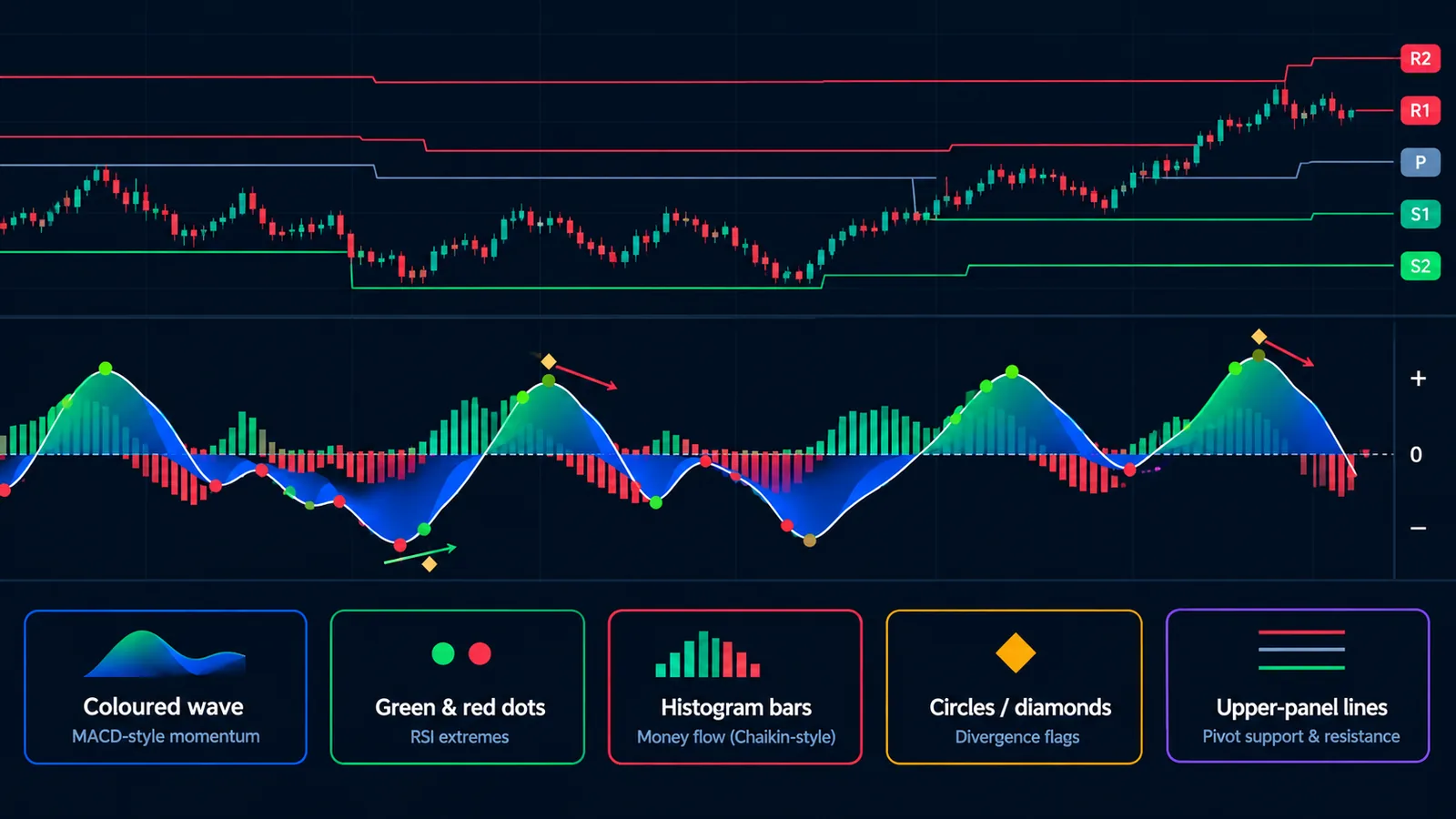
A Market Cipher chart confuses people because four unrelated things are drawn in the same small panel. Here is what each element actually is, in plain terms:
| What you see | What it is | What it is telling you |
|---|---|---|
| Coloured wave (the big blue/green shape) | A smoothed MACD-style momentum reading | Direction and strength of momentum. Above zero = momentum up, below = down |
| Green and red dots on the wave | RSI-derived markers fired at wave extremes | A momentum extreme was reached. It is a condition, not a trade instruction |
| Coloured histogram bars behind the wave | A money flow reading (Chaikin-style) | Whether volume is flowing in or out while price moves |
| Small circles / diamonds | Divergence flags | Price and the oscillator disagree — a possible exhaustion signal |
| Upper-panel lines (if SR is loaded) | Pivot-based support and resistance | Levels where price has previously turned |
Three things the chart will not tell you, and this is where most beginners lose money:
- A dot is not an entry. The dots fire on every momentum extreme, including the ones in the middle of a strong trend that keeps going. Used alone they produce a long run of small losses in trending markets.
- The wave lags. It is smoothed momentum, so it confirms a move that has already begun. On fast crypto candles that confirmation can arrive after the useful part of the move.
- Behaviour changes with timeframe. The same setup can show a buy dot on the 15-minute and nothing on the 1-hour. This is the root of most of the “it repaints” arguments — see the user feedback below.
If you want the full step-by-step version of this — installing the scripts, which timeframes behave best, an entry checklist and the mistakes that cost people money — we have a dedicated walkthrough: how to use Market Cipher.
Market Cipher Pros and Cons
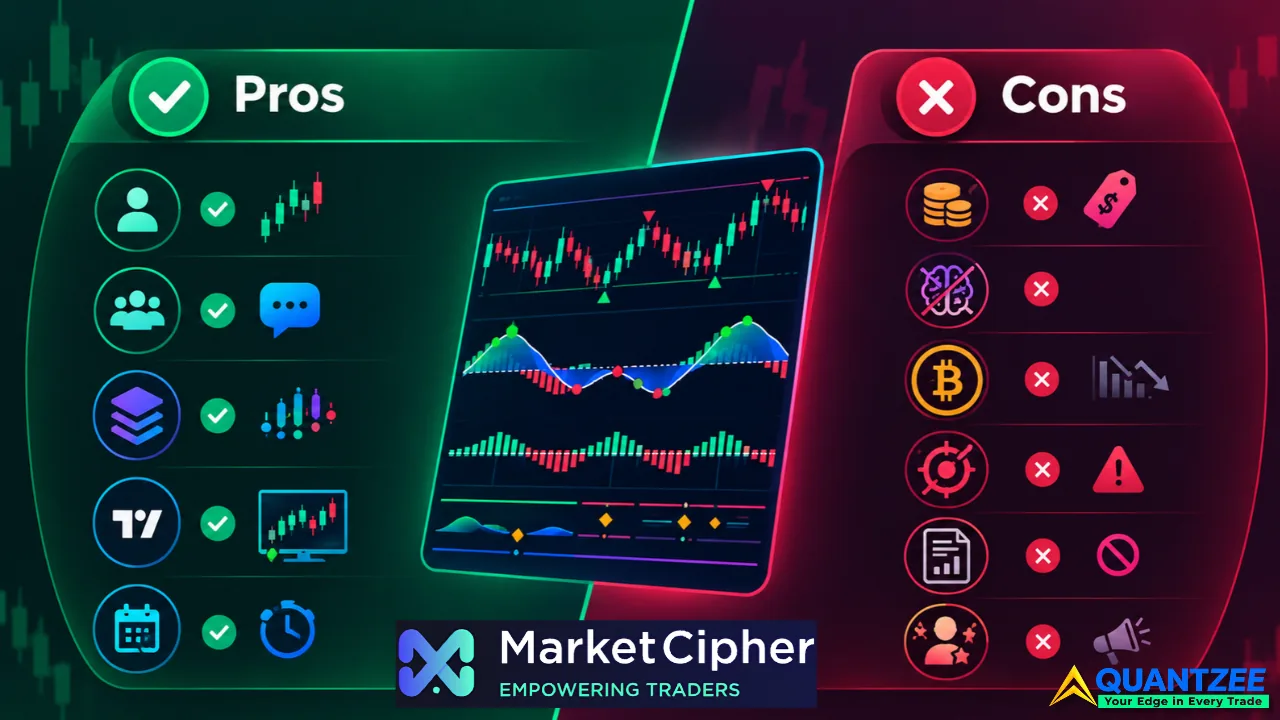
Pros
- Beginner-friendly visual interface. Green dots, red dots, and colored waves are easy to interpret without deep technical analysis knowledge.
- Strong community. A large Discord and social following, plenty of third-party tutorial content on YouTube and Reddit.
- Multiple specialized indicators. A, B, SR, and DBSI can be layered for different approaches — DBSI in particular is frequently cited as genuinely unique.
- TradingView native. Runs directly inside TradingView — no external platform or API required.
- Well-established track record. For crypto traders since 2018–2020, a known quantity with documented usage.
Cons
- Extremely high cost. $600/year or $1,500 lifetime for what is, at its core, a combination of several traditional indicators.
- No AI or adaptive logic. Pre-coded formulas that do not adapt to changing market conditions or self-optimize — what you see in 2026 is essentially the same logic as 2019.
- Crypto-centric. Limited optimization for equity, forex, and futures traders; no dedicated support for regional index instruments.
- Signal reliability concerns. Multiple community reports describe signal behavior that appears to change between timeframes or after candle close (see the repainting discussion below).
- No transparent performance data. No audited win-rate statistics or backtested performance data published.
- Influencer dependency. Much of the tool’s reputation is tied to one creator’s content output — a risky dependency for a $600 annual subscription.
What Real Users Say About Market Cipher
User sentiment on Market Cipher in 2026 is mixed. Here’s an honest cross-section from trading forums and Reddit threads — you can review the raw discussions on r/TradingView and independent ratings on Trustpilot:
Positive feedback (common themes):
- “The money flow wave on Market Cipher B genuinely helps me see accumulation and distribution zones better than anything else I’ve tried for Bitcoin.”
- “The visual clarity is great for beginners. I could see market structure immediately.”
- “Community is active. Whenever I had a question, there were people who helped.”
- Several long-term users describe Market Cipher as effectively four indicators bundled together, several with free equivalents elsewhere on TradingView — but call out DBSI specifically as the one component that alone justified the price for multi-asset use beyond crypto.
Critical feedback (common themes):
- “I paid $600 and the signals didn’t improve my win rate at all. I was expected to follow a YouTuber’s calls to make it work, which isn’t what I wanted.”
- “Some of the dots disappear after the fact. I know they say it’s ‘confirmation on close’ but it felt like repainting in practice.”
- “It’s built for crypto. I tried it on forex pairs and it felt like a completely different experience — not optimized at all.”
- “I switched to Quantzee. The AI adapts. Market Cipher feels like it was built in 2018 and hasn’t been updated.” (posted while Quantzee still sold a monthly plan; it is now a single $59.99 purchase)
- Several critical reviews describe the product as an overpriced repackaging of standard indicators leaning heavily on influencer marketing, with reports of strict Discord moderation around performance questions.
Verdict from user base: Useful for crypto-focused beginners who enjoy community-driven trading. Expensive and increasingly dated for experienced traders who need AI-adaptive signals, multi-market support, or equity/forex functionality.
Market Cipher Refund and Support Policy
Verified directly against Market Cipher’s published refund policy (marketciphertrading.com, checked September 2026):
- 14-day money-back guarantee. Customers have 14 days from the date of receiving the product to request a full refund, provided the product is in its original, unaltered condition and the purchase was made directly through Market Cipher.
- Exclusion: Users removed from Market Cipher’s Discord community for rule violations are ineligible for a refund.
- Processing: Approved refunds are handled within 5–7 business days back to the original payment method (crypto refunds go to the original payment address unless otherwise specified).
- How to request: Contact Market Cipher support with your order details and reason for the refund; they state a 3-business-day response time.
- Support channels: Discord is the primary support venue, with community members often answering questions rather than the team directly.
- Subscription management: Cancellations must be processed through the Market Cipher website before the next billing cycle. Cancelling stops future charges but does not refund an already-completed billing period beyond the 14-day window.
Policies can change without notice — always confirm current terms at marketciphertrading.com before purchasing.
Who Should Use Market Cipher?
Market Cipher still makes sense for a specific profile:
- You trade crypto exclusively (Bitcoin, Ethereum, major altcoins)
- You enjoy community-driven signal interpretation (Discord, YouTube live streams)
- You’re a beginner who values visual simplicity over algorithmic depth
- You’re buying at the $1,500 lifetime price and planning to use it for 5+ years
It is unlikely to be the right tool if:
- You trade equities, major indices, or forex
- You want AI-adaptive signals that self-optimize
- You need a verified non-repainting guarantee
- You’re cost-sensitive (at $600/year, one of the more expensive options in its category)
- You trade on multiple timeframes and need consistent signal behavior
Market Cipher vs Quantzee: Feature Comparison
| Feature | Market Cipher | Quantzee |
|---|---|---|
| Price | $59.99 once, no renewal | |
| Annual price | ~$600/yr | ~$120/yr |
| AI/adaptive signals | No | Yes — K-Means clustering + adaptive smoothing |
| Non-repainting | Disputed (community reports) | Closed-bar confirmation, independently verifiable |
| Crypto coverage | Yes (primary) | Yes |
| Equity/stocks | Limited | Yes |
| Forex | Limited | Yes |
| Global equity indices | No dedicated support | Yes |
| Number of indicators | 4 (A, B, SR, DBSI) | 6 full indicators |
| TradingView native | Yes | Yes |
| Community | Large Discord | Growing |
| Performance data | Not published | Not published |
| Last major update | 2021–2022 | Active (2026) |
The table above is the quick-glance version. Here is the line-by-line breakdown behind it, category by category — this is a straight comparison against Market Cipher B specifically, since B is the flagship component most people mean when they say “Market Cipher.”
Repainting behavior. Market Cipher B’s wave trend and standard divergence markers are widely reported as stable once a candle closes, but the money-flow layer and some of the secondary reversal dot markers have a documented history of behaving differently on the still-forming candle versus the closed one — consistent with the broader repainting concerns covered above. Quantzee’s entire suite is engineered as non-repainting by design: every signal confirms only on bar close and does not redraw historically, across all six indicators, not as a feature bolted onto one of them. Verdict: advantage Quantzee, specifically because non-repainting is a suite-wide architectural commitment rather than a per-indicator exception.
Multi-timeframe (MTF) confluence. Market Cipher is fundamentally a single-timeframe read — you can open several chart tabs at different timeframes and eyeball the wave on each, but there’s no built-in dashboard that pulls higher-timeframe bias onto your working chart. Quantzee’s indicators (SuperTrend Pro+, MACD Pro+, AI TrendPulse and others) ship with an on-chart MTF dashboard that surfaces signal state from higher timeframes, so a trader working a 5-minute chart can see hourly and daily alignment without switching charts. Verdict: advantage Quantzee for built-in MTF visibility; Market Cipher users can replicate a rough version manually, but it’s manual work, not a feature.
Divergence detection. This is Market Cipher’s real strength — DBSI’s divergence logic and Market Cipher B’s own divergence flags are mature and tested across a large user base over multiple market cycles. Quantzee’s divergence detection lives mainly inside MACD Pro+ (pivot-based divergence engine) and the Adaptive AI Oscillation Engine, and both confirm divergence markers only once both pivot points are closed — divergence is exactly the kind of signal that’s prone to repainting in oscillator-based tools, so repaint integrity matters here specifically. Verdict: close — slight edge to Market Cipher on sheer maturity of the divergence engine, slight edge to Quantzee on repaint integrity of its own divergence markers. If divergence trading is your core strategy, test both on your own instrument and timeframe before committing.
Trend and volatility tools. Market Cipher doesn’t compete in this category at all — it’s a momentum/divergence suite, full stop. Quantzee ships dedicated, non-repainting trend and volatility tools alongside its momentum indicators: SuperTrend Pro+, MACD Pro+ and the Smart Money Concepts (SMC) Toolkit Pro (order blocks, fair value gaps, liquidity sweeps). Most traders combine a momentum read with a trend or volatility filter — Market Cipher users typically have to source that filter from TradingView’s free public library (quality varies) or buy it separately from another vendor. Verdict: advantage Quantzee by scope — this is a comparison of coverage, not head-to-head quality on a shared feature.
Alerts and automation readiness. Both tools support TradingView’s native alert system, which is table stakes in 2026. The differentiator is signal stability feeding into those alerts: an alert built on a repainting signal can fire and then the underlying condition can invalidate itself on the same bar — a real problem if you’re using alerts to trigger manual or semi-automated execution. Because Quantzee’s signals are non-repainting by design, alerts fire once, on bar close, and don’t retract. Market Cipher’s alert reliability depends on which signal the alert is wired to — wave trend cross alerts are generally considered stable; alerts on some of the reversal dot markers have more mixed reports. Verdict: advantage Quantzee on alert reliability, directly downstream of the non-repainting design.
Pricing and licensing. Market Cipher is sold as a recurring or lifetime-access product — ~$99/month, ~$600/year, or ~$1,500 lifetime (confirm current terms on marketciphertrading.com, since vendor pricing changes). Quantzee is a one-time $59.99 purchase covering all 6 indicators, with no renewal. For a trader who wants a full toolkit — divergence plus trend plus volatility plus MTF dashboards — Quantzee’s one-time price for 6 indicators comes out well below Market Cipher’s recurring cost. Verdict: advantage Quantzee on total cost of ownership for anyone who needs more than a single oscillator; Market Cipher’s monthly plan may still work if divergence truly is the only tool you need and you don’t mind the recurring charge.
Platform and market coverage. Both are TradingView-native (Pine Script-based), so both technically run on any instrument TradingView supports. In practice, Market Cipher is tuned for crypto and has no dedicated calibration for forex, equities or global indices. Quantzee’s suite is built and positioned for multi-market use across crypto, forex, equities and indices. Verdict: advantage Quantzee on market breadth, consistent with the crypto-first framing covered earlier in this review.
Documentation and transparency. Market Cipher, like most long-standing paid TradingView tools, keeps its internal calculation methodology proprietary — standard practice in this market, but it means you’re trusting the track record rather than auditing the formula. Quantzee publishes a documentation page per indicator describing the calculation approach and signal logic in enough detail to see why a signal fired, not just that it fired. Verdict: advantage Quantzee on transparency, if that matters to your own due-diligence process — neither approach is wrong, but they are different.
Best Market Cipher Alternative in 2026
For traders who want what Market Cipher promises — reliable buy/sell signals without the noise — but at a fraction of the cost and with genuine AI under the hood, Quantzee’s AI trading indicator suite is the most direct alternative in 2026.
Quantzee is a suite of 6 proprietary, non-repainting AI indicators built natively for TradingView. Every signal confirms on closed bar. No repainting. No subscription to a YouTuber’s trading calls required — and no subscription to Quantzee either: you pay once and the Pine Script source is emailed to you.
Key advantages over Market Cipher:
- Price: $59.99 once vs $99/month (or $600/year) — Quantzee’s entire cost is less than Market Cipher’s first month, and there is no second payment.
- AI-adaptive: K-Means clustering and adaptive smoothing that self-optimize to current market conditions. Market Cipher uses fixed formulas.
- Multi-market: Works on stocks, crypto, forex, indices, and options. Market Cipher is built for crypto.
- Non-repainting guarantee: Signals confirm on closed bars and don’t change — explicitly verifiable via TradingView’s Bar Replay.
What people are saying about Quantzee:
“Quantzee indicators are worth every penny. Reliable, well-built, and gives real clarity.” — Neil Richards ⭐⭐⭐⭐⭐
“Non-repainting signals and adaptive trend logic helped filter bad trades in forex.” — Jason Smith ⭐⭐⭐⭐⭐
“A solid tool for crypto and forex traders. Easy to use and very consistent.” — Jack Reece ⭐⭐⭐⭐⭐
Who Should Use Which Tool?
| Trader Profile | Better Fit | Why |
|---|---|---|
| Crypto-only, community-driven beginner | Market Cipher | Large Discord, visual simplicity, established crypto community |
| Multi-market trader (stocks, forex, indices) | Quantzee | Market Cipher lacks dedicated calibration outside crypto |
| Budget-conscious trader | Quantzee | $59.99 once vs $99/mo — cheaper than one Market Cipher month |
| Wants AI-adaptive, self-optimizing signals | Quantzee | Market Cipher’s formulas are static since ~2019 |
| Wants a verified non-repainting guarantee | Quantzee | Independently testable via Bar Replay |
| Already profitable and comfortable with the cost | Market Cipher | No urgent reason to switch a working setup |
Verdict: Is Market Cipher Worth It in 2026?
Market Cipher was genuinely useful when it launched. The visual simplicity helped a generation of retail crypto traders read charts without knowing technical analysis. The community built around it has real value for beginners, and DBSI in particular has genuine differentiated value.
But in 2026, the product has aged. The $600–$1,500 price tag is harder to justify when AI-powered alternatives exist at a fraction of the cost. The lack of adaptive logic, the crypto-only focus, and the signal reliability concerns make it a difficult recommendation for anyone who trades outside crypto, trades multiple instruments, or wants signals that don’t require a community interpretation layer.
If you’re already profitable with Market Cipher and the cost is comfortable, there’s no urgent reason to switch. But if you’re evaluating it for the first time or looking to cut recurring costs out of your trading altogether, Quantzee delivers more for less — once.
Explore Quantzee Indicators
- Adaptive AI Oscillation Engine — money flow, momentum & divergence — no repainting
- AI Adaptive Quant Toolkit — full confluence system with dashboard
View all indicators · See pricing
Related Articles
- How to Use Market Cipher — the chart-reading walkthrough: panels, dots, timeframes and the mistakes that cost money
- VuManChu Cipher Alternative — the free lookalike, and why its live signals differ
- LuxAlgo Alternative
- FluxCharts Review
- EzAlgo Alternative — another AI-branded indicator suite to weigh against Market Cipher