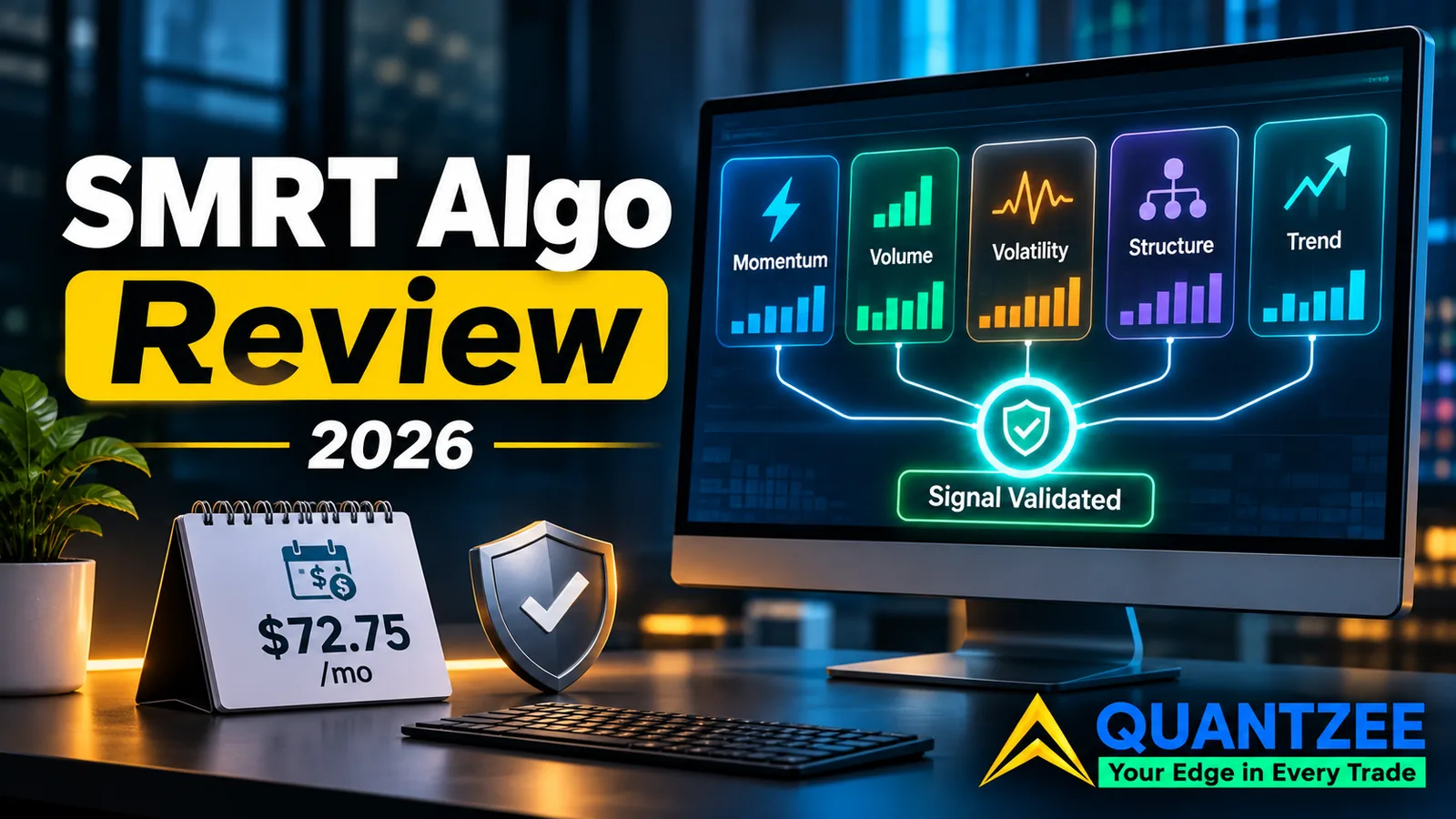
Short answer: SMRT Algo is worth it for one specific trader. That's someone who wants a coordinated, confluence-based signal system across 14 indicators and is fine paying a recurring fee with no refund guarantee attached. It's a weak fit for anyone who wants a free trial first. It's also a weak fit for anyone who'd rather own the tool outright, or test-drive the logic before a card gets charged. According to SMRT Algo's own live pricing page, the Monthly plan runs $72.75/mo on the current Halloween promotion, down from a $97/mo list price that resumes once the promo ends. We checked that figure, and every other price in this review, directly on the named vendor's own page on November 1, 2026. We compared the structure against Quantzee's own one-time plan and five more named TradingView indicator sellers.
Is SMRT Algo worth it in 2026?
SMRT Algo sells a coordinated signal system, not a single indicator. The pitch, per the vendor's own site, is five confluence factors: momentum, volume, volatility, structure, and trend. All five have to line up before the system marks an entry, a stop loss, and three profit targets on the chart. That's a meaningfully different product shape than a single oscillator or trend overlay. It's also why the price sits above the cheapest names in this category. You're paying for the coordination layer, not just one script.
What you don't get, at any tier, is a trial. SMRT Algo's refund policy states plainly that "SMRT Algo does not currently offer paid free trials." The same policy is explicit that all sales are final. Refunds are issued only for duplicate charges caused by a processor error, nothing else. We found that gap worth naming up front. Two of the seven alternatives compared later in this review do publish a trial window, and SMRT Algo doesn't.
Our own data on the wider category: paid TradingView signal suites in the "coordinated confluence system" bracket we track run from roughly $17 to $95 a month before promo pricing. SMRT Algo's $72.75/mo promo rate (list $97/mo) sits toward the upper half of that range. That's closer to Zeiierman Trading's $95.20/mo list price than to LuxAlgo's $17.49/mo entry tier. Neither figure is an outlier for a multi-indicator suite. It's simply not an entry-level price.
Who should actually buy it: a trader who wants one system handling the confluence-checking work across momentum, volume, volatility, structure, and trend. That trader also needs to be comfortable committing to a subscription, or the lifetime buyout, without testing it first. Who should look elsewhere: anyone who wants to see the signals fire on their own chart before paying. So should anyone chasing the lowest entry price in the category, or anyone who wants a renewal date they never think about again without paying the $596.25 lifetime fee up front.
What "no repainting guarantee" actually covers
SMRT Algo advertises a no-repainting guarantee across all 14 indicators. That means a signal that prints on a closed candle stays put. It doesn't redraw itself after the fact once more price data arrives. That claim matters more than most marketing lines in this category. A repainting indicator can look dramatically better in a backtest than it ever performs live, because the "signal" being tested was never actually available at the candle it's drawn on. We can't independently verify a vendor's internal code against that promise from the outside. The same limitation applies to any TradingView indicator seller's repaint claim, SMRT Algo's included. What we can say: it's worth testing yourself in TradingView's Bar Replay before committing to an annual or lifetime plan.
SMRT Algo pricing explained
Here's the full table, verified against smrtalgo.com and its linked refund policy page on November 1, 2026. All three tiers are running a 25% Halloween discount at the time of this review; the list prices in parentheses are what each plan reverts to once the promo ends.
| Plan | Billing | Price | What you get |
|---|---|---|---|
| Monthly | Per month | $72.75/mo (list $97/mo) | All 14 Pro indicators, Smart Money Toolkit, Discord access, no-repaint guarantee. Cancel anytime, access runs through the paid period. |
| Annual | Per year | $372.75/yr, $31.06/mo effective (list $497/yr) | Same 14 indicators plus priority support and beta access to new releases. "Most members pick it" per the vendor's own site. |
| Lifetime | One-time | $596.25 (list $795) | Never renews. All future indicator releases included. No cancellation needed because nothing recurs. |
Two things worth checking before you pay. First, the feature set barely changes between tiers. All three unlock the same 14 indicators and the Smart Money Toolkit. The real decision isn't "which tier has more features." It's "how long do I plan to keep using this." At $72.75/mo, the Monthly plan crosses the Lifetime plan's $596.25 price after roughly 8.2 months. If you're confident you'll trade with this system past month nine, the Lifetime buyout is the cheaper path even at the discounted monthly rate.
Second, SMRT Algo's refund policy is unusually firm for this category. There's no money-back window of any length. Not 7 days, not 14. According to the policy page, refunds exist only for a processor-caused duplicate charge, verified within 30 days with proof of both transactions. A Monthly or Annual subscriber who decides the system isn't a fit after week one has no refund path, only cancellation going forward. Compare that to Flux Charts' published 7-day risk-free trial, or LuxAlgo's 30-day money-back guarantee on paid tiers. SMRT Algo is the strictest policy of the group compared in this review.
SMRT Algo vs LuxAlgo vs Quantzee
These three get searched together constantly, but the billing models and the repaint posture differ in ways that matter more than the sticker price.
| SMRT Algo | LuxAlgo | Quantzee | |
|---|---|---|---|
| Model | Tiered subscription + lifetime option | Free tier + 4 paid tiers | One product, one payment |
| Entry price | $72.75/mo promo (list $97/mo) | Free forever; paid from $17.49/mo promo (list $24.99/mo) | $59.99 once, no renewal |
| Top tier | $596.25 lifetime (list $795) | $48.00/mo promo AI Ultra (list $120/mo) | Same $59.99 — there is no top tier |
| Free tier | None — demo + Discord preview channel only | Yes — limited charts, 1-day orderflow lookback | None |
| Refund terms | None, except duplicate-charge errors | 30-day money-back on paid tiers | Store checkout policy, see pricing page |
| Repaint claim | No-repainting guarantee, stated on the vendor's own site | Not published on the pricing page | Non-repainting signal core, explained in detail on AI TrendPulse's own page |
LuxAlgo is the only one of the three with a genuine free tier. That makes it the obvious place to start if you want to see the interface before spending anything. Its paid structure is the most complex of the three: four tiers, promotional discounts that shift the effective price, and a Quant usage allowance that refills on a schedule. We found that quoting a single "LuxAlgo price" is close to misleading on any given day. What you'd pay depends on which tier, and on whether the current discount is still running.
SMRT Algo and Quantzee sit closer together structurally. Both gate the full feature set behind payment, with no meaningful free tier. SMRT Algo asks for a recurring fee, or a $596.25 lifetime buyout. Quantzee asks for $59.99 once. Quantzee's AI TrendPulse indicator, the money page this review links to, uses adaptive EMAs with volatility-adjusted filters. It ships non-repainting by design, a pivot-based confirmation that lands a few bars after a swing forms rather than redrawing after the fact. SMRT Algo's five-factor confluence model takes a different approach to the same underlying problem: deciding when a trend is real enough to act on. Neither is wrong. They're built on different trade-offs between confirmation speed and false-signal reduction — the same trade-off ValorAlgo's institutional S/R versus AI-signal pitch makes from a different angle entirely.
Best SMRT Algo alternatives in 2026: 7 compared
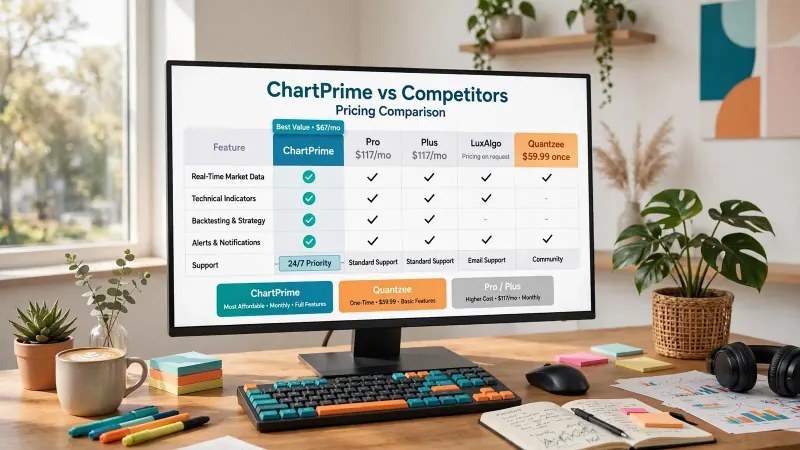
We compared seven named TradingView indicator and signal sellers people search for alongside SMRT Algo, sourced from each vendor's own live pricing page. Quantzee is included, and it isn't positioned as the automatic winner — some of these genuinely beat it on breadth, free-tier access, or trial terms, and the table says so. This review sits alongside our check of ChartPrime's own $67/mo Pro tier and Phantom Flow's $149 one-time SMC indicator in the same named-vendor series.
| Seller | Entry price | Model | Best for | Watch out for |
|---|---|---|---|---|
| SMRT Algo | $72.75/mo promo (list $97/mo) | Tiered subscription + lifetime at $596.25 | Traders who want one coordinated 5-factor confluence system instead of stacking separate indicators | No refund window of any length; no free trial |
| Quantzee | $59.99 once | One product, one payment, lifetime access | Traders who want a small, learnable 6-indicator set with no recurring fee | Only 6 indicators — not a fit if you want a 14-indicator breadth comparable to SMRT Algo |
| LuxAlgo | Free tier, or $17.49/mo promo (list $24.99/mo) | Free tier + 4 paid tiers | Traders who want to test the interface for free before paying anything | Four tiers and shifting promos make the "real" price harder to pin down |
| AlgoAlpha | $28.72/mo (Indicators tier) | Tiered (Indicators/Signals/VIP Bundle) | Traders who want a bundled signal feed plus Discord access | VIP Bundle runs close to 3x the entry tier — check the feature gap first |
| Flux Charts | $59.99/mo | Single Pro tier, 7-day risk-free trial reported | Traders who want an integrated screener and backtester, not just chart overlays | Confirm the trial terms directly — the published rate can change with site promos |
| Zeiierman Trading | $37.99/mo annualized (list $95.20/mo monthly) | Tiered membership, quarterly/annual/lifetime options | Traders who want breadth — 80+ tools and automated strategy bots | Lifetime price isn't published on the page; confirm before committing to annual billing |
| BigBeluga | $66.47/mo, or $1,999 lifetime | Single paid tier + lifetime option | Traders who want BigBeluga's named toolkits and are willing to pay once | No total indicator count published anywhere on the site (per our own October 26, 2026 check) |
A pattern worth naming: of these seven, only Quantzee, SMRT Algo, and BigBeluga offer a true one-time payment. BigBeluga's lifetime tier costs more than three times what SMRT Algo's does, and more than 33 times Quantzee's. LuxAlgo and Flux Charts are the two that publish an accessible free-or-trial path. LuxAlgo has a genuine free tier; Flux Charts has a reported 7-day trial. If a stated repaint policy matters to your decision, read each vendor's own documentation directly. Most names on this list don't state a repaint policy on their pricing page at all. SMRT Algo does, for whatever that's worth in your own evaluation.
Methodology: how we verified these numbers
We read every current price above from the named vendor's own live pricing page, checked on November 1, 2026. One exception is noted in the table: our own prior check from October 26, 2026, because the vendor's live page didn't return full pricing detail on this pass. We did not pull a single number from a reseller, a forum post, or an affiliate landing page. Where a vendor runs a site-wide promo, we recorded both the promotional and list prices, rather than quoting only the discounted figure as the standing rate. Where a vendor doesn't publish a number at all, like Zeiierman's lifetime tier, we said so instead of guessing. This review was reported and reviewed by Rajeev Gupta, Quantzee's founder, on November 1, 2026. Our data set for it covers seven named vendors and one of our own products, checked within the same session, so every row in the tables above is comparable. Prices in this category move often. If you're reading this more than a few weeks after November 2026, re-check the vendor's own page before paying anything.
Why repaint behavior and backtest claims matter
One regulatory point is worth understanding before acting on any vendor's advertised win rate or backtested performance figures, including SMRT Algo's or our own. FINRA Rule 2210 generally bars regulated broker-dealers from showing retail investors backtested or hypothetical performance numbers as if they predict future results. The reasoning behind that rule applies outside broker-dealer communications too. A backtest run on an indicator that repaints, redrawing its own signal after the fact, can look far better than it performs live. The signal being tested was never actually available at the candle it's drawn on.
That rule binds broker-dealers, not indicator vendors, so it doesn't apply to SMRT Algo, LuxAlgo, or Quantzee directly. The underlying math is the same for anyone marketing a trading tool, though. A backtest is only as honest as the signal that generated it. The SEC's investor-education site separately reports that fraud risk in this category has grown alongside the number of retail traders following signal accounts on social media. It recommends the same scrutiny for any trading-tool pitch leaning on a backtested number. None of the sellers compared in this review were accused of anything in those sources. They're cited here because they explain why "does it repaint" and "how was this backtest built" are the right questions to ask before paying for any indicator on this list, Quantzee included.
In our own experience building and testing signal logic, the honest trade-off is this: a non-repainting pivot confirms a few bars late. A repainting one looks perfect in hindsight and worse live. We'd rather ship the version that confirms late and stays true than the version that looks flawless in a screenshot — and we'd apply the same standard to SMRT Algo's five-factor confluence claim if we could see the code behind it.
The bottom line
Buy SMRT Algo if you want a single coordinated confluence system across 14 indicators, and you're comfortable paying $72.75/mo (or $596.25 once) with zero refund protection past the first week. Skip it, or at least test the free demo and Discord preview channel first, if a published trial or a money-back window matters to you. SMRT Algo offers neither. Our own product sits in a different camp by design: fewer indicators, one payment, no renewal. We've been upfront in this review about where that costs us too. SMRT Algo's 14-indicator breadth and multi-factor confluence model is real functionality Quantzee doesn't try to match. Pick the model that fits how you actually trade, not the one with the louder promo banner this week.
For a second premium suite checked the same way, see our FluxCharts review.