Short answer: MarketLumina is worth it if you want one all-in-one TradingView overlay with a trend cloud, labeled signals and a momentum dashboard, and you're happy to pay $35 every month to keep it. It's a weaker fit if you need written proof that its signals don't repaint, or if you'd rather pay once. According to the product markup on marketlumina.com, checked on 2026-11-17, the indicator costs $35.00 per month or $420.00 per year in USD. That yearly price is exactly 12 × $35, so there's no saving for paying up front. We found no repaint statement on any page we read, and the refund terms are strict. If you can live with both, it's a fair price for what's in the box. If you can't, read the repaint section before you subscribe.
Our methodology: we read the MarketLumina homepage, its "How it works" usage guide, the About page, the Terms of Service, the Refund policy and the Cancellation policy on 2026-11-17. We copied every price and policy wording as printed. Anything the vendor's pages didn't say, we marked as unknown rather than guessing. We then compared those findings with LuxAlgo and Quantzee, using pricing we'd already verified in earlier reviews. We did not run MarketLumina on a funded account, and we make no claim about how its signals perform.
Is MarketLumina worth it in 2026?
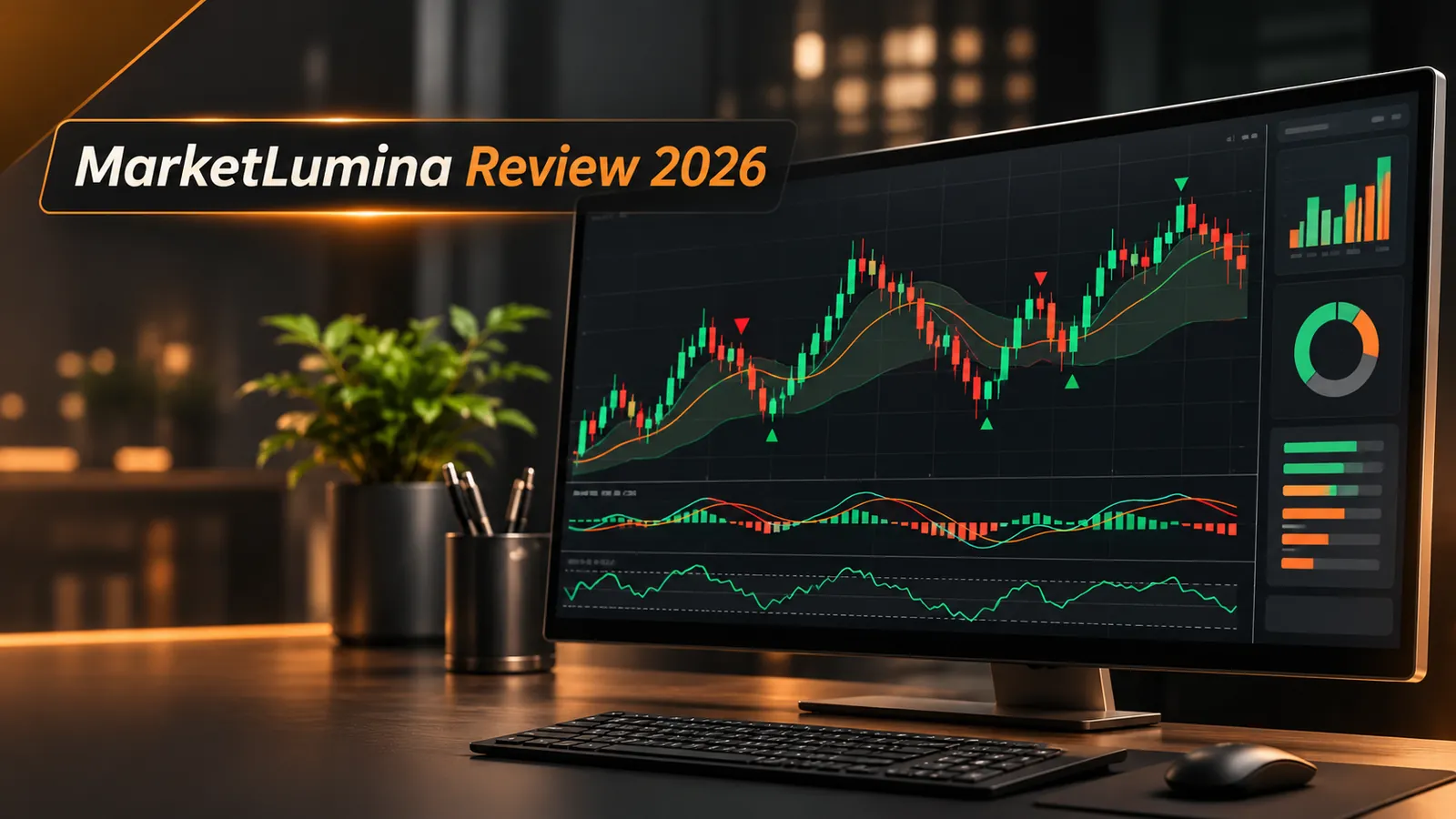
MarketLumina is a single invite-only TradingView indicator built by a small team that says it's based in Germany. It bundles three parts on one chart. The Fibonacci Trend-Cloud is a trend band built on what the site calls "advanced Fibonacci EMA values." The Advanced Signal System prints labeled signals for strong reversals, pullbacks, trend strength and overbought or oversold zones. LuminaPulse is a set of six bar gauges: Money Flow, Momentum, Volume, Strength, Squeeze and Volatility.
That's a lot of chart for $35. A trader who likes a busy, everything-on-one-screen layout will get real use from it, especially the gauges. The usage guide is detailed, too. It explains each signal category and tells you to confirm signals against higher timeframes, which is sound advice and more honest than many vendor guides we've read.
Here's the catch. The homepage says the tool "adapts to any market with machine learning tailored to each symbol and timeframe." The usage guide says Money Flow and Momentum use "a machine learning approach." Neither page explains the model, its inputs, or how often it retrains. Treat "machine learning" here as a description you can't check, not a feature you can verify. The U.S. Securities and Exchange Commission warns investors to be careful with AI-branded trading claims that a seller can't explain (see the SEC's investor resources at sec.gov).
So who should pass? Anyone who needs to know how a label behaves after the bar closes. Reversal signals are the classic place where repainting hides. A reversal arrow that appears late, or shifts once the candle completes, looks perfect on a historical chart and costs money live.
MarketLumina pricing explained
Here is everything we could verify on 2026-11-17, and nothing more:
| Plan | Price (USD) | Billing | What you get |
|---|---|---|---|
| Monthly | $35.00 | Renews every month | Full indicator on TradingView: Trend-Cloud, signals, LuminaPulse |
| Yearly | $420.00 | Renews every 12 months | Same indicator, no extra features listed |
Two plans, one product and nothing gated between them, which keeps the buying decision refreshingly simple. Visitors in the EU see euro pricing in the store's currency switcher, so your checkout figure may differ from the USD numbers above.
The yearly plan works out to $35 a month, the same as monthly. Most subscription vendors give 15% to 40% off for annual billing, so we'd pick monthly. You keep the option to leave and you pay nothing extra for it.
Over time the numbers add up. One year costs $420, two years cost $840, and three years cost $1,260 if the price never rises. When we compared that against a $59.99 one-time script, the subscription was cheaper only if you quit within the first 2 months. We cover that math in more depth in are TradingView indicator subscriptions worth it.
Is there a free trial? We didn't find one on offer. The footer invites you to "subscribe for free trials, discounts, and more," which reads as a newsletter promise, not a live trial. We couldn't open the product page itself on the day we checked because the store rate-limited our requests, so confirm on the checkout page before you pay.
Refunds deserve a careful read. Per the Refund policy, EU consumers normally get a 14-day right of withdrawal, but you lose it the moment you access the indicator, under Article 16(m) of the EU Consumer Rights Directive (the full text is on EUR-Lex). The Cancellation policy adds that they "do not offer refunds for the current billing period." In plain terms: once you add the script to a chart, you've paid for that month. You can cancel any time and keep access until the period ends, and you can also pause the subscription.
MarketLumina vs LuxAlgo vs Quantzee
All three put signals on a TradingView chart. They differ on pricing model, on what each vendor says about repainting, and on how much you can inspect before trusting it.
| Factor | MarketLumina | LuxAlgo | Quantzee |
|---|---|---|---|
| Pricing model | Subscription: $35/mo or $420/yr (checked 2026-11-17) | Subscription: $17.49 to $32.99/mo promo tiers (our 2026-10-31 check) | One-time: $59.99 |
| What you get | 1 indicator with 3 modules | Several toolkits plus screeners, by tier | 6 TradingView indicators |
| Repaint statement | None found on 6 pages we read | Documented tool by tool | Signals confirm on the closed bar |
| Refund | None once accessed; cancel anytime | 30 days on first payment | Pine Script source emailed so you can inspect it |
| Source code visible | No (invite-only) | No (invite-only) | Yes |
Each one has a real strength worth paying for. MarketLumina's LuminaPulse dashboard is the most visual of the three, and the single-product approach keeps it simple. LuxAlgo has the longest refund window and the deepest documentation. Quantzee wins on transparency and long-run cost.
The closest Quantzee match to MarketLumina is the AI Adaptive Quant Toolkit. Like MarketLumina, it layers a trend cloud, signals and a stretch-zone channel on one chart. Its Quant Cloud is a two-speed EMA trend cloud, and its Stretch Zones are mean-reversion bands set by how far price has moved from its 100-bar average. Turn on Confirmed Bars Only if you want signals only on the closed bar. Because you get the Pine Script source, you can read the logic yourself instead of trusting a label. It's still a TradingView-only tool, and it won't suit someone who wants MarketLumina's exact gauge layout.
When we compared costs over 24 months, the gap was large. MarketLumina comes to $840. Quantzee stays at $59.99. That's not a verdict on signal quality, only a plain statement of what each pricing model charges.
Does MarketLumina repaint?
We don't know, and nobody does until they test it. We searched the homepage, the usage guide, the About page and all three policy pages for the word "repaint." We found zero mentions, for or against.
Silence isn't proof of repainting, and we won't claim it is. It's a gap, and you can close it yourself in about 10 minutes. Our guide on how to test any TradingView indicator for repainting covers Bar Replay, a refresh test and a "Once Per Bar Close" alert check. Focus on the Strong Reversal and potential pullback labels first. The usage guide itself calls the pullback signals "early insights with moderate certainty," which is a hint they can form before a bar is final.
One practical warning: because of the refund terms, you'll be testing on money you can't get back. A cheap way to limit that is to subscribe monthly, run every test in the first week, and cancel if the labels move. For the background on why this matters, see our explainer on non-repainting TradingView indicators.
Best MarketLumina alternatives in 2026: 7 compared
Prices below come from our own dated reviews of each vendor, linked in the table where we have one. Vendors change prices often, so click through to the vendor's page before you buy. We haven't ranked them. The right choice depends on whether you want a platform, a subscription overlay or a one-time script.
| Alternative | Price (as of our review) | Model | Fits if |
|---|---|---|---|
| LuxAlgo | $17.49 to $32.99/mo promo tiers (checked 2026-10-31) | Subscription | You want documented, regularly updated overlays and a 30-day refund |
| Quantzee | $59.99 one-time | One-time | You want readable Pine Script source and no renewal |
| AlgoPro | $89.99 one-time | One-time | You want a bundle of indicators for one payment |
| UltraAlgo | $67 to $119/mo | Subscription | You need real-time data and broker links bundled in |
| TOP Trade Tools | $97/mo | Subscription | You want a coached, community-style membership |
| GainzAlgo | Lifetime pricing; see review | Lifetime | You want a single-signal lifetime tool |
| TrendSpider | Roughly $89 to $199/mo billed monthly | Subscription | You want automated multi-timeframe scanning on its own platform |
If the LuminaPulse gauges are what drew you in, it's worth knowing that most of them map to standard studies. Money Flow resembles MFI, Squeeze is a Bollinger-inside-Keltner idea, and Volatility tracks range expansion. You can build a rough version free on TradingView. Our walkthrough of Bollinger Bands settings and squeeze rules shows the squeeze part. What you're really paying MarketLumina for is the packaging and the claimed machine-learning thresholds.
For a wider list, our LuxAlgo alternatives guide covers more vendors in the same price band.
What we'd check before subscribing
We've reviewed more than 25 TradingView indicator vendors this year. In our experience, the same three questions decide whether a subscription pays for itself. MarketLumina answers one well and two poorly.
First, can you see the price before checkout? Yes, and that already puts it ahead of several vendors we've looked at. $35 a month and $420 a year are in the page markup, and the plans are simple. Second, can you get your money back if it isn't right? Not really, once you've loaded the script. Third, does the vendor say how its signals behave on a closed bar? No.
Our test setup for any new indicator is the same, and it fits inside a single monthly billing cycle. We load it on 3 markets with different personalities, usually a large-cap stock, a major currency pair and Bitcoin, on the 15-minute and 1-hour charts. We note every signal for 5 trading days while the bars form, then compare those notes against how the same bars look on a refreshed chart at the end of the week. If more than a couple of labels have moved, vanished or appeared after the fact, we cancel before the next renewal date.
FINRA's guidance on evaluating trading tools makes the same basic point: understand how a product works and what it costs over time before you commit (see finra.org). MarketLumina's own Legal Notices agree that it is "a technical analysis tool, not a substitute for professional financial advice" and that "past performance does not guarantee future outcomes." That's the right framing for any indicator, ours included.
Quantzee is analytical software, not investment advice. Nothing here tells you to buy or sell anything.