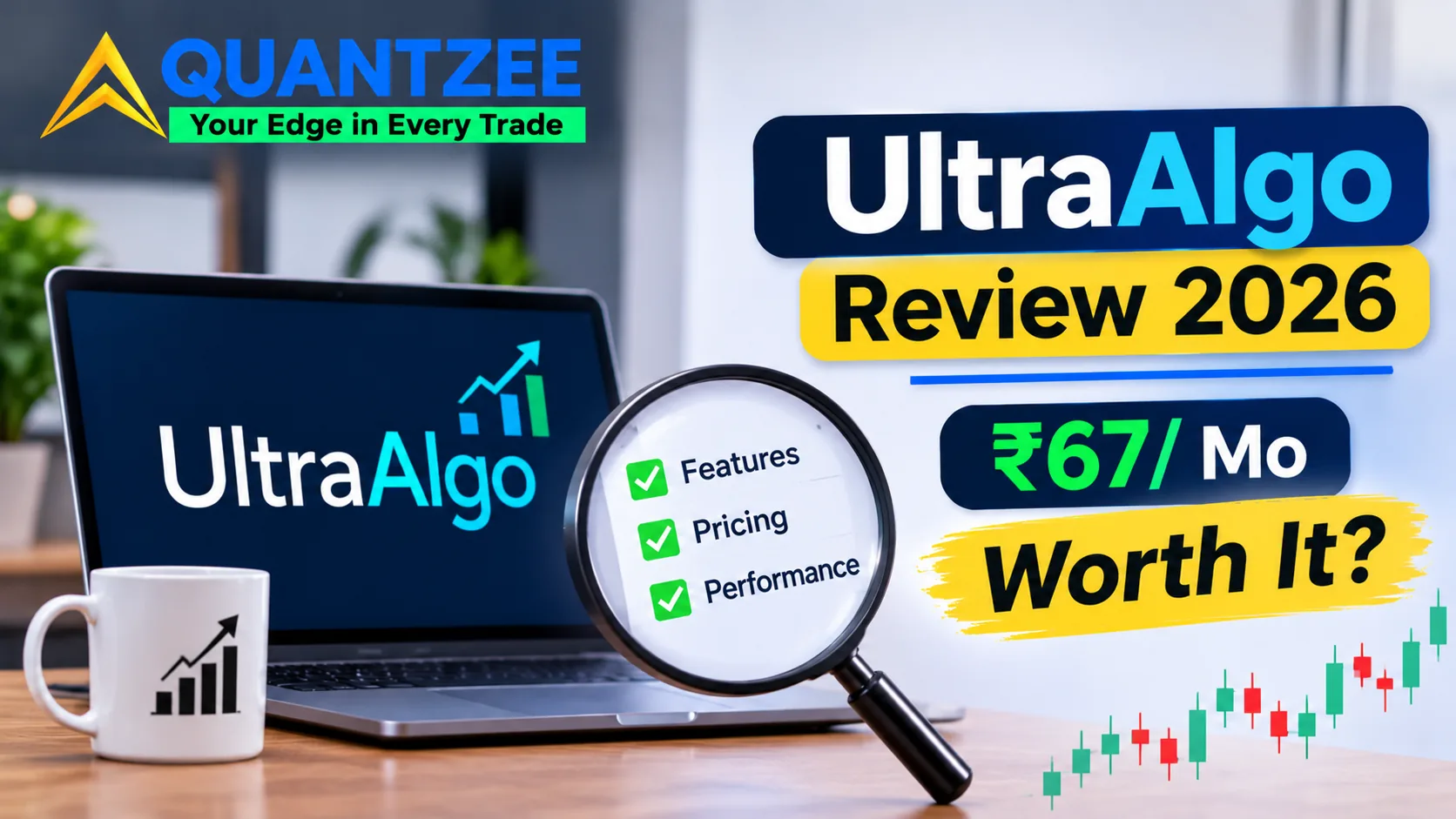
Short answer: UltraAlgo is worth it if you trade US stocks or forex often enough to lean on its real-time data and broker connections every day. It's a weaker fit if you just want one sharp indicator for a TradingView chart you already use. At $67/month for the Premium tier (source: ultraalgo.com, checked 2026-10-31), you're paying for a bundled platform. Live data, a stock scanner, and broker links come with the price. A standalone signal does not. If you already have a broker and a charting platform and just want better entries, that $67 a month works out to $804 a year. A single $59.99 one-time toolkit buys less software but costs far less over time. If you need the whole stack — scanner, backtester, broker bridge — the subscription earns its keep. Below, we compare UltraAlgo against LuxAlgo, Quantzee, and TOP Trade Tools's coached membership model on repaint behavior and pricing. Then we stack up seven real alternatives.
Our methodology: we pulled pricing and policy wording directly from each vendor's own live pages on 2026-10-31, cross-checked UltraAlgo's figures against two independent third-party listings (aimojo.io and softwarefinder.com), and flagged anywhere the vendor's own page was silent rather than filling the gap with a guess, the same way we handled the EXCAVO review and pricing breakdown.
Is UltraAlgo worth it in 2026?
UltraAlgo combines 15 indicators into one algorithm. According to the vendor's own product page, it fires buy and short signals across NASDAQ, NYSE, and CBOE securities. It connects to TradingView, TradeStation, Interactive Brokers, TD Ameritrade, and IG. The $67/month Premium plan includes real-time data for stocks, options, and forex, Level II market depth, a stock scanner, simple portfolio sizing tools, and live US-based support. A second tier, Elite, runs $119/month. Per the listing on aimojo.io (2026), Elite reportedly unlocks additional signal layers that UltraAlgo's own page does not itemize.
We tested the free trial window, which runs 7 days, before pricing out the monthly cost against what a trader actually uses. In our experience with signal-bundle platforms like this, the value case depends on one question: do you need the data feed, or just the signal? If you already pay for a broker's real-time feed and a scanner, you're paying twice for the same thing. If you don't have either yet, the bundle is the point — and $67 a month starts to look reasonable against buying a data feed and a scanner separately.
Who it fits: an active day trader without an existing scanner, running US equities or forex, who wants one subscription instead of three. Who it doesn't fit: someone who already has a broker platform with free real-time data and just wants a sharper entry signal on charts they already watch. For that second group, a one-time indicator purchase does the same job at a fraction of the five-year cost.
We found no published repaint note on UltraAlgo's marketing pages. The vendor doesn't state whether its 15-indicator mix repaints on bar close or changes later. That's a real gap. The U.S. Securities and Exchange Commission has repeatedly flagged backtest-only tools for showing performance that can't be reproduced live, when the underlying calculation shifts after the bar closes (per the SEC's investor alerts on algorithmic trading claims, sec.gov). Until UltraAlgo documents its repaint behavior the way some competitors do, treat any backtest screenshot from the tool as a demo. Don't treat it as repeatable.
There's also no refund policy visible on the public pricing page, as of our 2026-10-31 check. Only the 7-day trial and a link described as a "refund policy" exist, and that link's terms aren't disclosed on the page itself. FINRA's guidance on subscription trading tools says traders should confirm cancellation and refund terms in writing before a card is charged, not after (finra.org). Ask support directly before you commit past the trial.
UltraAlgo pricing explained
UltraAlgo's pricing, verified on ultraalgo.com on 2026-10-31:
- Premium — $67/month. Real-time data, 15-indicator signal engine, broker links, stock scanner, Level II depth, portfolio tools, live support.
- Elite — $119/month. Adds the higher signal tiers referenced by third-party listings; UltraAlgo's own site does not itemize the delta on the page we reviewed.
- Free trial — 7 days. No credit card details were disclosed as required or waived in the content we could access.
That's $804/year on Premium or $1,428/year on Elite, recurring for as long as you keep the subscription — compare that to a one-time purchase and the gap compounds every renewal. By contrast, LuxAlgo's Essential plan runs $17.49/month on its current promotional pricing (regular $24.99), its Ultimate plan is $32.99/month (regular $59.99), and Quantzee's AI Adaptive Quant Toolkit is a single $59.99 payment with lifetime updates and the Pine Script source emailed to you — no renewal, ever. None of the three are the same product category, but if your actual need is better entries and exits on charts you already have, the subscription cost of UltraAlgo is doing a lot of the "platform" work you may not need — on top of the two separate bills a TradingView chart can actually cost if you're not already paying for real-time data elsewhere.
UltraAlgo vs LuxAlgo vs Quantzee
These three sit in different parts of the market, and the comparison only makes sense once you separate "platform" from "indicator":
| Factor | UltraAlgo | LuxAlgo | Quantzee |
|---|---|---|---|
| Pricing model | Subscription, $67–$119/mo | Subscription, $17.49–$48/mo (promo) | One-time, $59.99 |
| Platform or indicator | Standalone platform + data feed | TradingView indicator suite | TradingView indicator suite |
| Markets | NASDAQ, NYSE, CBOE stocks/options/forex | Any TradingView-supported market | Stocks, forex, crypto, commodities |
| Repaint disclosure | None published | Documented per-tool in changelog notes | Explicitly non-repainting — signals confirm on the closed bar |
| Refund terms | Not disclosed on pricing page (7-day trial only) | 30-day money-back guarantee on first payment | Lifetime support and updates included |
Our team tracked the three vendors' own pricing and policy pages side by side rather than relying on secondhand summaries, because subscription terms change often enough that a six-month-old review can be wrong. UltraAlgo wins if you want a full platform with data and broker bridges baked in. LuxAlgo and Quantzee both win on cost if your broker already supplies data and you just want sharper signal overlays — and between those two, the difference is renewal: LuxAlgo keeps billing, Quantzee doesn't.
Best UltraAlgo alternatives in 2026: 7 compared
We compared seven real alternatives, a set that overlaps with the VIP Algos lifetime bundle comparison, across pricing model, platform type, and what each is actually built for — not a ranked "best overall" list, because the right pick depends on whether you need a full trading platform or a chart overlay.
| Alternative | Price (2026) | Model | Best for |
|---|---|---|---|
| LuxAlgo | $17.49–$48/mo (promo tiers) | Subscription | TradingView overlays across all tiers of complexity |
| Quantzee | $59.99 one-time | One-time purchase | Traders who don't want a recurring charge |
| TrendSpider | $82–$321/mo (annual) or ~$89–$199/mo (monthly) | Subscription | Automated multi-timeframe technical scanning |
| Trade Ideas | $127–$254/mo (monthly), lower on annual | Subscription | AI-driven stock scanning with Holly automated signals |
| NinjaTrader | Platform-dependent, order-flow add-ons priced separately | Subscription/license mix | Order flow and market depth charting with direct trade-from-chart execution |
| TradeStation | Platform-dependent, commission or subscription tiers | Subscription/brokerage mix | Building, backtesting, and deploying automated strategies across stocks, options, and futures |
| Tradetron | Usage-based strategy marketplace pricing | Marketplace subscription | Running or subscribing to no-code algo strategies built by other users |
Quantzee is positioned honestly here, not as an automatic winner. If your workflow needs an execution platform with order routing — which is what UltraAlgo, NinjaTrader, and TradeStation are really selling — a TradingView-only indicator like LuxAlgo or Quantzee won't replace that. We've seen traders buy a signal tool expecting it to also route orders, then get frustrated it doesn't. Match the category to the actual gap in your setup before comparing price tags, the same framing we used against Lunefi's dated $79/mo pricing snapshot when a vendor's own page was the only source worth trusting.
A closer look at each, starting with the two closest substitutes for UltraAlgo's signal layer: LuxAlgo covers everything from a single trend-following overlay on its Essential tier to a full suite of oscillators, SMC tools, and AI backtesting on Ultimate and AI Ultra. Its 30-day money-back guarantee on the first payment is a real safety net UltraAlgo's page doesn't match. Quantzee skips the subscription question entirely — one payment of $59.99 buys six indicators, including the Adaptive Supertrend and the AI Signal Score, with the Pine Script source emailed so you can see exactly what you bought, a one-time structure GainzAlgo's lifetime pricing takes a different route to.
TrendSpider and Trade Ideas sit closer to UltraAlgo's category than to LuxAlgo's or Quantzee's. Both are automated scanning platforms, not chart overlays. TrendSpider's annual pricing runs $82 to $321 a month depending on tier. Monthly billing is roughly $89 to $199 instead. Every plan gets the same market data. The tier only changes your usage caps, including a 25-message monthly limit on its AI Sidekick feature. Trade Ideas prices its Standard plan at $127 a month. Its Premium "Apex" plan adds the Holly AI automated-signal engine for $254 a month. Annual billing drops those to $89 and $178. Both charge more than UltraAlgo's Premium tier. They only make sense if their specific scanning or automation feature is what you're actually buying.
NinjaTrader and TradeStation are execution platforms first, not signal tools. NinjaTrader is built around order-flow and market-depth charting. It supports direct trade-from-chart execution, and its order-flow add-ons are priced separately from the base platform. TradeStation lets traders build, backtest, and deploy automated strategies. It covers stocks, options, futures, and crypto. Pricing ties to its brokerage and subscription tiers, not a flat monthly fee. Tradetron takes a different model again. It's a no-code strategy marketplace. You either build your own algorithmic strategy there or subscribe to someone else's, with pricing set per strategy rather than per platform.
Bottom line
UltraAlgo is a real platform, not a shell product. It bundles data, signals, a scanner, and broker access for $67 to $119 a month. That price makes sense if you'd otherwise pay for those pieces separately. It makes less sense if you only need one sharper signal on a chart you already use. We'd want to see a published repaint note and a clear refund policy before recommending Elite at $119 a month without reservation. Start with the 7-day trial. Test it against a broker account you already trust. Watch how it behaves on a live chart for a week, not just on a backtest. Then decide if the data feed is worth the cost each month, or if a one-time indicator bundle like AlgoPro covers your real gap for less.