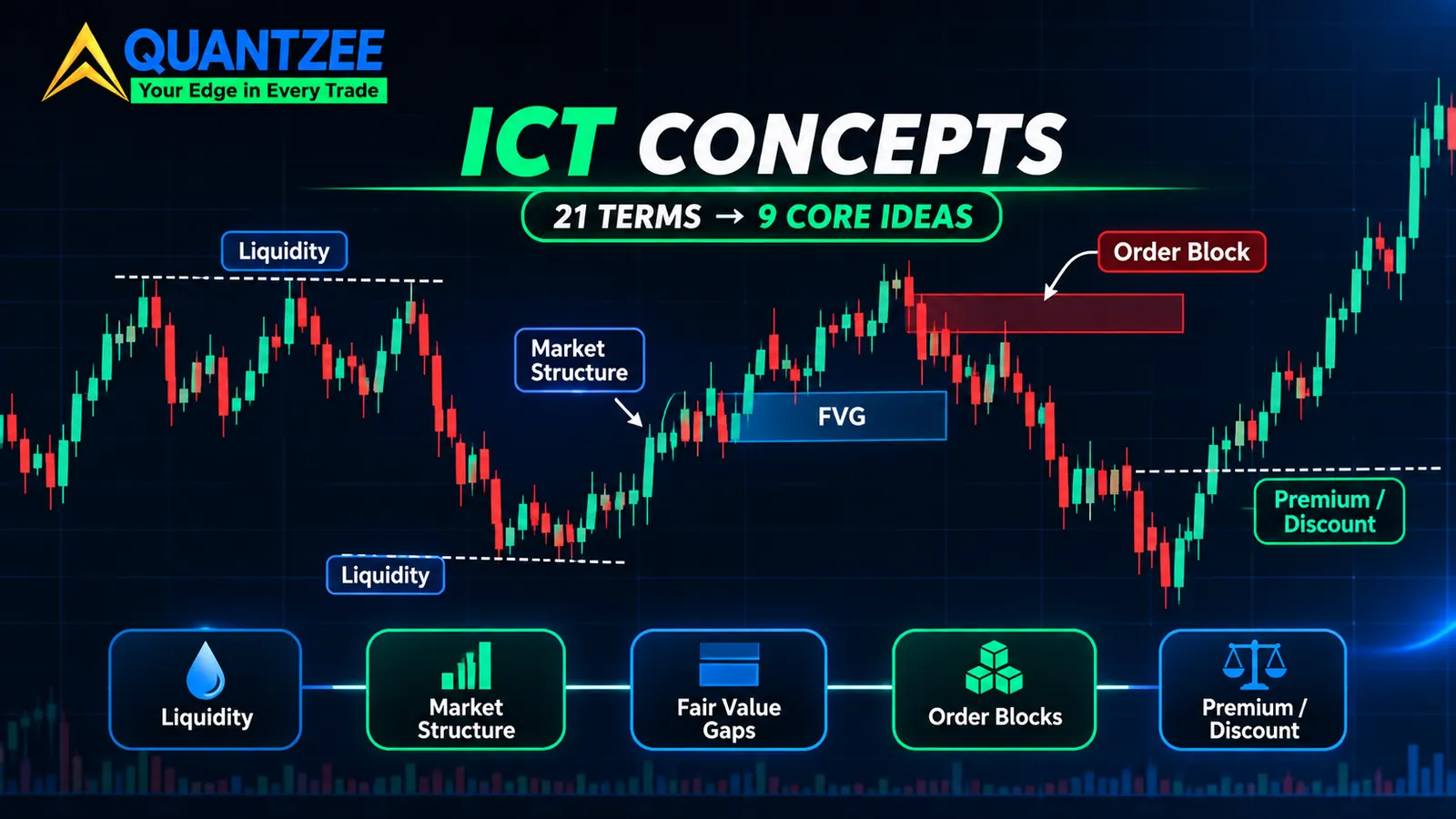
What is ICT? ICT stands for Inner Circle Trader. It's the online alias of the trader who put the methodology together, and the methodology itself is a vocabulary for describing where price is likely to go looking for resting orders: stops above old highs, stops below old lows, and the gaps a fast move leaves behind. That's the whole answer in one breath. The rest of this page deals with the part nobody on page one does, which is counting the vocabulary and admitting how much of it repeats, a pattern you can see in how turtle soup is just a sweep once you add penetration depth and bar-count limits for turtle soup.
Here's why that matters. We compared the three articles that rank for this question. One lists 15-plus named concepts, one lists 7, one lists 8. None of them gives a total. None of them says that some of those names describe the exact same candle on the exact same chart. A beginner who reads all three walks away with 21 terms to memorise and no idea that roughly half of them are relabels.
Paper trade first. Nothing below is a signal or a recommendation. Quantzee builds analytical software, and every concept here should be practised on a demo account before real money goes near it.
What is ICT, and who is ICT?
The definitional answer is short, so let's get the provenance right before anything else. According to the ATAS guide that currently ranks for this query, "Inner Circle Trader (ICT) is the alias of the trader behind the Smart Money Concept," his real name is Michael Huddleston, and he is based in the United States (source: ATAS, February 2025). That is the only one of the three ranking pages that names him at all. TrendSpider says ICT is "short for Inner Circle Trader" and stops there. LuxAlgo's page never spells out the acronym.
We're treating the name as reported, not as something we've independently confirmed. It's widely repeated across trading forums, and ATAS prints it in its own disclaimer, but we haven't found a primary biographical source, so you won't find a biography here. The alias is what matters for reading the material anyway. Every "ICT concept" you meet traces back to his videos and mentorship content, which is why the terms read like one person's private shorthand that escaped into the wild.
The name has a lineage too. Per the same ATAS article, the phrase "Inner Circle" was borrowed from the Inner Circle Workshop, an educational programme run by the futures trader Larry Williams; Huddleston liked the phrase and adopted it as his brand. That's a naming story, not a claim that Williams taught or endorses the method. None of the three pages gives a start year for ICT, and we won't invent one.
ICT vs SMC: one thing or two?
This is the question that trips up most people searching "what ict" in the first place. The most complete competitor page uses ICT and Smart Money Concepts (SMC) almost interchangeably. It opens by saying SMC "is a strategic trading approach developed by a trader known as Inner Circle Trader," then spends 6,000-plus words switching between the two labels without saying whether they're the same system.
Our read, plainly: ICT names one teacher's framework, including the time-of-day model, the session windows and the specific entry recipes he teaches. SMC is the broader umbrella label that grew around those ideas as other educators repackaged them, usually keeping the structure and liquidity vocabulary and quietly dropping the clock-based parts. So every ICT concept is an SMC concept, but plenty of what gets sold as SMC isn't ICT as he teaches it.
What should you take from a page that swaps the two? Treat it as a signal that the author is describing the shared vocabulary and not one specific rule set. That's fine for learning words. It's a problem if you're trying to reproduce someone's exact method, because two "SMC" traders can mean different entry rules while using the same nouns. Our audit of which SMC ideas survive a rule test goes into which of those shared ideas hold up when you have to write them down precisely.
How many ICT concepts are there? The count nobody publishes
Methodology first, because the number depends entirely on how you count. We took the named concepts each of the three ranking pages presents as a distinct idea, as recorded in our research notes from October 2026, and put them in one table. We counted a term once even if a page used it 10 times. We didn't add anything from outside those three pages, so this isn't a "complete" ICT glossary. It's the vocabulary a searcher is actually handed.
| Named concept | ATAS (15+) | TrendSpider (7) | LuxAlgo (8+) | Same chart event as… |
|---|---|---|---|---|
| Fair value gap | Yes | Yes | Yes | Imbalance family |
| Volume imbalance | – | – | Yes | Imbalance family (narrower gap) |
| Displacement | – | Yes | – | The move that prints the gap |
| Balanced price range | Yes | Yes | – | Two opposing gaps overlapping |
| Order block | Yes | – | Yes | Supply/demand zone |
| Supply and demand zones | Yes | – | – | Order block |
| Breaker block | Yes | – | – | Failed-zone family |
| Mitigation block | Yes | – | – | Failed-zone family |
| Market structure | Yes | – | – | Umbrella label, not an event |
| Break of structure | Yes | – | Yes | Distinct (with-trend break) |
| Change of character | Yes | – | – | Market structure shift |
| Market structure shift | – | Yes | Yes | Change of character |
| Buyside/sellside liquidity | – | Yes | Yes | Liquidity family (the pool) |
| Liquidity sweep | Yes | – | – | Liquidity family (the pool being taken) |
| Inducement | – | Yes | – | Liquidity family (a small pool) |
| Premium and discount zones | Yes | – | – | Price-location family |
| Optimal trade entry | Yes | Yes | – | A slice of the discount/premium zone |
| Kill zones | Yes | – | Yes | Time layer |
| Asian session range | Yes | – | – | Time layer |
| Power of three | Yes | – | – | Time layer |
| New week/new day opening gaps | – | – | Yes | Time layer |
Read the totals. That's 21 distinct names across 3 pages. Only 1 of them, the fair value gap, appears on all three. Seven appear on exactly two. The other 13 show up on just one page each, which means your vocabulary depends on which link you happened to click. Land on TrendSpider and you learn 7 words. Land on ATAS and you learn 15 or more, including several TrendSpider never mentions, and you'd have no reason to suspect the other list exists.
Now look at the right-hand column. Group the names by the chart event they actually describe and the 21 collapse to roughly 9 questions: where is the liquidity, has it been taken, did structure break with the trend or against it, where did the move start, did that zone fail, is there a gap, is price cheap or expensive inside the range, and what time is it. Our grouping is a judgement call, and you could argue a family or two either way. But nobody can look at that table and argue there are 21 separate ideas.
One worked pair: change of character and market structure shift on the same bars
Asserting that two terms overlap is cheap, so here's one pair on a single bar sequence. Picture a 15-minute chart in a clean downtrend. The swing highs step down: 104.20, then 103.60, then 103.10. The swing lows step down too: 102.40, 101.80, 100.90. Price bottoms at 100.90 on bar 9.
From bar 10 to bar 14 price rallies, and bar 14 closes at 103.35, above the last lower high at 103.10. That's the first time in the sequence that price has broken a swing point against the prevailing trend.
ATAS calls that close a change of character. TrendSpider and LuxAlgo call it a market structure shift. It's the same bar, the same level and the same close. Some teachers add a condition to the second label, saying a "real" shift needs a strong displacement candle through the level, but that's a filter layered on top of the event. It isn't a different event. If you learn both words as separate concepts, you'll go hunting for two things on a chart that only contains one.
The other pairs follow the same pattern: an order block and a demand zone drawn from the same last down-candle before a rally, a displacement move and the fair value gap it leaves on the same three bars. We won't walk through each one here, because the ICT framework map with its full duplication table already does that job, term by term, in three layers. If you want the BOS-versus-CHoCH argument settled with a written rule, our piece on the rule that separates BOS from CHoCH covers it.
The minimum a beginner actually needs
If the vocabulary is mostly relabels, what's the smallest set that lets you read a chart with this framework? When we built our own ICT/SMC-style indicators, our team had to answer that question in code, because every concept you add is another function with its own parameters. Five ideas did almost all the work:
- Liquidity. Where stops are probably resting: above equal highs, below equal lows, beyond obvious swing points. Our explainer on buy-side vs sell-side liquidity shows how to mark them.
- A structure break. One rule for "the trend just broke," whichever of the three names you prefer.
- The fair value gap. The three-candle gap a fast move leaves behind.
- The order block. The zone a move started from. Our guide to drawing order blocks without the guesswork gives a repeatable definition.
- Premium and discount. Whether price is in the upper or lower half of the current range.
That's 5 out of 21. The honest statement about the remaining 16 is that most are finer labels on events those five already cover. A breaker is an order block that failed. Optimal trade entry is a specific slice of the discount zone, usually quoted as the 62% to 79% retracement. Inducement is a small liquidity pool. They can be useful refinements once the core five are second nature, but learning them first is like memorising regional slang before you know the base language.
Does ICT work? What the one published number actually says
Search results for this topic contain exactly one performance figure. The ATAS FAQ says backtests of rule-based SMC entries "have reported win rates in the 50–65% range with a profit factor above 1.5." It names the US Dollar Index as an example market. That's it. There's no link to the backtest, no author, no bar size, no sample size, no date range and no cost assumption. It's the most authoritative-looking page for the term, and it carries a number nobody can check.
We're not saying the figure is wrong. We're saying it can't be evaluated, and a 15-point spread in win rate is wide enough to cover very different outcomes. Before a claim like that means anything, it needs six things:
- The instrument, exactly, not "for example."
- The bar size used to define every swing and gap.
- The sample size: how many trades, not how many charts.
- The date range, start and end.
- The cost assumption, covering spread, commission and slippage per trade.
- An out-of-sample split, so the rules weren't tuned on the same data that scored them.
Regulators make the same point about trading claims in general. The CFTC's investor advisories repeatedly warn about promoted trading systems and hypothetical results presented without context (CFTC advisories and articles). FINRA's guidance on day trading notes that it is risky and that traders should be prepared to lose money they put at risk (FINRA on day trading). Neither agency says anything about ICT specifically. They don't need to: any unsourced win rate deserves the same scepticism.
We haven't published a win rate for any ICT concept, and we won't quote one we didn't measure. The only place on Quantzee that carries rule-test results is the SMC audit, and it states its rules before its results.
Why the clock matters more than the vocabulary suggests
A good part of the framework is time-of-day dependent. Kill zones, the Asian range and the power of three all assume a market with a quiet overnight session and specific hours when London and New York traders arrive. That assumption holds reasonably well for currency pairs and index futures. It transfers badly to a 24-hour market like crypto, where there's no daily open in the same sense and the "overnight" range can be the busiest part of the day. We've covered which session windows still hold, instrument by instrument, in our piece on ICT killzones by market, so we won't re-derive it here.
How to use this page
If you came here asking "what is ICT," you now have the answer and the provenance with its source. You also have the number that matters most for learning it: 21 published names, around 9 real questions, and a working minimum of 5. Start with those five on a demo chart for a few weeks. Add a refinement only when you can name the core concept it refines. When you're ready for the full framework, the one-page ICT map is where it lives.
Quantzee's SMC tools draw several of these levels the same way on every chart, so you can practise reading them without re-drawing each one by hand. That's a convenience for learning the vocabulary. It isn't a substitute for paper trading the rules yourself.