
Disclaimer: This is educational content about analytical software. Nothing here is investment advice, and trading carries a risk of loss. Paper trade any indicator before you put money behind it.
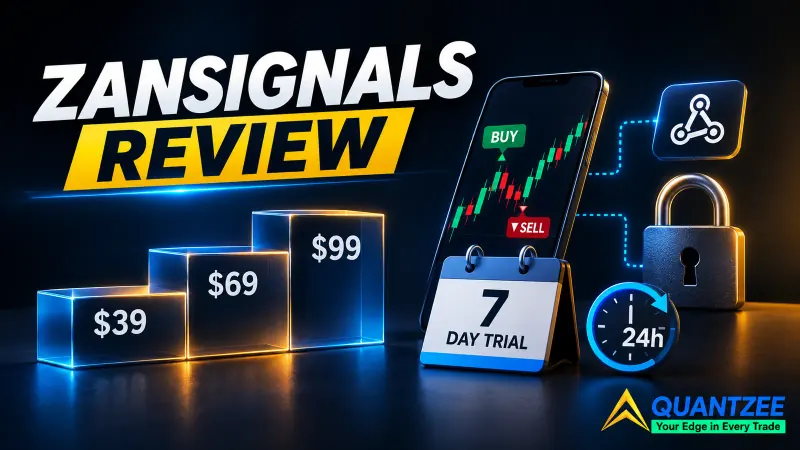
Short answer: Big Move Algo is worth paying for if you want a simple, signal-on-the-chart TradingView overlay and you're happy to rent it. It has a real 14-day money-back window, a clear repaint policy with a $1,000 payout attached, and a feature list that's genuinely tidy. It's a poor fit if you hate recurring bills, want the source code, or plan to lean on its "up to 92% win rate" headline. That number comes from one instrument over about three months in 2023. Prices below were read live on bigmovealgo.com on November 9, 2026, and you can set them against the ZanSignals monthly tiers and 24-hour refund window.
How we compared these products
Our team opened the Big Move Algo homepage and its repaint-guarantee terms page on the day of writing and copied every tier, billing period and feature line as shown. Then we compared that against LuxAlgo's live pricing page and against the pricing we recorded on our own review pages for eight other indicator vendors. The methodology is plain: a sample of 9 products, one price per tier, one date. Where a number comes from an older review of ours, such as ZynIQ's one-time pricing and refund terms, the table says so. We did not run a repaint test on Big Move Algo ourselves, and nothing below pretends we did.
Is Big Move Algo worth it in 2026?
It depends on three things: how you trade, how long you'll keep paying, and how much weight you put on signal arrows in the first place.
It's worth it when you trade discretionary entries on stocks, crypto, forex, indices or commodities and want something that prints Long, Short and Take Profit labels without a settings maze. The AUTO mode has three trading styles, which means you pick one and move on. Version 3 also adds a Fake Trend Detector that greys out candles in what the vendor calls danger zones and stops new signals there. That's a sensible idea, since chop is where arrow indicators bleed.
It's not worth it if you want to own the tool. Every Big Move Algo plan is a subscription. Stop paying and the indicator leaves your TradingView account. Over three years, Version 3 at the $64/mo yearly list rate adds up to $2,304. Quantzee's lifetime plan is $59.99 once. That gap is the whole story for a lot of traders.
It's also not worth it if the win-rate banner is what sold you. We'll get to why in a moment.
Big Move Algo pricing explained
Here's what the pricing section showed on November 9, 2026. Per the page, all plans carry a 14-day money-back guarantee, and cancelling stops future charges.
| Plan | Yearly rate (per month) | Monthly rate | What's inside |
|---|---|---|---|
| Version 2 | $55/mo ($660 billed yearly) | $78/mo | Long and Short signals, exit signals, 1 AUTO mode, 2 manual parameters. Marked "no longer developed." |
| Version 3 (most popular) | $64/mo ($768 billed yearly) | $97/mo | Enhanced signals, exit signals, Fake Trend Detector, 3 AUTO modes, 5 manual parameters, updates included. |
| Version 3 Plus | $79/mo ($948 billed yearly) | $139/mo | Everything in Version 3, plus a multi-timeframe dashboard, customizable candle colors and priority support. |
A 50% launch coupon was also running on Version 3: $32/mo ($384) for the first year, then $768 a year. That's a promotion with a countdown timer, so treat the $64/mo figure as the honest ongoing price and $32/mo as the first-year price only.
Two details are easy to miss. First, Version 2 is the cheapest-looking tier but it's flagged as no longer developed, so you'd be buying a product the vendor has stopped working on. Second, the monthly rate on Version 3 is $97, which is 52% higher than the yearly equivalent. A month-to-month trial of the main plan costs about $1,164 a year if you never switch. The checkout pop-up even tells monthly buyers they'd pay $780 more this year than on the discounted annual plan. That's an accurate statement about its own pricing, not a hidden fee, but it's a strong nudge to commit for twelve months.
What the price doesn't include: source code, a backtester, or ownership. You get the indicator inside your TradingView account, unlimited devices, free alerts, a free hook-up to automated trading platforms, and lifetime updates for as long as you subscribe.
The "up to 92% win rate" claim, read carefully
The hero banner says "Up to 92% win rate" with a footnote: based on 1,388 trades on XAUUSD, May 18 to Aug 23, 2023. We found two things worth saying out loud.
One instrument, gold, over roughly 14 weeks. That's a single market regime, and the vendor chose the window. "Up to" also does a lot of work in that sentence: it's the best slice, not the average across the markets the homepage lists. Win rate on its own also says nothing about the size of winners versus losers. A system can win 9 trades in 10 and still lose money if the one loser is five times the size of the winners.
None of this means the indicator is bad. It means the banner can't tell you whether you'll make money, and you shouldn't let it. The fair way to use a headline stat like this is as a hypothesis to test on your own symbol and timeframe, using the 14-day window the vendor gives you.
Does Big Move Algo repaint?
The vendor says no, and backs it with a written $1,000 No Repaint Guarantee. Reading the terms (last updated May 2026), repainting is defined narrowly: a long, short or exit signal on a fully closed candle that later changes position, disappears or is replaced, with no settings changed. Signals on a live, still-forming candle are explicitly excluded.
That's a reasonable, honest definition, and the payout is a genuine confidence signal. Two catches matter in practice. You must be an active paying subscriber when the repaint happens and when you file, and you must be running the latest version. You also need recorded evidence from two separate recordings. So the guarantee is real, but it's a high bar for an ordinary trader to clear, and it only covers closed candles. If you want to check any indicator yourself, our walkthrough on how to test a TradingView indicator for repainting covers the replay method, and the broader piece on non-repainting TradingView indicators explains why closed-candle behaviour is the only fair standard.
Big Move Algo vs LuxAlgo vs Quantzee
These three sit at different points on the price-versus-ownership line. None is a drop-in replacement for another.
| Big Move Algo | LuxAlgo | Quantzee | |
|---|---|---|---|
| Pricing model | Subscription | Subscription | One-time |
| Entry price (Nov 9, 2026) | $64/mo yearly, $97/mo monthly (Version 3) | Essential $17.49/mo billed yearly, $24.99/mo monthly | $59.99 once |
| Top tier | Version 3 Plus, $79/mo yearly | Ultimate $32.99/mo yearly, $59.99/mo monthly | Same single plan |
| Repaint stance | Closed-candle signals locked; $1,000 payout terms | Varies by script; check each one on replay | Non-repainting on closed candles across the suite |
| What you hold if you stop paying | Nothing | Nothing | Everything, including Pine Script source |
| Money-back window | 14 days | 30 days on paid tiers | No refunds; all sales are final |
LuxAlgo has the deepest toolbox of the three, and its pricing runs from $17.49 to $32.99 per month on annual billing, per its pricing page on the same day. If you want a huge menu of overlays, that's where it wins. Big Move Algo wins on focus: one product, one job, three AUTO styles. Quantzee wins on cost over time and on ownership, because the $59.99 plan includes all six paid indicators, with the Pine Script source emailed on payment. You can read the longer comparison in our LuxAlgo alternative breakdown.
Where Quantzee loses: it has no 14-day refund. Sales are final, and that's published on the refund page. If you like to try before you commit, Big Move Algo's window is a real advantage and LuxAlgo's 30 days is better still. Quantzee's answer is to let you see what you're buying first, including AI TrendPulse, an adaptive EMA trend tool with reversal alerts that makes a good first look at how our signals behave, and the pricing page that lists the six scripts.
Best Big Move Algo alternatives in 2026: 7 compared
We compared seven alternatives, with Quantzee as one of them and not automatically on top. Figures marked with a date come from our own review pages, which each link to the vendor page we read at the time. Check the vendor before you buy, because several of these change quarterly.
| Alternative | Model | Price we recorded | Best for | Main trade-off |
|---|---|---|---|---|
| LuxAlgo | Subscription | $17.49 to $32.99/mo yearly (Nov 9, 2026) | Big overlay library | Recurring cost, overwhelming menu |
| ChartPrime | Subscription | About $67/mo (earlier review) | Chart-heavy overlays | Recurring cost; closed scripts |
| BigBeluga | Subscription | $66.47/mo (earlier review) | Visual, chart-heavy setups | Cost; steep learning curve |
| FluxCharts | Subscription | $720/yr (earlier review) | Traders who want a broad suite | Highest annual outlay in this list |
| GainzAlgo | One-time | $49.95 Standard/Pro, $299.95 V2 (earlier review) | Simple buy/sell arrows | Repaint claim only on V2 |
| Indicator Vault | One-time | From $249 (earlier review) | Buy-once collection | High entry price |
| EXCAVO | Subscription | $49/mo (earlier review) | Mid-priced signal overlay | Rent, never own |
| Quantzee | One-time | $59.99 once (Nov 9, 2026) | Owners who want source code and no renewal | No refunds |
Look at that table as a budget question first. Three years of Big Move Algo Version 3 at list costs $2,304. Three years of EXCAVO at $49/mo is $1,764. FluxCharts is $2,160. GainzAlgo Standard is $49.95 for life, but the cheaper tiers make no repaint promise at all. Quantzee is the cheapest over any period longer than a couple of months, though that's only a good deal if you actually use the scripts.
If your priority is a refund window, pick a subscription vendor and use the window to test. If your priority is owning the code and never seeing a renewal email, the one-time options are the real choice, and the question becomes which one has the clearest repaint behaviour.
Who should pick which
Pick Big Move Algo Version 3 if you trade a handful of liquid symbols, like labelled signals, and want a vendor that publishes repaint terms in writing. Take the first-year promo only if you're certain you'll keep it for a year, since the second year costs double.
Pick LuxAlgo if one toolbox covering price action, liquidity and statistics matters more than a single clean signal.
Pick a one-time option if you've been renting indicators for two years and noticed you're paying the same fee for the same arrows. We built Quantzee for that person, and for global traders who trade stocks, crypto, forex and indices from any time zone. Whichever you choose, check the regulator's own guidance on trading tools. The SEC's investor alerts and FINRA's investor insights both explain why a past win rate says little about future results.