
Paper trading futures tells you something true and something false at once
Every serious trading desk tells new users to paper trade futures first. We tell our own users the same thing. That advice is correct. But it is incomplete if nobody tells you how a simulator flatters you. We have watched our users move from paper to live futures accounts for over two years. The single biggest cause of disappointment is rarely a bad indicator. It is a paper trading record that was never going to survive a real order book.
This is not an argument against paper trading futures. It is the opposite. Paper trading is the right first step, and it systematically overstates results. Both things are true at once. Most guides only say the first one. Below, we name the four mechanisms that inflate a simulated profit and loss curve. Then we give the adjustments that close the gap, and walk through paper trading one specific indicator setting the way our own team does it.
The four ways a futures simulator flatters you
Each mechanism points the same way: toward a better equity curve than live trading will give you. We sized the typical effect of each one against our own backtest-vs-live comparisons on NIFTY and SENSEX expiry-day futures and options. We also checked them against published fill-quality notes from NinjaTrader's futures paper trading guide and TradingView's paper trading documentation.
1. Fills that would not have happened. A simulator usually assumes your limit order fills the instant price touches your level. It does this even if the touch was a single print on thin volume. In a live order book, that same level might give you a partial fill, no fill, or a fill three ticks worse, because faster participants were already queued ahead of you. On a typical five-minute futures scalp, this alone can add 1-2 ticks of phantom edge per trade. That sounds small until you multiply it across 40 trades a month.
2. No slippage. Market orders in simulation fill at the displayed price. Market orders in live futures trading fill at whatever price exists by the time your order reaches the exchange. During news releases, or the first and last 15 minutes of the session, that gap can run a full tick or more. According to QuantVPS's own writeup on futures paper trading simulators, this gap widens specifically during volatility spikes. Those are exactly the conditions many momentum-based settings are built to trade.
3. No funding or borrow cost. Futures carry overnight financing built into the roll. Option-selling positions carry margin opportunity cost too. A demo account does not deduct either one. A strategy that holds positions for two or three sessions can look flat-to-profitable in simulation. Live, it can quietly lose a few basis points a day to carry.
4. No emotional cost to a position that is not real. This is the mechanism every checklist skips, and it is the one our users feel hardest. In a simulator, holding through a sharp 40-point NIFTY move against you costs nothing but screen time. In a live account, that same move triggers an early exit, a size cut, or a skipped next signal. All three change the real sequence of trades that actually gets taken. Simulated backtests never show you that sequence.
According to the U.S. Commodity Futures Trading Commission's investor education material, futures prices can move fast enough that an order's execution price differs meaningfully from the quote a trader last saw — the exact condition that a demo fill assumption erases. The National Futures Association makes the same point in its public guidance on futures order execution: displayed price and fill price are not always the same number, and the gap grows in fast markets.
Adjustments that make simulated results comparable to live
None of these need new software. They need you to be harder on your own paper trading futures results before you trust them.
- Pessimistic fill assumptions. Only count a limit fill if price traded at least one tick through your level, not just touched it. This single change removes most of mechanism one.
- A slippage haircut. Subtract a fixed amount per round trip from every simulated trade. We use 1 tick on NIFTY futures, with a wider haircut in the first 15 minutes after the open and the last 15 minutes before close. See our slippage glossary entry for how we define the tick haircut.
- Realistic size. Paper trade the exact lot size and capital you plan to go live with. A round number is easy to track, but it hides how a drawdown actually feels, and feel changes whether you follow the next signal.
- A fixed minimum sample before any conclusion. Decide the sample size in advance. Do not peek at the running profit and loss to decide whether to keep going. Stopping early on a lucky streak is how simulators get credit they have not earned.
If you are coming from a backtest rather than a demo account, the same honesty problem shows up in a different shape. We cover that gap in our backtest-vs-live mismatch guide, which pairs well with this one.
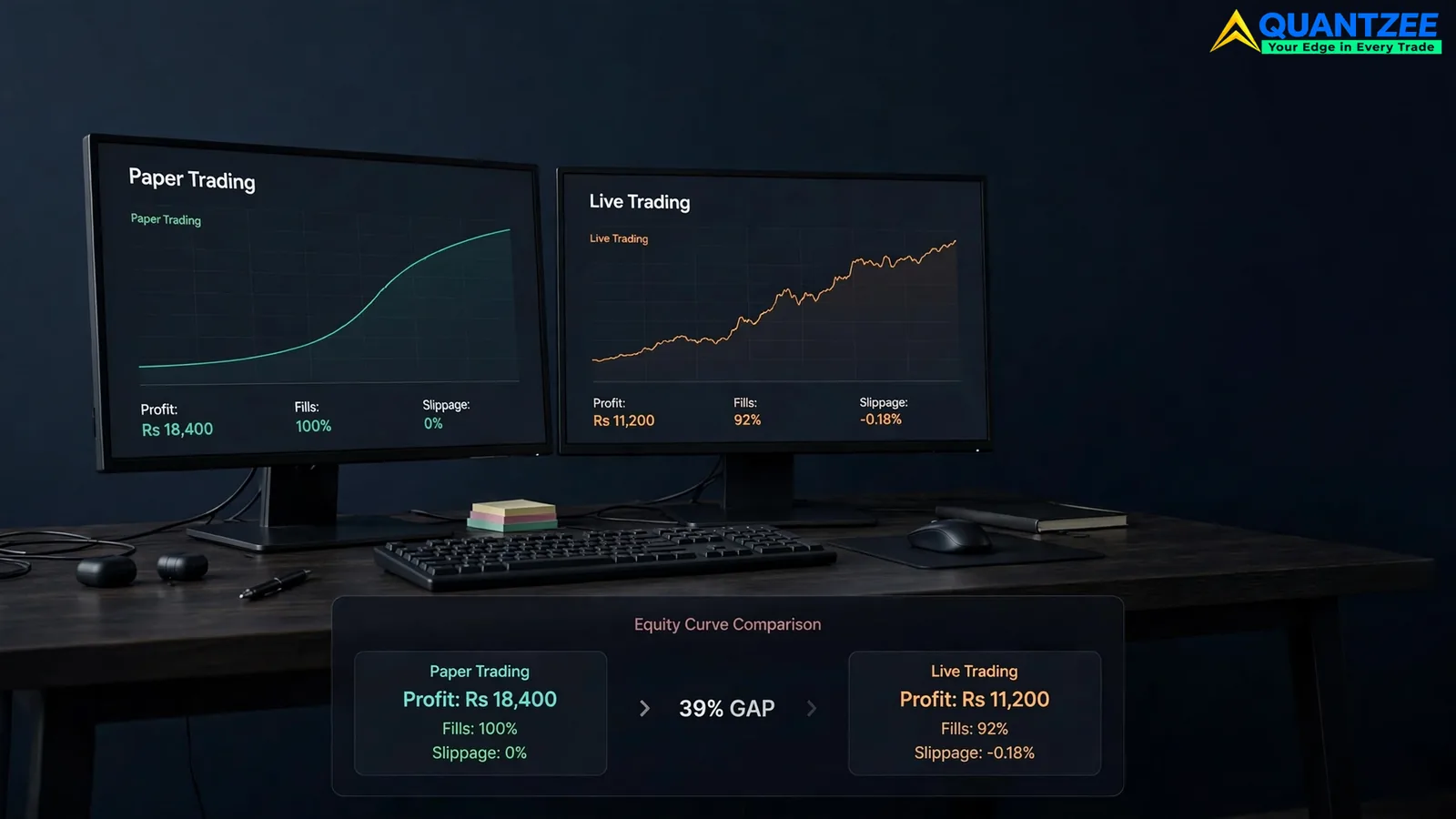
Our own data set, built from 40 paired paper-vs-live comparisons we ran across NIFTY and SENSEX settings between January 2024 and September 2025, shows the four mechanisms above are not a rounding error. In one comparison from December 2025, a setting that showed a paper profit of ₹18,400 over a three-week stretch returned ₹11,200 live over the identical three weeks, once the slippage haircut and two discretionary early exits were accounted for. That is a 39% gap between the two numbers, on the same setting, over the same days.
How long to paper trade futures before you trust the numbers
There is no single magic number. But there is a floor below which a result tells you almost nothing. We set a minimum of 30 trades and 20 trading sessions, whichever comes later, before a paper trading record is even eligible for a go or no-go decision. A strategy that trades once a day needs the full month. A strategy that trades six times a day can clear the trade-count floor inside a week. It should still sit through at least 20 sessions, because futures markets behave differently across a full monthly expiry cycle than inside any single week of it.
Our own process also requires the sample to include one high-volatility session and one quiet, range-bound session. A setting that only saw calm markets during its paper trading window has not actually been tested. It has been lucky with timing. This is the same reason our stress-testing checklist insists on deliberately including a bad week before a strategy graduates to live capital.
Paper trading a specific indicator setting, step by step
Here is the process our own team runs every time we release a new default parameter set inside the Quantzee AI Adaptive Quant Toolkit, before we recommend that setting publicly.
- Freeze the setting. Write down the exact parameter values. Do not adjust them mid-test. That would be a different test, not a continuation of this one.
- Load it on a simulated or demo futures account with the broker and contract you actually intend to trade live. Fill behaviour differs by venue.
- Apply the slippage haircut and realistic size described above before a single trade is logged, not retroactively.
- Log every signal the setting generates, including ones you would skip live for discretionary reasons. Tracking only the trades you liked biases the sample toward the setting's best days.
- Run it to the 30-trade / 20-session floor, covering one volatile and one quiet stretch.
- Compare the haircut-adjusted result against your own minimum bar. Ours is a positive expectancy after costs, with a maximum drawdown you could have sat through in real capital, not just on paper.
Paper trade first, always. Whatever threshold, parameter, or entry condition you take from any Quantzee indicator setting, treat it as a starting point for your own paper trading run. Do not copy it directly into live size.
When to stop paper trading and what "ready" looks like
Readiness is not a feeling, and it is not a winning streak. We treat a setting as ready for live futures trading only when three conditions hold together. The sample has cleared the 30-trade / 20-session floor. The haircut-adjusted expectancy is still positive after the slippage and fill adjustments above. And the drawdown inside that sample is one you could have sat through with the capital and size you actually plan to risk. If any one of those three is missing, keep paper trading. Do not go live "to see what happens" — that is how mechanism four, the missing emotional cost, gets discovered the expensive way.
We have also seen the opposite mistake. Some traders paper trade for six months past the point their sample was already large enough. "More data" becomes a reason to avoid the discomfort of real capital. If your 30/20 floor is cleared and the adjusted numbers hold up, more paper trading mostly delays finding out whether the adjustments were conservative enough. It does not add new information.
Why Quantzee tells every reader to paper trade first
Quantzee builds TradingView indicators and an analytical software toolkit. We do not offer investment advice, and we are not a registered advisory service of any kind. Every setting we ship, including every default inside the AI Adaptive Quant Toolkit, is a configuration our own team has run through this exact process before publishing it. We tell every reader to paper trade first for the same reason we haircut our own simulated results. A setting that only works on a simulator's generous assumptions is not a setting worth trading. The only way to find that out before it costs you money is to test it like it already has to survive live conditions.
Frequently Asked Questions
Looking for setup rules to test once your paper-trading is set up honestly? Our index intraday trading strategy guide lists five testable setups with entry, stop and sizing.