Why "0DTE Meaning" Doesn't Have One Answer
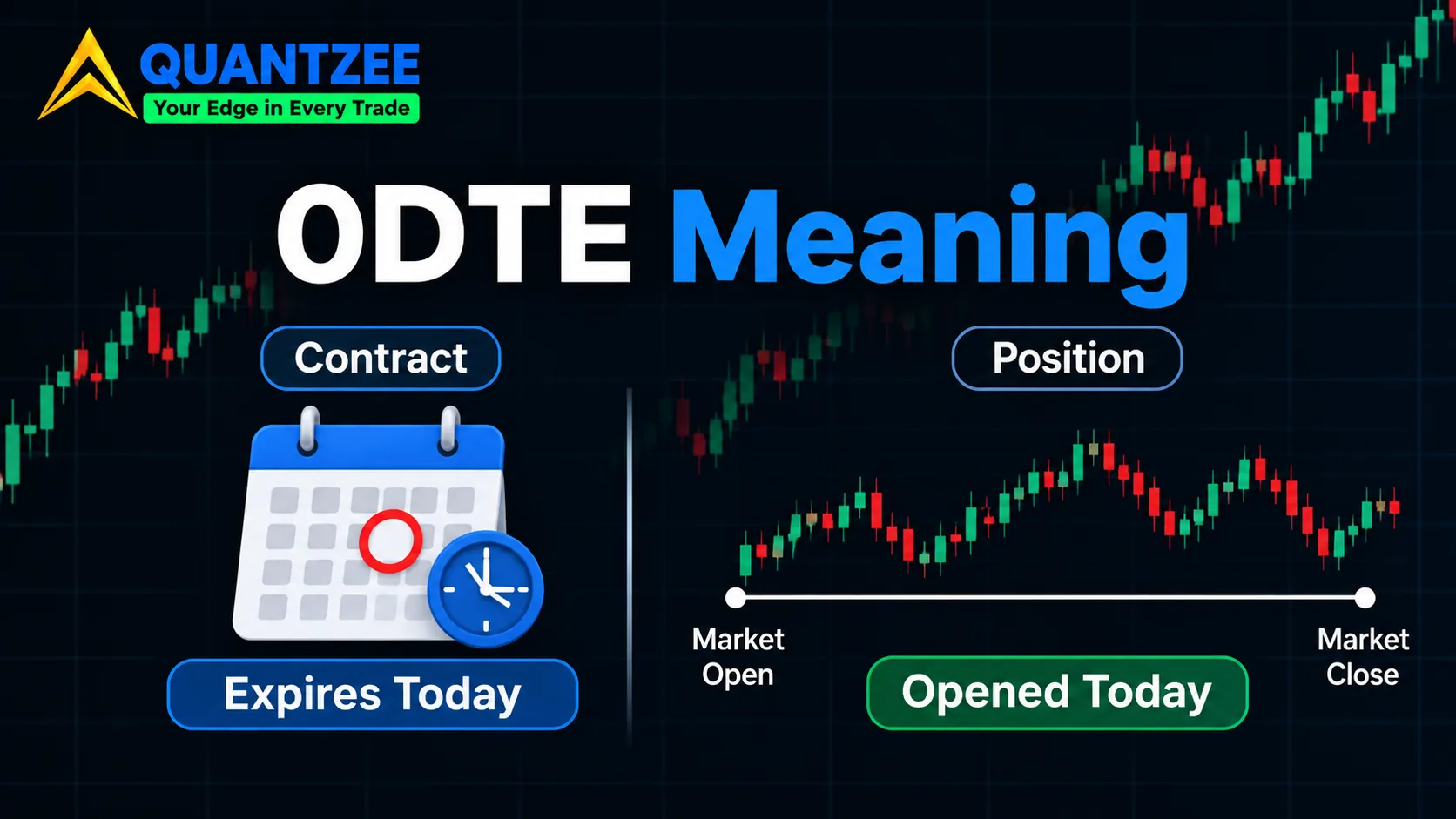
Type "0DTE meaning" into a search bar and you'll get two different answers that most pages never admit are different. Merrill Edge defines it contract-side: a zero-days-to-expiration option is one that "no longer trades after the conclusion of the current trading day." Option Alpha defines it position-side: a 0DTE trade is "an option contract that expires on the same day it is opened." Those sound like paraphrases of the same idea. They aren't. A weekly option bought on a Monday and still sitting in an account on its Friday expiry is a 0DTE option under the first definition the moment Friday starts — and was never a 0DTE trade under the second, because nobody opened it that day.
That mismatch is not a pedantic footnote. Every volume-share statistic quoted in this corner of the internet is counted under the contract-side definition — the one that includes Friday holders of Monday's trade — which is why two sources report two different numbers for the same underlying question and both get cited as current. This piece states which definition each number uses, works through an example where the split actually changes the answer, and then gets to the part that matters for anyone running a signal: what a contract's final hours do to theta, gamma, and delta, and why a signal built for daily or 4-hour bars can't be expressed on a position that won't exist by the next bar.
The Two Definitions, Quoted and Attributed
Per the glossary page at Merrill Edge, "a zero days to expiration option (0DTE) is an option that no longer trades after the conclusion of the current trading day" — a statement about the contract, true for anyone holding it regardless of when they opened it. Option Alpha's framing, in its primer on the term, describes 0DTE as "an option contract that expires on the same day it is opened" — a statement about the trade, true only for same-day round trips. A third source, the trading-education site Bullish Bears, independently lands on the contract-side reading, describing 0DTE as a contract "that will expire later that same day" — a third confirmation that the industry's default usage, when pressed, is contract-side, even though the position-side framing is the one that shows up in most casual explainers.
Neither definition is wrong. They're measuring different populations. The contract-side definition is the one you'd use if you were counting open interest or volume on an exchange's books at the close — you don't know or care when each holder opened. The position-side definition is the one you'd use if you were studying a specific trading style — buy and sell inside one session, never carry overnight risk. The failure in most 0DTE content isn't picking the wrong one. It's picking one, not saying so, and then quoting a statistic that was measured under the other.
A Worked Case Where the Split Changes the Answer
Say a trader buys a SPX weekly put on Monday with a Friday expiry, and still holds it unsold when Friday's session opens. Under the Merrill Edge contract-side definition, that position is a 0DTE option for the entirety of Friday — it no longer trades past the close of that day. Under the Option Alpha position-side definition, it is not a 0DTE trade at any point, because the trader didn't open it the day it expires. Flip it around: a trader who sells an SPX put at 10am on Friday and buys it back at 2pm the same afternoon is 0DTE under both definitions simultaneously, because the contract-side and position-side conditions happen to coincide.
Those two traders could appear in the same end-of-day open interest snapshot, get bucketed together as "0DTE activity," and have nothing in common in terms of risk exposure, holding period, or intent. One is managing gamma risk on a four-day-old position into its final hours. The other opened and closed a trade entirely within the day's volatility. A statistic that says "X percent of volume was 0DTE" is silent on which of those two it's counting, and in practice it's almost always the first kind — contract-side, because that's what exchanges can measure from settlement data without knowing each account's open timestamp.
Why the Volume-Share Numbers Disagree
Two widely cited 0DTE volume figures don't match, and the gap is a direct consequence of the definitional split rather than a data error. Option Alpha, citing Cboe data, reports SPX 0DTE volume above 47% of total SPX option volume. Databento's market-data blog, citing a different Cboe measurement window, reports about 56% of SPX option volume in 0DTE contracts as of early 2025. Neither source explains the gap against the other — each simply states its own number as if it were the current figure.
Both numbers come from Cboe's own published volume-by-DTE data, and both are counted contract-side — they describe open interest and trading volume in contracts expiring that day, not the fraction of traders who opened and closed inside the session. The disagreement is mostly a dating problem: the figures were measured at different points as 0DTE activity grew, and 0DTE share of total SPX volume has been climbing steadily since Cboe expanded daily expirations in 2022, so a 2023 snapshot and a 2025 snapshot will diverge for the ordinary reason that the underlying number moved. Reported alongside those two, a third figure — cited by the trading-education site Bullish Bears from an unnamed investment bank and attributed to 2023 market activity — put notional 0DTE volume on US markets near $1 trillion per day, with no source link and no definition stated, which is exactly the pattern this piece is trying to get readers to stop accepting at face value.
The practical lesson: any 0DTE statistic you read needs a measurement date attached, or it's not comparable to any other 0DTE statistic you've read. "0DTE is X% of volume" without a date is a number from one date pretending to be a constant.
How 0DTE Became a Daily Market
0DTE options are not a new product category — weekly options have existed for over a decade, and any option has a 0DTE day at the end of its life. What changed is frequency. According to Cboe's own 2022 product announcement, SPX Weeklys previously expired only on Mondays, Wednesdays, and Fridays. The SEC's order approving the filing — SR-CBOE-2022-005 — permitted Tuesday-expiring SPXW options effective that April, with Thursday expirations following in May 2022. That single regulatory change is what created a same-day expiry for SPX, SPY, NDX, and QQQ on every weekday rather than three days a week, and it is the structural reason 0DTE activity has a daily rhythm instead of an occasional one.
This matters for anyone evaluating an indicator-driven approach to 0DTE: the market you'd be trading has existed in its current, every-weekday form only since 2022. Statistics, backtests, or strategy claims that reach further back than that aren't describing the market structure that exists today — they're describing a thinner, less liquid, less frequent version of it.
What the Final Session Actually Does to a Position
Theta decay on a multi-week option is a slow, roughly linear drip — a day's time value loss is a small, predictable fraction of the premium. On a contract's final day, that curve steepens sharply as expiration approaches, and the closer the strike sits to the underlying's price, the faster it accelerates. See our glossary entry on theta decay for the shape of that curve across a contract's full life, including why the last hours look nothing like the first weeks.
Gamma rises as a contract nears its strike on expiration day, which means delta — the Greek that tells you how much the option's price moves per point of underlying movement — stops behaving like a stable hedge ratio and starts changing by the minute. A position that was comfortably out-of-the-money at 10am can have its delta double or triple by 2pm on a modest intraday move, simply because there are only a few hours of time value left to cushion the strike. Our options Greeks glossary page walks through how theta, gamma, and delta interact across a contract's life if this is new territory.
Implied volatility behaves differently too. On a normal multi-week option, an IV spike and a price move can offset each other in ways that keep the position's value relatively stable. On a 0DTE contract with hours left to expiry, there's no time premium left to absorb an IV shock — the option's price moves almost entirely with the underlying, not with sentiment about future volatility. Our implied volatility glossary page covers why IV's influence shrinks as time to expiry shrinks.
Why a Daily-Bar Signal Can't Be Expressed on a Contract That Won't Exist Tomorrow
Here is where this stops being a vocabulary problem and becomes a mechanics problem for anyone running TradingView indicators against options. A signal built on daily or 4-hour bars is measuring a holding period of days to weeks — that's the time horizon its math assumes. A 0DTE contract's remaining life, by definition, is hours. If the signal fires and the trader expresses it through a contract that expires before the next bar even prints, the signal's intended holding period and the position's actual holding period have nothing to do with each other.
This is the single most common mismatch we see when traders try to adapt a working swing-trading signal to 0DTE execution: the signal is still correct about direction, but the instrument chosen to express it decays on a completely different clock than the signal was built around. If you're evaluating whether a given indicator setup is even appropriate for same-day expiry contracts, our piece on non-repainting indicators for options traders covers the signal-stability side of that question, and our roundup of TradingView indicators built for options traders is the place to start matching an indicator's intended time horizon to the instrument you plan to trade it on. For the wider question of which chart tools pair with which options-side numbers (IV rank, open interest, put-call ratio), see our guide to indicators for index options trading.
Cash-Settled Index Options vs. Deliverable ETF Options on the Last Day
SPX and NDX options are cash-settled index options: on expiration, there's no underlying shares changing hands, just a cash difference based on where the index settles. SPY and QQQ options are options on an ETF — a deliverable instrument — and that distinction changes what happens if a contract finishes in the money without being closed. Merrill Edge's own risk disclosure pages are, among the sources checked for this piece, the only ranking source that spells this difference out plainly for a retail audience: an in-the-money SPY or QQQ option left open at expiration triggers automatic exercise and assignment of the underlying shares, which can create an overnight position, margin call, or unexpected delivery obligation that a cash-settled index option simply cannot produce.
For a trader running a 0DTE strategy mechanically through an indicator signal, this is not a minor technicality. An index option that isn't closed by the close just expires for cash or worthless. An ETF option that isn't closed can hand you (or take from you) actual shares on Monday morning. Any automation or alert-driven execution plan needs to know which of the two it's touching before the final minutes of the session, not after.
What to Ask of Any 0DTE Statistic You Read
Given how much the numbers move depending on who's counting and when, treat any 0DTE statistic as incomplete until it answers five questions: which definition is it using, contract-side or position-side? Which product — SPX, SPY, NDX, QQQ, or something else? What date range was the data pulled from, and how recent is it? Was trading friction — commissions, bid-ask spread, slippage — modeled, or is it a theoretical gross number? And were flat, no-trade days counted in the denominator, or only active trading sessions?
A number that answers none of those five is a number you can't compare against anything else you've read, including the other numbers in this same article. For context on how seriously regulators treat the risk side of this product, FINRA's own investor guidance on zero-days-to-expiration options trading warns that a 0DTE contract can expire worthless the same day it's opened, and that firms may liquidate an expiring position before the close if intraday margin requirements aren't met — a mechanical risk that has nothing to do with which definition of 0DTE you're using.
Why Quantzee Isn't Publishing a 0DTE Performance Figure Here
It would be easy to close this piece with a win rate or an average-day profit figure for a 0DTE strategy. We're not doing that, for the same reason the five questions above exist. The only internal signal-to-options test on file at Quantzee ran against a non-US index priced in a non-US currency, which makes it the wrong data set for this audience and the wrong data set for the US 0DTE products discussed here — SPX, SPY, NDX, and QQQ trade in dollars against US market structure, and a figure pulled from a different market under different settlement rules isn't a usable stand-in. Our team's working rule across Quantzee's content is that a performance figure without a stated definition, product, date range, friction assumption, and treatment of flat days isn't a figure worth publishing, and that standard applies here the same as anywhere else on the site. That's also our methodology for sourcing this piece: both definitional quotes above were checked against the live Merrill Edge and Option Alpha pages on the write date, not copied from a secondary summary, and the two volume figures are each attributed to the specific source and measurement window that produced them rather than restated as one current number.
What a reader evaluating a 0DTE approach should actually measure, if building or testing one: the holding-period match between the signal and the contract's remaining life, the realized slippage on same-day entries and exits (which tends to run wider than on longer-dated contracts because 0DTE bid-ask spreads widen sharply in the final hour), and whether the strategy's edge survives being tested across both calm and high-volatility sessions rather than just the easy ones.
Frequently Asked Questions
If you are weighing same-day index options against micro futures for an intraday setup, our index intraday trading strategy guide compares the instruments side by side.