Introduction
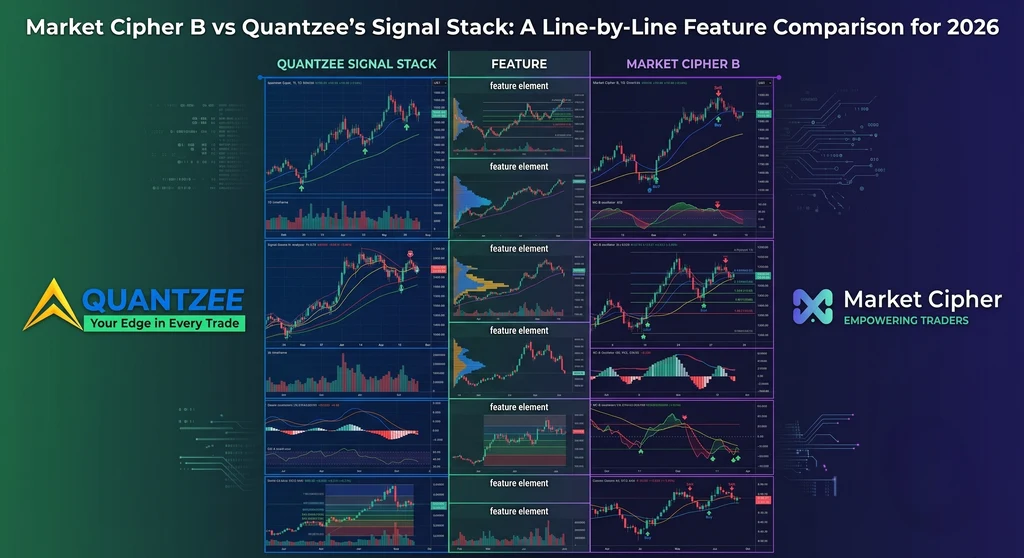
Market Cipher B and Quantzee are both TradingView indicator suites, but Market Cipher B is a wave/momentum divergence tool priced around $600/year, while Quantzee is an AI-adaptive, non-repainting signal suite at $9.99/month — the choice comes down to whether you want divergence visualization or direct, verifiable entry/exit signals at a lower price.
If you’ve spent any time in trading Discord servers or TradingView comment threads, you’ve run into Market Cipher B. It’s one of the longest-running paid indicator suites on TradingView, built around wave/momentum divergence detection, and it has a loyal following that goes back years. It has also earned a reputation — deserved or not — as expensive, opaque about its internal math, and slow to evolve.
Quantzee is a newer entrant: a suite of proprietary, non-repainting TradingView indicators built for traders who want multi-timeframe confluence, transparent alert logic, and a lower price point without giving up signal quality. This is not a hit piece on Market Cipher B — it’s a genuinely useful tool that has helped a lot of traders, and we’ll represent it fairly throughout. But if you’re evaluating both in 2026, you deserve a comparison that goes feature by feature instead of marketing claim by marketing claim.
This article is written for a global trading audience — forex, crypto, commodities, indices, and equities across every timezone and every broker. Nothing here is country-specific or the index-specific; both tools are used by traders worldwide, and the comparison reflects that.
A quick disclosure and disclaimer up front: Quantzee builds and sells the indicator suite discussed in this article, so treat our side of the comparison with the healthy skepticism you’d apply to any vendor writing about a competitor. We’ve tried to source Market Cipher B’s claims from its own TradingView listing and public user discussion rather than from hearsay. And to be unambiguous about positioning: both Market Cipher B and Quantzee are chart-analysis and signal-generation software — technical tools, not investment advice, and not a substitute for your own risk management. Nothing in this article should be read as a recommendation to buy or sell any financial instrument.
What Both Tools Actually Are
Before comparing features, it’s worth being precise about what category these products sit in, because “indicator suite” gets used loosely.
Market Cipher B is a TradingView-based momentum and divergence overlay. Its core is a wave trend oscillator paired with a money-flow-style volume component, plus divergence detection (regular and hidden) and a set of dot/diamond markers meant to flag high-probability reversal zones. It’s sold as a single indicator with several visual layers rather than a family of separate tools.
Quantzee is a suite of 6 individually purchasable, non-repainting TradingView indicators — AI TrendPulse, SuperTrend Pro+, MACD Pro+, SMC Toolkit Pro, the Adaptive AI Oscillation Engine, and the AI Adaptive Quant Toolkit. Each indicator is scoped to do one thing well, and most expose multi-timeframe (MTF) dashboards so a trader can see higher-timeframe context without switching charts.
The structural difference matters for the rest of this comparison: Market Cipher B is one indicator, several signals; Quantzee is several indicators, one philosophy (non-repainting, MTF-aware, alert-ready). Which structure suits you depends on whether you want a single all-in-one overlay or a toolkit you assemble around your own strategy.
Feature-by-Feature Comparison
1. Repainting Behavior
This is the single most-asked question in every Market Cipher B review thread, and for good reason — a signal that repaints (i.e., changes or disappears after the bar closes) is close to useless for live decision-making, because the backtest you see on historical bars is not the signal you’d have actually received in real time.
Market Cipher B’s wave trend and divergence dots are widely reported by users to be stable once a candle closes, but the money-flow layer and some of the “small circle” reversal markers have a documented history of behaving differently on the current, still-forming candle versus the closed candle. This is common with volume-and-momentum composite oscillators — the underlying wave trend math depends on smoothing functions that adjust as new price data arrives within the bar.
Quantzee’s entire suite is engineered as non-repainting by design: every signal, dot, arrow, or shaded zone is confirmed only on bar close and does not redraw historically. This is a deliberate, load-bearing design constraint across all six indicators, not a feature added to one of them. If repaint-proofing is your top priority — and for anyone trading off alerts rather than sitting and watching the chart, it should be — this is the most consequential line item in the whole comparison.
Verdict: Advantage Quantzee, specifically because non-repainting is a suite-wide architectural commitment rather than a per-indicator toggle.
2. Multi-Timeframe (MTF) Confluence
Market Cipher B is fundamentally a single-timeframe tool. You can, of course, open several chart tabs at different timeframes and eyeball the wave trend on each — plenty of experienced users do exactly that — but there is no built-in dashboard that aggregates higher-timeframe bias onto your working chart.
Quantzee’s indicators (SuperTrend Pro+, MACD Pro+, AI TrendPulse, and others) each ship with an on-chart MTF dashboard that pulls signal state from higher timeframes (e.g., 15m/1H/4H/1D) and displays them as a compact panel, so a trader working a 5-minute chart can see 1-hour and daily trend alignment without leaving the chart. For traders who build strategies around timeframe confluence — a very common and well-documented approach to filtering false signals — this is a meaningfully different level of built-in tooling.
Verdict: Advantage Quantzee for built-in MTF visibility; Market Cipher B users can replicate a version of this manually with multiple chart layouts, but it’s manual work, not a feature.
3. Divergence Detection
This is Market Cipher B’s signature strength, and it deserves credit here. Its regular and hidden divergence detection on the wave trend oscillator is mature, well-tested by a large user base over multiple market cycles, and the “money flow” cross-reference (checking momentum divergence against a volume-weighted flow reading) is a genuinely useful confirmation layer that not every divergence tool offers.
Quantzee’s divergence-style detection lives primarily inside MACD Pro+ (pivot-based divergence engine) and the Adaptive AI Oscillation Engine, and both are non-repainting on divergence markers specifically — which is worth noting because divergence markers are exactly the kind of signal that’s prone to repainting in oscillator-based tools, since a “divergence” only becomes final once both pivot points are confirmed.
Verdict: Close, with a slight edge to Market Cipher B on sheer maturity of the divergence engine and community-tested track record, and a slight edge to Quantzee on repaint integrity of the divergence markers themselves. If divergence trading is your core strategy, test both on your own instrument and timeframe before committing.
4. Trend and Volatility Tools (SuperTrend, MACD, SMC)
This is where the comparison stops being close, because Market Cipher B doesn’t compete in this category at all — it’s a momentum/divergence tool, full stop. Quantzee’s suite includes dedicated, non-repainting versions of the trading world’s most-used trend and volatility tools: SuperTrend Pro+ (dual confluence + TP/SL ladder), MACD Pro+ (adaptive chop zone + normalized mode + divergence engine), and SMC Toolkit Pro (order blocks, fair value gaps, liquidity sweeps).
If your strategy is divergence-only, this category doesn’t move the needle for you. But most traders build strategies that combine a momentum/reversal read with a trend or volatility filter — for example, only taking a Market Cipher B divergence signal when price is above/below a key moving average, or only taking a mean-reversion signal when SuperTrend confirms the broader trend. Market Cipher B users typically have to source these filter tools from TradingView’s free public library (quality varies enormously) or buy them separately from other vendors. Quantzee bundles a coherent, non-repainting set of these tools under one suite with consistent visual language and MTF logic.
Verdict: Advantage Quantzee by category — this is a comparison of scope, not head-to-head quality on a shared feature.
5. Alerts and Automation Readiness
Both tools support TradingView’s native alert system, which is table stakes in 2026. The differentiator is signal stability feeding into those alerts. An alert built on a repainting signal can fire, then the underlying condition can invalidate itself moments later on the same bar — a frustrating and potentially costly experience if you’re using alerts to trigger manual or semi-automated execution (e.g., via a webhook to a broker or bot).
Because Quantzee’s signals are non-repainting by design, alerts fire once, on bar close, and don’t retract. Market Cipher B’s alert reliability depends on which specific signal you’ve wired the alert to — wave trend cross alerts are generally considered stable by the user base; alerts on some of the divergence/reversal dot markers have more mixed reports, consistent with the repaint discussion above.
Verdict: Advantage Quantzee on alert reliability, directly downstream of the non-repainting architecture.
6. Pricing and Licensing Model
Market Cipher B has historically been sold as a higher-ticket, often lifetime-access product, with pricing that has fluctuated but has generally sat in the premium tier of the TradingView indicator market — reflecting its brand recognition and long track record. Exact current pricing should always be verified on Market Cipher B’s own listing, since vendor pricing changes.
Quantzee is positioned as a lower-cost, modular alternative: indicators can be purchased individually or as part of a bundle, which suits traders who only want (say) a non-repainting VWAP and SuperTrend rather than paying for a large all-in-one suite they’ll only use part of. For traders comparing total cost of ownership across a full toolkit — divergence + trend + volatility + MTF dashboards — Quantzee’s modular pricing tends to come out meaningfully lower than buying Market Cipher B plus separate trend/volatility tools from other vendors to fill the gaps.
Verdict: Advantage Quantzee on cost efficiency for traders who need a full toolkit rather than a single oscillator; Market Cipher B may still be the cheaper single-purchase option if divergence is genuinely the only tool you need.
7. Platform and Market Coverage
Both are TradingView-native (Pine Script-based), which means both work on any market or instrument TradingView supports: forex pairs, crypto (spot and perpetuals across major exchanges), commodities like gold and oil, global indices, and equities on any listed exchange, in any timezone. Neither tool is restricted to a single geography or asset class — this is a global-market comparison, not a regional one. Quantzee’s own positioning explicitly frames its suite as multi-market: the same non-repainting logic and MTF dashboards apply whether you’re trading EUR/USD in London hours, BTC/USDT around the clock, or an S&P 500 futures contract.
8. Documentation and Transparency
Market Cipher B, like many long-standing paid TradingView tools, keeps much of its internal calculation methodology proprietary — which is standard practice in this market but does mean users are trusting the track record rather than auditing the formula. Quantzee publishes a documentation page per indicator describing the calculation approach, anchor modes, and signal logic at a level of detail intended to let a trader understand why a signal fired, not just that it fired. Neither approach is wrong, but if transparency into signal logic matters to your due diligence process, it’s a real difference.
Side-by-Side Summary Table
| Category | Market Cipher B | Quantzee |
|---|---|---|
| Repainting | Wave trend generally stable; some money-flow/reversal markers reported unstable pre-close | Non-repainting by design, suite-wide |
| Multi-timeframe dashboard | Not built in (manual multi-chart workaround) | Built-in MTF dashboard on most indicators |
| Divergence detection | Mature, well-tested core strength | Present (MACD Pro+, Adaptive AI Oscillation Engine), repaint-safe |
| Trend/volatility tools (SuperTrend, VWAP, BB, EMA, MACD) | Not offered | Full dedicated suite |
| Alert reliability | Generally stable on wave trend; mixed on some dot markers | Stable — alerts fire post-close, non-retracting |
| Pricing model | Single premium-tier product | Modular, buy-what-you-need |
| Platform coverage | TradingView, all global markets | TradingView, all global markets |
| Documentation | Proprietary, track-record-based trust | Published per-indicator methodology docs |
Which One Should You Actually Use?
Feature comparisons are useful, but the honest answer depends on your strategy:
- If your entire edge is wave-trend divergence trading and you don’t need trend/volatility filters or MTF dashboards, Market Cipher B’s maturity and community track record are real assets — it’s a focused tool that does one job it’s known for.
- If you’re building a strategy that combines multiple signal types (trend + volatility + momentum) and you care about non-repainting integrity for alert-driven or semi-automated execution, Quantzee’s suite structure is built for exactly that use case, and the modular pricing means you’re not paying for tools you won’t use.
- Many traders in 2026 run both — using Market Cipher B’s divergence read as one input and Quantzee’s non-repainting SuperTrend or VWAP as a trend/mean-reversion filter on the same chart. There’s no rule that says you have to pick one vendor.
Whatever you choose, the single most important step — and this applies regardless of which indicator suite you use — is to backtest and forward-test on your own instrument and timeframe before trading live. Vendor marketing (including this article) is not a substitute for your own verification process. See our guide on how to backtest a TradingView indicator for a walkthrough of that process, and our piece on why backtest results don’t always match live trading for the pitfalls to watch for.
Related Reading
- Market Cipher Review 2026: Is It Worth $600/Year?
- Market Cipher Review
- Non-Repainting TradingView Indicators, Explained
- How to Test a TradingView Indicator for Repainting
- Best TradingView Indicators 2026
- Quantzee SuperTrend Pro+
- Quantzee MACD Pro+
- Quantzee indicator suite
External references: TradingView’s own Pine Script documentation on repainting is the authoritative technical source on why indicators can repaint, and is worth reading regardless of which vendor’s tools you use.
Quantzee builds non-repainting, multi-timeframe TradingView indicators for global traders across forex, crypto, commodities, indices, and equities. This article is for educational and comparison purposes only and does not constitute investment advice.