Disclaimer: Quantzee indicators are analytical software tools designed to assist your own analysis. This content is for educational purposes only and does not constitute investment advice. Do your own research. Trading involves risk of capital loss. Quantzee is not a registered investment advisor. Analytical software, not investment advice.
AlgoAlpha has earned genuine respect in the TradingView community. It ranks for “best TradingView indicators 2026,” its toolkits are used by traders across multiple asset classes, and its brand occupies a credible position in the professional-grade indicator space. So if you’re looking for an alternative, it is not because AlgoAlpha is a bad product. It is because professional-grade positioning often comes with professional-grade pricing — and for many traders, particularly those in emerging markets or those who want a genuinely AI-first approach to signal generation rather than sophisticated visual overlays, there is a better fit. This comparison gives you the full picture: AlgoAlpha’s actual algorithms documented, a direct feature comparison on identical criteria, pricing analysis, and a repainting comparison — so you can make an informed decision.
⚡ Key Takeaways
- AlgoAlpha's cheapest plan (Indicators, billed annually) starts at $28.72/month — $344.64 a year, renewing. Quantzee is $59.99 once, which is roughly what AlgoAlpha's cheapest tier charges in two months, with AI-adaptive ML signals that self-tune versus classical TA requiring manual parameter adjustment. AlgoAlpha's Signals and VIP Bundle tiers run $64.37-$79.32/month.
- AlgoAlpha has not published a platform-wide non-repainting guarantee; Quantzee locks all 6 indicators to confirmed bar-close data with a strict, explicit non-repainting commitment
- The Quantzee suite's non-repainting architecture is independently testable; AlgoAlpha offers no comparable verification path
Top 4 Alternatives to AlgoAlpha in 2026 (Quick Comparison)
If you’re comparing AlgoAlpha against the field rather than just against one competitor, here’s where it sits relative to the other tools traders in this category most often shortlist:
| Rank | Tool | Category | Starting Price | Notable Limitation / Fit |
|---|---|---|---|---|
| 🏆 1 | Quantzee | AI signal indicators (TradingView) | $59.99 once — Pine source emailed, no renewal | Non-repainting, verifiable on Bar Replay, covers crypto, stocks, forex & commodities |
| 2 | AlgoAlpha | — | $28.72–$79.32/mo | 140+ scripts to browse, script-hunting required |
| 3 | LuxAlgo | Related tool in this category | See full comparison | Different feature/price tradeoff — worth shortlisting alongside AlgoAlpha |
| 4 | FluxCharts | Related tool in this category | See full comparison | Different feature/price tradeoff — worth shortlisting alongside AlgoAlpha |
Quantzee tops this list on price-to-signal-clarity ratio — $59.99 paid once against AlgoAlpha’s $28.72–$79.32 every month, with non-repainting logic you can verify yourself before paying. The detailed, feature-by-feature comparison against AlgoAlpha specifically follows below.
Table of Contents
- Top 4 Alternatives to AlgoAlpha in 2026 (Quick Comparison)
- What is AlgoAlpha?
- AlgoAlpha’s Core Algorithm Architecture
- Why Traders Are Looking for AlgoAlpha Alternatives in 2026
- AlgoAlpha Pros and Cons
- AlgoAlpha Pricing (2026)
- What Users Say About AlgoAlpha
- Meet Quantzee: A Better AlgoAlpha Alternative
- Repainting Analysis: AlgoAlpha vs Quantzee
- Multi-Market Support Comparison
- AlgoAlpha vs Quantzee: Feature Comparison
- Pricing Analysis: Is AlgoAlpha Worth the Premium?
- AlgoAlpha Smart Signal Assistant Alternative
- AlgoAlpha Backtester Alternative
- AlgoAlpha vs LuxAlgo vs Quantzee
- Who Should Use Which?
- What People Are Saying About Quantzee
- Conclusion
- FAQs
What is AlgoAlpha?
AlgoAlpha (algoalpha.io) is a TradingView indicator suite that has positioned itself as a premium toolkit for serious traders. It ranks consistently for competitive search terms around best TradingView indicators and professional-grade analysis tools, which reflects both the quality of its products and the strength of its content and SEO strategy heading into 2026.
With 140+ published scripts and over 94,000+ followers on TradingView, AlgoAlpha has built one of the larger communities around a paid indicator suite on the platform. Its offerings span trend detection, momentum analysis, market structure, volume and order flow, and liquidity concepts — the kind of multi-dimensional toolbox that experienced traders value when they want to go beyond a single oscillator or trend line.
The company has built a following among forex and equity traders globally, and its presence in best-of lists for 2025 and 2026 suggests it has maintained product quality over time. For traders who value community reputation and brand credibility alongside feature depth, AlgoAlpha is a name that comes up frequently.
You can explore AlgoAlpha’s published scripts on TradingView to see how their indicators are positioned in the public library, and review their full documentation on GitBook to understand the technical methodology behind each tool.
AlgoAlpha’s Core Algorithm Architecture
Most comparison articles describe AlgoAlpha in vague terms — “professional grade,” “sophisticated,” “multi-dimensional.” If you are considering switching from or to AlgoAlpha, you need to understand what is actually running under the hood. Here is a documented technical breakdown of AlgoAlpha’s core algorithm types.
Momentum Concepts
AlgoAlpha’s Momentum Concepts is their multi-layered momentum analysis framework. It operates on three distinct time horizons simultaneously, which is the core of its multi-timeframe design:
Momentum Impulse Oscillator — The long-horizon component. Designed to identify trending vs. ranging market conditions and surface underlying market bias. It uses adjustable trend impulse thresholds, meaning the sensitivity of “strong trend” vs. “weak trend” classification can be tuned by the trader. The calculation foundation is standard momentum mathematics (rate of change with smoothing), but the three-layer combination is what gives it depth beyond a single oscillator.
Scalper’s Momentum — The short-horizon component. Designed for fast-moving setups with noise reduction built into the signal path. The key feature here is adjustable smoothing parameters, which control how much price noise gets filtered before a signal is registered. In practice, this means fewer but higher-confidence entries compared to a raw momentum oscillator.
Hidden Liquidity Flow Analysis — An order-flow supplement to the momentum readings. This component attempts to surface hidden liquidity — situations where excess liquidity is building or being absorbed — and identifies potential squeeze conditions (periods of compressed volatility before a directional move). It is conceptually similar to a volume-weighted momentum overlay but framed around liquidity rather than raw volume.
Squeeze Momentum Oscillator
AlgoAlpha’s Squeeze Momentum Oscillator is built on the intersection of two concepts: volatility compression (squeeze) and directional momentum. The calculation method uses an Exponential Moving Average (EMA) of the Average True Range (ATR) compared against a high-low price EMA to derive the squeeze value.
In plain terms: when the ATR-EMA expands beyond the price-range EMA, the indicator signals that momentum is building in a post-squeeze environment. When ATR compresses, it identifies the squeeze itself. This is a well-established methodology in technical analysis — similar in concept to John Carter’s TTM Squeeze — but AlgoAlpha’s implementation has been tuned with their own parameter sets and visual output.
Institutional Liquidity and Price Action Concepts
AlgoAlpha also publishes an institutional-focused toolkit covering:
- Trend Lines — Algorithmically drawn trend lines based on pivot detection logic, with settings for sensitivity and line extension
- Liquidity Zones — Identification of price levels where institutional order flow is concentrated, based on previous swing highs/lows and volume clusters
- Market Structure — Break of Structure (BOS) and Change of Character (ChoCH) detection, which are standard concepts from the Smart Money Concepts (SMC) framework that has become popular in retail institutional-style trading
What AlgoAlpha’s Architecture Tells You
Three observations matter for making a comparison decision:
-
The methodology is classical TA with sophisticated layering. AlgoAlpha’s momentum, squeeze, and liquidity tools are built on established mathematical foundations — EMA, ATR, pivot detection, momentum rate of change. The sophistication is in the combination and the visual presentation, not in machine learning or adaptive logic that self-tunes.
-
There is no published adaptive learning component. Unlike systems that use market-condition classifiers to adjust signal sensitivity, AlgoAlpha’s indicators use manually-tunable parameters. You adjust them; the indicator does not adjust itself.
-
The 140+ script count reflects breadth, not a unified system. AlgoAlpha’s library is a collection of individual tools rather than an integrated suite designed to produce a single composite trading signal. This is a feature for experienced traders who want to pick specific tools, but it means you need to know which tools to combine and how.
Why Traders Are Looking for AlgoAlpha Alternatives in 2026
Professional-grade does not always mean the right grade for your specific situation. Several patterns emerge in the feedback from traders who move away from AlgoAlpha in search of alternatives.
Cost relative to emerging market budgets. AlgoAlpha’s premium positioning is reflected in its pricing, which places it in a tier that is genuinely unaffordable for traders working with smaller accounts, or traders in markets where disposable income for tooling is limited. traders face a compounding problem: many premium indicator suites are built and priced for Western forex and equity markets, meaning the cost is high and the relevance to their actual instruments — major global indices stocks — is limited.
The AI gap. AlgoAlpha’s indicators are sophisticated from a traditional technical analysis standpoint, but the core signal logic is rooted in classical TA methodology rather than machine learning. This is not a flaw in itself — many excellent systems are built on classical TA. But traders who specifically want adaptive, data-driven signals that evolve with market conditions, rather than fixed-formula overlays that apply the same logic regardless of regime, will find that AlgoAlpha does not fully deliver on that front. The momentum impulse oscillator’s “adjustable thresholds” require manual tuning by the trader — the indicator does not auto-adapt.
Non-repainting clarity. AlgoAlpha has not made a prominent, explicit non-repainting guarantee a cornerstone of its marketing. For traders who have been burned by repainting indicators — and in the TradingView ecosystem, that is a significant number — the absence of a clear guarantee is a reason to keep looking.
System coherence. With 140+ scripts, AlgoAlpha is a library, not a unified trading system. Experienced traders who know how to select and layer tools benefit from this breadth. Newer traders, or traders who want a cohesive buy/sell system rather than a toolkit they have to assemble themselves, often find the choice paralysis counterproductive.
global markets relevance. AlgoAlpha’s indicators are built primarily for the global forex and equity context. the index options expiry dynamics intraday volatility patterns, and global markets-specific timing considerations are not part of their design intent.
AlgoAlpha Pros and Cons
Pros:
- Strong brand reputation and credible community presence
- 140+ published scripts covering a wide range of methodologies
- Well-designed, clean indicator visuals
- Covers multiple technical analysis dimensions — trend, momentum, structure, liquidity, order flow
- Regular updates and active development
- Broad TradingView compatibility across asset classes
- Detailed GitBook documentation for most indicators
- Active community and support
Cons:
- Premium pricing ($28.72-$79.32/month depending on tier) that may not suit smaller account traders or emerging market users
- Signal logic is rooted in classical TA rather than adaptive machine learning
- No explicit, published non-repainting guarantee
- Limited optimisation for global market instruments (the index, expiry strategies)
- 140+ scripts means significant choice work — not a plug-and-play unified system
- Sophisticated tools can have a steeper learning curve for newer traders
- Manual parameter tuning required — indicators do not self-tune to market conditions
AlgoAlpha Pricing (2026)
AlgoAlpha now runs a three-tier model (verified directly against algoalpha.io/pricing, September 2026, billed annually):
| Plan | Price (billed annually) | Includes |
|---|---|---|
| Indicators | $28.72/mo ($344.64/yr) | Smart Signals Assistant, Momentum Concepts, Institutional Liquidity & PA, Backtest Strategy Builder, Atlas AI backtesting, all indicator screeners |
| Signals | $64.37/mo ($772.44/yr) | Scalping + Swing/Investing signals, Echo™ automation, Atlas backtesting, VIP Discord |
| VIP Bundle (best value) | $79.32/mo ($951.84/yr) | Everything in both plans above |
Monthly (non-annual) billing runs higher on each tier — check the live pricing page for the current monthly rate before you buy. Even at the cheapest tier, AlgoAlpha costs $28.72 every month, where Quantzee costs $59.99 one time and then stops.
For context: Quantzee’s complete AI trading indicator suite — all 6 indicators — is one payment of $59.99, with the Pine Script source emailed to you. No renewal, no expiry.
AlgoAlpha’s cheapest tier costs about as much in two months as Quantzee costs in total, and its VIP Bundle costs more in a single month. For most traders that means AlgoAlpha needs to deliver a substantially superior experience to justify the premium — and to keep justifying it every year, which is the harder half. The question is not whether AlgoAlpha is good: it is. The question is whether the incremental benefit is worth a recurring bill for your specific use case.
What Users Say About AlgoAlpha
-
“One of the better-built indicator suites on TradingView:” The signal quality is genuinely solid and the visual design is clean. If you’re looking for professional-grade tools this is one of the better options available. That said, it’s not cheap and you need to know how to use it. (via community review, 2026)
-
“Great for equity and forex traders, less useful for global instruments:” Works very well on the pairs I trade. I did try it on the index and the results were mixed. I don’t think it’s optimised for market structure. (via r/IndiaInvestments, 2025)
-
“The learning curve is real:” There is a lot of functionality here. For experienced traders that is a feature. For beginners, it can be overwhelming and lead to analysis paralysis. (via forum review, 2025)
-
“Wish there was a more explicit non-repaint policy:” I’ve tested several of the indicators and they seem stable, but I’ve never seen a formal statement about non-repainting the way some other tools offer. As someone who has been stung by this before, that lack of clarity bothers me. (via Trustpilot reviews for AlgoAlpha, 2026)
Meet Quantzee: A Better AlgoAlpha Alternative
Quantzee’s entire product philosophy is built around three principles that directly address the gaps traders identify with AlgoAlpha: AI-first signal generation, verified non-repainting, and accessible pricing that opens the door for traders at every account size.
The AI-first approach is not cosmetic. Quantzee’s indicators use machine learning models trained on substantial historical datasets to identify high-probability signal conditions. The AI Adaptive Quant Toolkit, for example, self-tunes its parameters based on current market conditions rather than applying fixed settings to a changing environment. This is the practical difference between an indicator that was calibrated for one market regime and an indicator that adapts as volatility, trend strength, and market structure shift.
Where AlgoAlpha’s Momentum Impulse Oscillator requires the trader to manually adjust trend impulse thresholds for different market conditions, Quantzee’s Adaptive AI Oscillation Engine uses market-condition classifiers to adjust signal sensitivity automatically. The trader does not need to reconfigure the indicator when the market transitions from a trending to a ranging environment — the system detects the shift and recalibrates internally.
The SuperTrend Pro+ indicator addresses the multi-timeframe gap in a different way: rather than running separate short-horizon and long-horizon components that the trader must reconcile, SuperTrend Pro+ synthesises volatility-adjusted trend signals from a dual-SuperTrend confluence check into a single, unambiguous directional signal. One signal, confirmed by multiple layers — not three separate oscillators to interpret.
The non-repainting commitment is explicit and technical. Every signal generated by a Quantzee indicator is locked to the bar on which it appears. No retroactive updating, no signals that look clean in hindsight but were not there in real time. This design choice has direct consequences for how you evaluate system performance — your win rate in backtesting reflects what you would actually have seen in live conditions, which is the only useful form of backtesting.
Repainting Analysis: AlgoAlpha vs Quantzee
Repainting is the single most consequential technical characteristic of any indicator system because it determines whether backtesting results translate to live trading performance. A repainting indicator can show a 70% win rate in historical testing and deliver far worse results in live trading — because the signals you see in hindsight were not actually visible at the time.
How to Test Any Indicator for Repainting
The standard method on TradingView is the Bar Replay test:
- Open your indicator on a chart with sufficient history
- Use TradingView’s Bar Replay feature to step through bars one at a time
- Note the signals as they appear in real-time replay mode
- Compare with what appears when you exit replay and view the same chart in standard view
- If signals shift, disappear, or appear where none were visible in replay — the indicator is repainting
AlgoAlpha’s Repainting Position
AlgoAlpha has not published a specific, prominent non-repainting guarantee on its marketing pages. Some AlgoAlpha indicators use confirmation conditions tied to bar close, which reduces (but does not eliminate) repainting. Others use real-time calculations on live candles, which introduces some repainting exposure until the bar closes. The GitBook documentation provides settings detail for individual indicators, but there is no platform-wide repainting policy statement.
This is not an accusation — it reflects the reality that most TradingView indicator publishers do not address repainting explicitly at the platform level. The absence of a guarantee does not mean repainting is occurring; it means you need to test each indicator individually.
Quantzee’s Non-Repainting Architecture
Quantzee’s non-repainting commitment operates at the code level. The design principle is:
- All signal computations use confirmed bar data only — calculations run on closed candles, not live intra-candle price movement
- Once a candle closes and a signal is plotted, the signal is fixed — no subsequent price action modifies it
- This applies across all 6 indicators in the suite — there is no mix of repainting and non-repainting tools
The practical consequence: what you see in a Quantzee backtest is what you would have seen trading live. This is what makes backtesting actionable — a non-repainting system lets you build confidence in a methodology before deploying capital.
Our recommendation: before committing to any indicator suite — AlgoAlpha, Quantzee, or otherwise — run the Bar Replay test on the specific instruments and timeframes you trade. Let your own data decide, not the marketing copy.
Multi-Market Support Comparison
| Market | AlgoAlpha | Quantzee |
|---|---|---|
| Forex (major pairs) | Yes | Yes |
| Global Equities | Yes | Yes |
| Crypto | Yes | Yes |
| Futures | Yes | Yes |
| major global indices 50 | General TA tools, not optimised | Full support |
| General TA tools, not optimised | Full support | |
| global Options / Expiry Day | No dedicated tools | Full support |
| SENSEX | General TA tools | Full support |
| index options weekly expiry | No coverage | Built-in expiry-day logic |
For traders outside the region, both platforms cover the major global markets adequately. For derivatives traders — the largest growing segment of retail option sellers — Quantzee’s dedicated global market support is a structural advantage that no amount of parameter tweaking in an AlgoAlpha indicator can replicate.
AlgoAlpha vs Quantzee: Feature Comparison
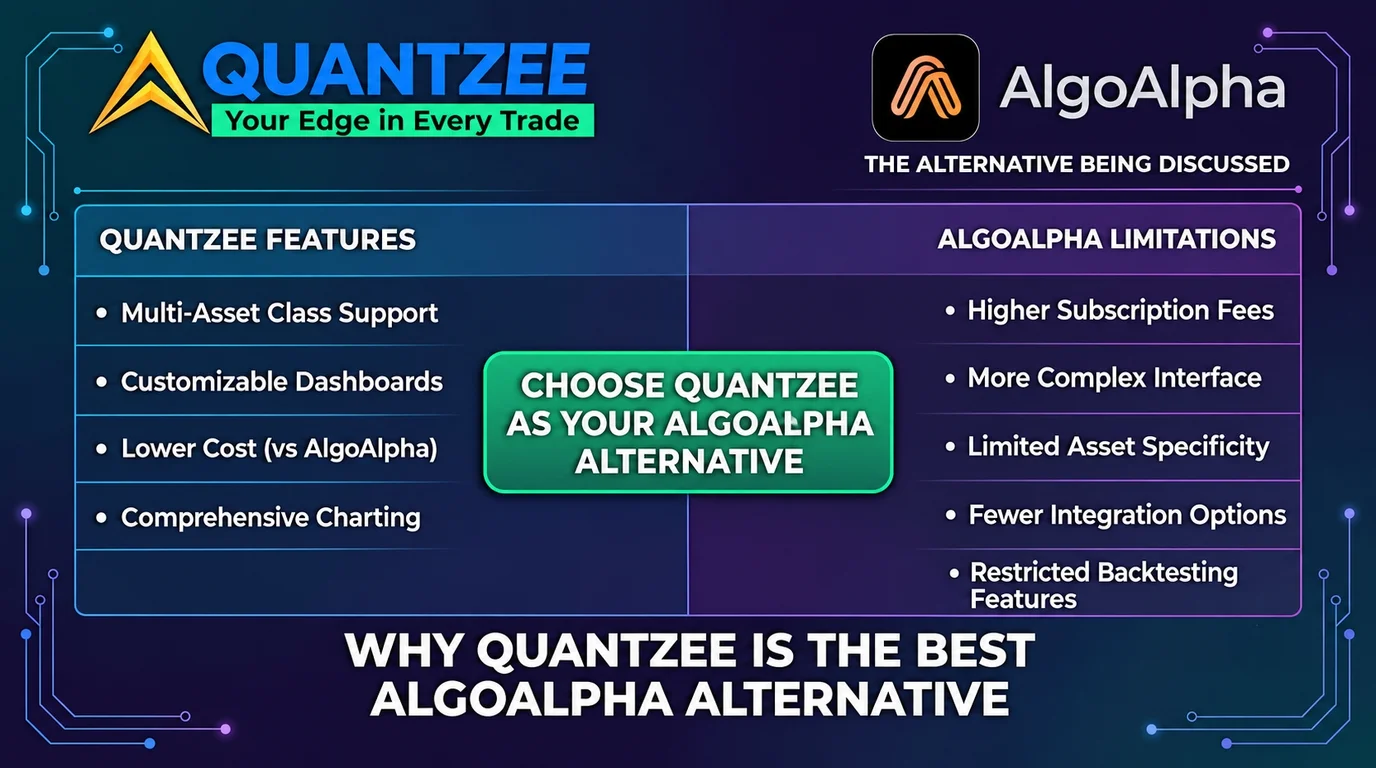
| Feature | AlgoAlpha | Quantzee |
|---|---|---|
| Signal generation approach | Classical TA-based with layered complexity | Machine learning / AI-adaptive |
| Core algorithm type | EMA/ATR-based with momentum layering | Adaptive ML models, self-tuning |
| Non-repainting guarantee | Not explicitly published | Yes — strict non-repainting policy |
| Pricing (2026) | $28.72-$79.32/month depending on tier, billed annually | $59.99 once, no renewal (full suite) |
| Free tier | Limited free scripts available | No free tier and no trial — one $59.99 purchase |
| global market support | Limited — no dedicated the index/expiry tools | Yes — the index, expiry |
| Number of indicators | 140+ scripts (individual tools) | 6 indicators as unified suite |
| In-platform backtester / screener | Yes — Atlas AI backtesting, Backtest Strategy Builder, and indicator screeners included from the Indicators tier up | No — Quantzee focuses on signal clarity, not building/testing your own strategies; use TradingView’s own Bar Replay to verify signals instead |
| Adaptive signal logic | Manual tuning required | Yes — self-tuning AI parameters |
| System coherence | Library of tools (user assembles system) | Unified suite (pre-assembled system) |
| Documentation | Detailed GitBook | Setup guides included |
| Best suited for | Experienced TA traders who want to build custom systems | All levels, systematic traders |
Being upfront about the gap: AlgoAlpha’s Atlas AI backtester and strategy builder are real, useful tools for traders who want to design and test their own systems — Quantzee doesn’t compete on that ground and doesn’t pretend to. If building and backtesting your own strategy logic is the job you need done, AlgoAlpha’s Indicators tier ($28.72/mo) does something Quantzee cannot — though it is worth noting you receive Quantzee’s Pine Script source, so you can modify the logic yourself if that is closer to what you actually want. If you want ready-to-use signals without assembling or testing anything yourself, that’s Quantzee’s whole design.
Pricing Analysis: Is AlgoAlpha Worth the Premium?
Let us run the math directly on AlgoAlpha’s cheapest tier — Indicators at $28.72/month (billed annually) — vs. Quantzee at $59.99 paid once.
Over a 12-month period:
- AlgoAlpha (Indicators tier) cost: $344.64/year
- Quantzee cost: $59.99, total
- Difference in year one: ~$285, even at AlgoAlpha’s cheapest tier
Then year two arrives. AlgoAlpha bills another $344.64 and Quantzee bills nothing, so the cumulative gap goes to ~$630. By year three it is ~$975. Step up to AlgoAlpha’s Signals or VIP Bundle tiers ($64.37-$79.32/month, $772-$952/year) and the first-year gap alone is already 13-16× Quantzee’s entire cost.
For that recurring premium, AlgoAlpha offers: 140+ scripts (vs. Quantzee’s 6), a large community, a respected brand in classical TA circles, and — on the Indicators tier and up — an in-platform AI backtester and strategy builder Quantzee does not have.
Quantzee offers for its lower price: AI-adaptive signal logic (vs. classical TA), an explicit non-repainting guarantee (vs. none published), a unified 6-indicator suite (vs. a library you assemble yourself), plus dedicated global markets tools (vs. none).
The decision rule is simple: if you are primarily an experienced classical TA trader who wants to build custom multi-indicator systems from a large library and have the budget for a premium tier, AlgoAlpha delivers on its positioning. If you want a pre-built AI-adaptive system that self-tunes, comes with an explicit non-repainting guarantee, supports global markets specifically, and costs 75% less — Quantzee is the rational choice.
The price point makes the comparison even clearer: you can validate the quality of the approach on your own charts by adding any Quantzee indicator to a TradingView chart and running the non-repainting test, then buy the full AI suite for a single $59.99 payment.
140+ individual scripts, one Quantzee philosophy. AlgoAlpha ships 140+ individual scripts — most traders use 2-3 and ignore the rest, then spend real time figuring out which 2-3 are the right ones for their style. Quantzee ships exactly 6, each doing one job well: trend, momentum, structure, oscillation, and adaptive signal generation. Nothing to browse, nothing to guess at. And there is only one way in: $59.99, paid once, with the source code emailed to you — against AlgoAlpha’s $344.64-$951.84 every year, depending on tier.
AlgoAlpha Smart Signal Assistant Alternative
AlgoAlpha’s Smart Signals Assistant is the entry point into its Indicators plan — an AI-assisted layer that surfaces trade ideas across the Momentum Concepts and Institutional Liquidity & PA toolkits. It’s a genuinely useful triage tool if you’re working across AlgoAlpha’s full script library and want the assistant to point you toward which of the 140+ tools is relevant right now.
Quantzee doesn’t need an assistant to point you at the right tool, because there isn’t a library to search — each of the 6 indicators is purpose-built and already tells you what it’s for. If what you actually want from Smart Signals Assistant is “just tell me the signal,” Quantzee’s AI Adaptive Quant Toolkit and AI TrendPulse do that directly, without the intermediate step of the assistant recommending which other tool to open next.
AlgoAlpha Backtester Alternative
AlgoAlpha’s Atlas AI backtesting and Backtest Strategy Builder (included from the Indicators tier, $28.72/month billed annually) are real, capable tools for traders who want to design a rules-based strategy and test it against historical data before risking capital. This is a genuine category AlgoAlpha competes in and Quantzee does not — Quantzee has no built-in backtester or strategy builder.
If backtesting your own custom logic is the job you need done, AlgoAlpha’s tooling is the more direct fit — don’t switch away from it for that use case. What Quantzee offers instead is a different kind of verification: every signal in the suite is non-repainting by design, you can independently confirm that using TradingView’s free Bar Replay tool before you spend anything, and after purchase you hold the Pine Script source and can read the logic directly. That’s not a substitute for a strategy backtester — it’s a different question (“is this signal trustworthy?”) rather than (“would this strategy have been profitable?”).
AlgoAlpha vs LuxAlgo vs Quantzee
A three-way comparison for traders deciding between the three most-searched premium TradingView indicator suites:
| AlgoAlpha | LuxAlgo | Quantzee | |
|---|---|---|---|
| Cheapest plan | $28.72/mo (Indicators, billed annually) | $49.99/mo (Premium, ~$34.99/mo annual) | $59.99 once — the only plan |
| Top plan | $79.32/mo (VIP Bundle) | $79.99/mo (Ultimate) | $59.99 once (there is no higher tier) |
| Number of tools | 140+ individual scripts | 3 core toolkits + Quant AI + LUCID backtesting | 6 indicators, unified suite |
| Signal approach | Classical TA, manually tuned | Adaptive threshold classifier (proprietary) + SMC/ICT | AI-adaptive (K-Means, dual-SuperTrend confluence, Ehlers filters), self-tuning |
| Non-repainting guarantee | Not explicitly published | Closed-bar signals non-repaint; open-bar signals recalculate | Yes — all 6 indicators, closed-bar only, independently verifiable |
| In-platform backtester | Yes — Atlas AI + Strategy Builder | Yes — LUCID (Ultimate tier only) | No |
| Pine Script AI generation | No | Yes — Quant AI agent | No |
| Free tier | Limited free scripts | Yes (basic charting only) | No — one-time paid plans only |
| Best for | Traders who want a large script library to build custom systems | Traders who want SMC/ICT overlays + AI strategy backtesting | Traders who want ready-made, non-repainting signals without assembling or testing anything themselves |
The honest read: AlgoAlpha and LuxAlgo both compete on breadth and configurability — more tools, more tiers, more to build yourself. Quantzee competes on the opposite axis — fewer, pre-built, verifiably non-repainting signals for a single $59.99 payment, source code included. If you want a system to build and backtest, look at AlgoAlpha or LuxAlgo Ultimate. If you want signals you can use immediately, Quantzee is built for exactly that.
Who Should Use Which?
| If you are… | Best choice |
|---|---|
| An experienced TA trader who wants a large script library to build custom systems | AlgoAlpha |
| A trader who wants adaptive, self-tuning AI signals | Quantzee |
| An global markets / derivatives trader (major global indices options) | Quantzee |
| A beginner who needs clarity over complexity | Quantzee |
| A trader on a budget who wants full-suite access | Quantzee |
| Someone who needs explicit non-repainting assurance | Quantzee |
| A professional swing trader on Western equity/forex who uses classical TA | Either |
| A trader who does not want another monthly bill | Quantzee ($59.99 once, then nothing) |
What People Are Saying About Quantzee
“Quantzee indicators are worth every penny. Reliable, well-built, and gives real clarity.”
— Neil Richards ⭐⭐⭐⭐⭐
“Quantzee has helped me tremendously as a beginner trader. Everything feels simple and practical.”
— Ben Mathew ⭐⭐⭐⭐⭐
“Non-repainting signals and adaptive trend logic helped filter bad trades in forex.”
— Jason Smith ⭐⭐⭐⭐⭐
“Clear AI trend signals and automatic entries make trading much easier.”
— Tim Spencer ⭐⭐⭐⭐⭐
“Quantzee changed the way I trade. Finally something that actually works.”
— Marcus Freeman ⭐⭐⭐⭐⭐
Conclusion
AlgoAlpha is a well-constructed product that has earned its place in the upper tier of TradingView indicator suites. For experienced traders who are comfortable with classical technical analysis frameworks, want to build custom systems from a large library of tools, and have the budget for a $42/month premium tier — it is a credible choice. The brand’s reputation, the depth of its GitBook documentation, and the quality of its momentum and liquidity toolkits are genuine strengths.
But for traders who want AI-first signal logic that adapts to market conditions without manual retuning, a verified non-repainting guarantee they can stake their backtesting on, genuine support for global market instruments including the index expiry-day dynamics, and a price point that does not require a substantial account to justify — Quantzee is the more rational choice.
The path is low-risk: verify any Quantzee indicator on your charts via Bar Replay, then buy the full 6-indicator AI suite for $59.99, once. Compare the two in live conditions and let your results decide.
Educational disclaimer: All indicator comparisons in this article are for analytical and educational purposes only. Neither AlgoAlpha nor Quantzee constitute investment advice. Past backtest performance does not guarantee future results. Trading involves risk. Always conduct your own analysis and consult a qualified financial advisor before making trading decisions.
Explore Quantzee Indicators
$59.99 once, source code emailed. No free tier or trial:
- AI Adaptive Quant Toolkit — self-tuning signals, overlays & dashboard — no repainting
- SuperTrend Pro+ — volatility-adjusted trend signals
View all indicators · See pricing
Related Articles
- LuxAlgo Alternative
- FluxCharts Alternative
- Market Cipher Review
- AI Signals Alternative — comparing AlgoAlpha’s 127+ scripts against an external, higher-priced AI signal service
- EzAlgo Alternative — another AI-branded script suite worth cross-checking against AlgoAlpha’s 127+ scripts