Disclaimer: Quantzee indicators are analytical software tools designed to assist your own analysis. This content is for educational purposes only and does not constitute investment advice. Do your own research. Trading involves risk of capital loss. Quantzee is not a registered investment advisor. Analytical software, not investment advice.
VuManChu Cipher is a free, community-built TradingView momentum overlay — Quantzee is a paid alternative, one payment of $59.99, for traders who want non-repainting AI-adaptive signals and built-in dashboards rather than a free open-source script. You receive the Pine Script source for all six indicators by email, so you end up owning readable code either way; the difference is what the code does.
VuManChu Cipher is one of the most recognisable names in TradingView’s public indicator library. It is free, it is widely shared across crypto trading communities, and its wave-based momentum visualisation has become almost iconic for a generation of retail traders — particularly in the crypto space. If you have spent time on TradingView, there is a good chance you have used it or at least seen it on someone else’s chart.
But free does not mean complete. And as your trading evolves, the limitations of VuManChu Cipher become harder to work around: documented repainting on certain settings, no AI or adaptive intelligence, a limited alert system, and a design that assumes crypto — not equities, forex, or global indices. For traders who have outgrown the free tier and want a complete, intelligent system, there is a better option.
This post gives you the full picture: VuManChu Cipher’s components documented in technical detail, why the free-vs-paid decision is more nuanced than it looks, where each tool falls short for serious active trading, and why Quantzee is the AI indicator step up that traders are making in 2026.
⚡ Key Takeaways
- VuManChu Cipher is free but has documented repainting on live candles — a single false signal in active trading can cost more than Quantzee's entire one-off $59.99 price.
- MACD Pro+ and the Adaptive AI Oscillation Engine address VuManChu's core gap — adaptive, non-repainting momentum signals with divergence detection.
- VuManChu is momentum-only (WaveTrend oscillator + MFI); Quantzee provides 6 AI indicators covering trend, momentum, support/resistance, volatility, and expiry-specific options logic.
- all 6 Quantzee indicators compute signals from closed bar data only — permanently fixed once plotted, making backtests accurate and live trading decisions reliable.
Top 4 Alternatives to VuManChu Cipher in 2026 (Quick Comparison)
If you’re comparing VuManChu Cipher against the field rather than just against one competitor, here’s where it sits relative to the other tools traders in this category most often shortlist:
| Rank | Tool | Category | Starting Price | Notable Limitation / Fit |
|---|---|---|---|---|
| 🏆 1 | Quantzee | AI signal indicators (TradingView) | $59.99 once — Pine source emailed, no renewal | Non-repainting, verifiable on Bar Replay, covers crypto, stocks, forex & commodities |
| 2 | VuManChu Cipher | — | Free | repaints on live candles (documented) |
| 3 | LuxAlgo | Related tool in this category | See full comparison | Different feature/price tradeoff — worth shortlisting alongside VuManChu Cipher |
| 4 | FluxCharts | Related tool in this category | See full comparison | Different feature/price tradeoff — worth shortlisting alongside VuManChu Cipher |
Quantzee tops this list on price-to-signal-clarity ratio — $59.99 paid once against VuManChu Cipher’s Free, with non-repainting logic you can verify yourself before paying. The detailed, feature-by-feature comparison against VuManChu Cipher specifically follows below.
Table of Contents
- Top 4 Alternatives to VuManChu Cipher in 2026 (Quick Comparison)
- What is VuManChu Cipher?
- VuManChu Cipher Components: Technical Documentation
- The Free vs. Paid Indicator Decision Framework
- Why Traders Are Looking for VuManChu Cipher Alternatives in 2026
- When the Free Option Stops Working: Specific Market Condition Examples
- VuManChu Cipher Pros and Cons
- VuManChu Cipher Pricing (2026)
- What Users Say About VuManChu Cipher
- Repainting Comparison
- Meet Quantzee: A Better VuManChu Cipher Alternative
- VuManChu Cipher vs Quantzee: Feature Comparison
- Who Should Use Which?
- Conclusion
- FAQs
What is VuManChu Cipher?
VuManChu Cipher is a free TradingView indicator — available in TradingView’s public library — created by a developer known as VuManChu. It comes in two primary versions: Cipher A and Cipher B, with Cipher B being the more widely used of the two.
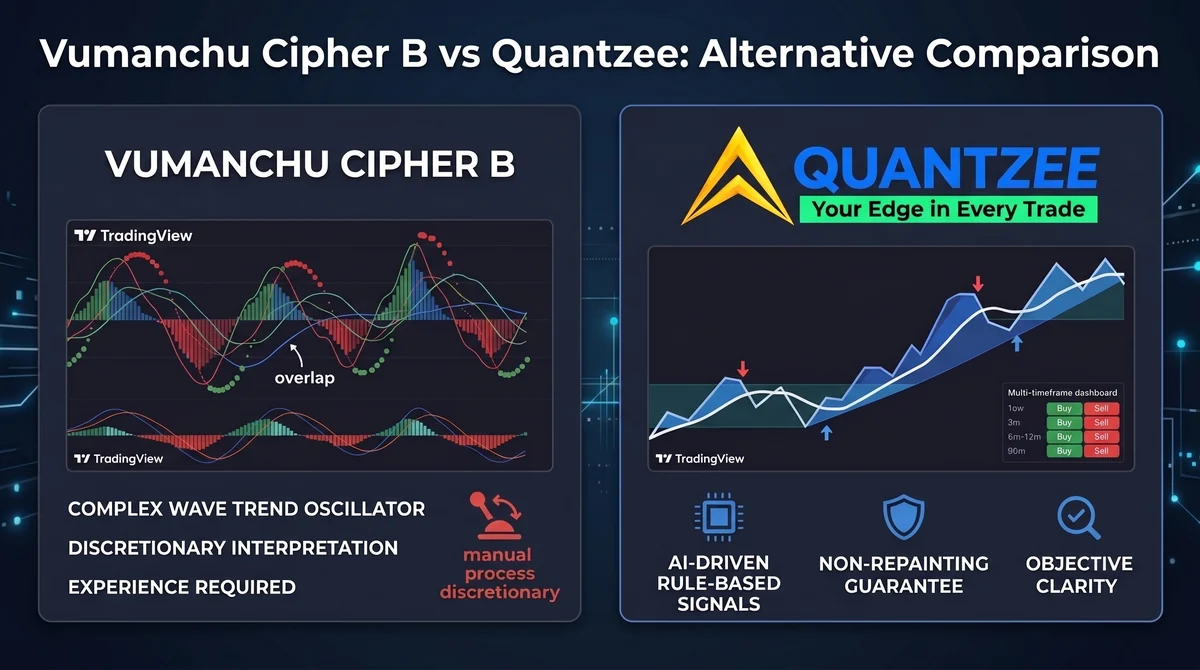
The indicator is a momentum oscillator that uses a combination of wave trend analysis, divergence signals, and money flow calculations to identify potential buy and sell zones. At its core, VuManChu Cipher is designed to show overbought and oversold conditions through a visual wave-based display, with diamond and dot signals overlaid to mark potential reversal or continuation points.
The indicator gained significant traction through social media sharing — traders would post their Cipher B charts on Twitter, YouTube, and Discord, building organic word-of-mouth. The free availability made it accessible to everyone, from complete beginners to experienced traders adding it as a supplementary tool. It remains one of the most added free indicators on TradingView, particularly among Bitcoin and altcoin traders.
VuManChu Cipher Components: Technical Documentation
Most traders who use VuManChu Cipher have a rough sense of what it does but do not know exactly what is running under the hood. Understanding the components is essential for evaluating where the free tool falls short and what a paid AI alternative actually provides differently.
Cipher A: The Core Wave Oscillator
Cipher A is the simpler of the two versions. Its primary calculation is the WaveTrend Oscillator — a custom momentum oscillator built around the relationship between a smoothed price series and its Exponential Moving Average.
How WaveTrend works:
- An average price (AP) is calculated, typically using High + Low + Close / 3 (HLC3)
- An EMA of the AP is computed over a defined period (typically 10)
- The absolute difference between AP and its EMA is smoothed further using another EMA
- The resulting “Enhanced Linear Weighted Moving Average” (ESLMA) forms the oscillator baseline
- A second smoothing pass creates the signal line
The result is plotted as a wave oscillating around zero, with overbought zones above +60 and oversold zones below -60 (approximate thresholds that can be adjusted). When the wave crosses above or below these thresholds and then reverses, it generates the diamond and dot signals that VuManChu Cipher is known for.
What Cipher A tells you: Momentum direction and overbought/oversold extremes. Nothing about trend direction, volatility context, support/resistance levels, or trade quality filtering.
What Cipher A does NOT tell you: Whether the overall trend supports the momentum signal. A buy signal in a downtrend and a buy signal at the start of an uptrend look identical on Cipher A — the indicator has no trend filter.
Cipher B: The Full System
Cipher B is where most of the complexity lives. It extends Cipher A with three additional components:
1. WaveTrend (as in Cipher A) — The core oscillator foundation, plotted in Cipher B’s wave panel as the two crossing lines. Same calculation method as Cipher A.
2. Divergence Detection — Cipher B includes automated divergence identification: it marks when price makes a higher high (or lower low) but the oscillator does not follow. These divergences are among the most useful signals Cipher B generates — they identify potential momentum exhaustion before price reverses.
Regular bullish divergence: price lower low, oscillator higher low — potential reversal to the upside. Regular bearish divergence: price higher high, oscillator lower high — potential reversal to the downside.
The divergence detection in Cipher B is the component experienced traders most often cite as valuable. The visual markers (highlighted dots, arrows) make otherwise-hidden divergences easy to spot without manually scanning the oscillator.
3. Money Flow (MFI-based component) — Cipher B includes a money flow calculation derived from the Money Flow Index (MFI), a volume-weighted oscillator that measures buying and selling pressure. In Cipher B, this appears as coloured circles or dots in the oscillator panel — green indicates net money inflow (buying pressure), red indicates net outflow (selling pressure).
The money flow component adds a volume dimension to the momentum signals — a momentum buy signal with green money flow is a higher-confidence entry than a momentum buy signal with red money flow. This is a genuinely useful filter.
4. Momentum Base (Background Signal) — Cipher B uses a background colour shift to indicate the overall momentum state. When the oscillator is above zero and the wave is expanding, the background shifts to one colour; when below zero and contracting, it shifts to another. This gives a quick visual read of the current momentum regime without requiring the trader to interpret the exact oscillator level.
What the Components Tell Us About VuManChu’s Limits
Examining the four components of VuManChu Cipher B reveals the tool’s fundamental architectural constraint: it is a momentum-only analysis system. Every component — WaveTrend, divergences, money flow, momentum base — measures momentum from different angles. None of them provides:
- Trend direction context (is this momentum in the direction of the trend or against it?)
- Volatility-adjusted signal quality (is this a high-volatility false spike or genuine momentum?)
- Adaptive calibration (does the oscillator respond differently in a low-volatility vs. high-volatility regime?)
- Trade timing precision (how many bars after the signal is the optimal entry?)
These gaps are not bugs in VuManChu Cipher. They are structural limitations of what a single-component free indicator can deliver versus what a purpose-built AI trading suite provides.
The Free vs. Paid Indicator Decision Framework
The VuManChu Cipher’s zero price tag makes the free-vs-paid comparison feel obvious in one direction. But the real decision is not “free vs. $59.99” — it is “what is the actual cost of using a free tool with known limitations in live trading?”
There are three real costs to using VuManChu Cipher in a live trading context:
Cost 1: Repainting Losses
VuManChu Cipher B has documented repainting on certain settings — particularly on live candles. This means a buy signal that appears as the candle is forming may shift or disappear when the candle closes. If you take a trade based on an intra-candle signal that subsequently vanishes, you have paid the cost of the free indicator in actual trading capital — not in subscription fees.
A serious backtesting error follows directly from this: if you build a strategy around VuManChu Cipher B using historical data, the strategy will include signals that look valid in hindsight but were not visible in real time. The backtest win rate is inflated relative to live performance. The cost of this discrepancy is impossible to quantify without live testing, which is why the repainting issue is the most financially consequential limitation VuManChu has.
Cost 2: False Signal Rate in Choppy Markets
VuManChu’s WaveTrend oscillator has no built-in market-condition filter. In a clean trending market, the signals are reliable. In a choppy sideways market — which is the dominant condition in most instruments for most of the time — VuManChu generates a high rate of overbought/oversold readings that lead to losing trades. There is no mechanism in the indicator itself to tell you “this is a choppy regime, reduce signal weight.”
The cost of this is not the indicator’s price. It is the capital lost on false signals during ranging conditions before the trader learns to manually filter them.
Cost 3: System Assembly Time and Cognitive Load
VuManChu Cipher provides one dimension of analysis: momentum. To trade systematically, you also need trend direction, support/resistance context, volatility awareness, and trade timing. That means stacking VuManChu with additional free indicators — RSI, EMA ribbons, volume oscillators — and manually synthesising conflicting signals across multiple panels.
This takes time to set up and introduces cognitive load during live trading decisions. The cost is not monetary in the first instance — but decisions made under cognitive load tend to be lower quality, which eventually has a monetary cost.
When Free Actually Makes Sense
Free is the right choice when:
- You are learning how momentum oscillators work conceptually (VuManChu Cipher B is an excellent learning tool for understanding divergences)
- You have a very small account where a one-off $59.99 is material to your P&L
- You are testing a trading idea informally and do not need strict non-repainting for live deployment
When Free Stops Making Sense
The free option stops making sense when:
- You are trading live capital and repainting signals expose you to losses that exceed the cost of a paid non-repainting alternative
- You are backtesting a system and need the backtest to reflect live-tradeable signal conditions
- You are trading markets other than trending crypto (where VuManChu’s strengths are most visible)
- You want to expand beyond momentum into a multi-dimensional analysis system
The free/paid inflection point — for most active traders who are past the learning stage — is reached when the cost of a single avoidable loss from a repainting signal exceeds the cost of a non-repainting alternative. At $59.99 once for Quantzee, that threshold is crossed one time and never again.
One bad repainted signal in a choppy session can cost more than Quantzee costs in total — $59.99, paid once, with no renewal at any point. You’re not paying for the indicator itself; you’re paying to stop guessing whether the signal in front of you will still be there once the candle closes. There’s no trial to sign up for, and no refund either, since the source code is emailed to you immediately — so the honest version of “try before you buy” here is running the Bar Replay test yourself, for free, before you ever pay anything.
Why Traders Are Looking for VuManChu Cipher Alternatives in 2026
The free nature of VuManChu Cipher is genuinely its biggest strength and its most misleading quality. Free does not mean it will perform as well as a paid, AI-driven system — and the gap becomes clearer the more seriously you trade.
Repainting on certain settings. VuManChu Cipher B, depending on configuration, has been shown to repaint signals in real-time — meaning a signal that appears on a live candle may shift, change, or disappear as the candle closes or new data arrives. While not all VuManChu settings repaint equally, the risk is real and well-documented across trading communities.
No AI or adaptive intelligence. VuManChu Cipher uses fixed mathematical formulas to generate its wave signals. It does not adapt to market conditions, does not filter signals based on volatility regimes, and does not learn from market behaviour. In trending markets it can perform reasonably well; in choppy or sideways conditions it generates a high rate of false signals without any built-in mechanism to flag the difference.
No real-time alert system. VuManChu Cipher does not come with a built-in alert framework tied to signal generation. While TradingView allows users to set custom alerts on indicator crossings, setting up reliable alerts for VuManChu’s specific signal logic requires manual configuration and is not seamless.
Single indicator, not a system. VuManChu Cipher is a momentum oscillator. It gives you one view of the market. Serious traders need more than one lens, which means stacking multiple indicators and manually synthesising conflicting signals.
Primarily built for crypto. VuManChu Cipher’s wave logic is optimised for the high-volatility, 24-hour crypto market. Traders applying it to equities, forex, or global markets indices often find the signal frequency and sensitivity misaligned with those market structures.
When the Free Option Stops Working: Specific Market Condition Examples
Theory aside, here are the specific market conditions where VuManChu Cipher B’s limitations become materially costly:
Choppy Markets (Range-Bound Conditions)
When a market enters a consolidation phase — no clear directional bias, price cycling between support and resistance — VuManChu’s WaveTrend oscillator will repeatedly reach overbought (above +60) and oversold (below -60) extremes without a real breakout following. Each crossing appears to be a valid signal. Many are not. A trader following VuManChu signals in a choppy market will take multiple small losses in quick succession — “death by a thousand cuts” — before the market eventually resolves its range and the trend resumes.
Quantzee’s AI-adaptive logic specifically addresses this: the system’s market-condition classifiers identify ranging environments and reduce signal confidence during consolidation. You get fewer signals, but higher-quality ones, because the system is not treating a ranging market the same way it treats a trending market.
Post-FOMC or High Volatility Events
Major macro events — Fed rate decisions, earnings announcements, geopolitical news — create sharp, fast price movements followed by extreme volatility. In this environment, VuManChu Cipher B’s wave calculations lag behind the actual price movement. The signal arrives late (after the move) or generates false reversal signals during the spike itself, where the oscillator reaches extremes that look like trade signals but are actually noise.
The money flow component helps partially, but there is no mechanism in VuManChu to dynamically widen its “neutral zone” during high-volatility events the way an adaptive ATR-based system can.
Expiry Day Dynamics (the index /)
On index options expiry days, intraday volatility follows a distinctive pattern: typically quiet in the morning session, expanding sharply as options expire, with specific support/resistance levels around Central Pivot Range (CPR) becoming critically important in the afternoon. VuManChu Cipher B was not designed for this market structure and has no concept of CPR levels, expiry-day timing, or the volatility expansion that characterises these sessions.
It incorporates CPR logic and expiry-day dynamics into its signal generation — something a free crypto-oriented momentum oscillator cannot approximate, regardless of parameter tuning.
Post-Consolidation Breakouts
The period immediately after a squeeze (compressed volatility → expansion) is one of the highest-probability setups in technical trading. VuManChu Cipher B’s momentum base and money flow give some signal of building pressure before a breakout, but there is no squeeze-specific detection mechanism. Traders trying to time breakouts with VuManChu often enter too early (while momentum builds) or too late (after the breakout has already moved significantly).
VuManChu Cipher Pros and Cons
Pros:
- Completely free — available directly in TradingView’s public library
- Visually intuitive wave-based display, easy to read for beginners
- Strong community following, especially in crypto trading circles
- Cipher B’s divergence signals are genuinely useful when used carefully
- Money flow component adds volume context to momentum signals
- Easy to add to any TradingView chart with one click
- Large library of YouTube tutorials and community guides
- Excellent for learning how momentum oscillators and divergences work
Cons:
- Documented repainting on certain settings — live signals may differ from backtested results
- No AI, machine learning, or adaptive signal filtering
- No automatic market-condition detection — performs poorly in choppy/ranging markets
- No built-in alert system for signal notifications
- Single-purpose oscillator, not a unified trading system
- High false signal rate in sideways market conditions
- Not optimised for equities, global indices, or options trading
- No official support channel or paid development updates
- Relies on community-generated documentation, which varies in accuracy
VuManChu Cipher Pricing (2026)
VuManChu Cipher A and Cipher B are free indicators published in TradingView’s public library. There is no official paid version. Some third-party sellers attempt to repackage or sell modified versions of VuManChu indicators, but these are unofficial.
The zero cost is genuinely appealing, especially for traders just starting out. However, the real cost of using VuManChu Cipher is in opportunity cost — trades taken on repainting signals, false entries in choppy markets, and the time spent manually patching together a trading system from multiple free indicators that were not designed to work together.
What Users Say About VuManChu Cipher
-
“Works great in trending crypto markets but gives too many false signals in ranging conditions” — A near-universal observation from experienced traders is that Cipher B performs well when there is a clear directional move but struggles significantly in consolidation phases. (Source: Reddit r/CryptoTrade)
-
“I backtested a strategy that looked incredible, then lost money in live trading — later learned about the repainting issue” — This is the most common cautionary story in VuManChu discussions. The indicator’s behaviour on historical bars can differ from live market performance, and many traders learn this the hard way. (Source: TradingView community comments)
-
“Great starter indicator — helped me understand momentum and divergences when I was learning” — VuManChu Cipher genuinely serves a purpose as an educational tool. Beginners appreciate its visual clarity for understanding how momentum oscillators work. (Source: Twitter / X trading community)
-
“Cipher B is everywhere in crypto communities but I’ve moved on to tools with actual AI signals now” — As traders grow in experience, a recurring pattern emerges: VuManChu is where they started, but it is not where they stayed. (Source: Discord trading servers)
Repainting Comparison
Repainting is the most financially consequential technical issue in the VuManChu vs. paid indicator comparison, so it deserves a dedicated section with enough detail to test it yourself.
How VuManChu Cipher B Repaints
VuManChu Cipher B’s repainting issue is specific to signals generated on live (unclosed) candles. The WaveTrend oscillator is a moving-average-based calculation — as price moves within an open candle, the oscillator value shifts with each tick. A buy signal that appears when the oscillator dips to -60 and starts reversing may vanish when the candle close pulls the oscillator value to a different level.
This is not unique to VuManChu — any oscillator calculated on intra-candle data can exhibit this behaviour. What matters is whether the indicator uses confirmed (closed) candle data for its signals. VuManChu Cipher B’s default configuration does not guarantee this for all signal types.
How to test it yourself:
- Open VuManChu Cipher B on any chart
- Enable TradingView’s Bar Replay (clock icon in the toolbar)
- Step through bars one at a time and note the signals as they appear
- Exit Bar Replay and compare what you see on the same historical section
- If signals moved, disappeared, or appeared where none were during replay — you have observed repainting
Quantzee’s Non-Repainting Architecture
Quantzee’s non-repainting design is enforced at the code level across all 6 indicators:
- Signal computations use closed bar data only — the calculation runs after the candle closes, not while it is forming
- Once a signal is plotted to a closed candle, it is permanently fixed — no subsequent price movement alters it
- This applies uniformly across all indicators — there is no inconsistency between different tools in the suite
The result: backtesting a Quantzee-based system produces results that accurately reflect what you would have seen in live trading. The win rate in testing is the win rate in live conditions (subject to execution differences). This is the most important single technical fact in the free-vs-paid comparison.
Meet Quantzee: A Better VuManChu Cipher Alternative
Quantzee was built to address every limitation that makes VuManChu Cipher a starter tool rather than a serious trading system.
AI vs. fixed formulas. Where VuManChu applies fixed wave formulas calibrated once and applied uniformly, Quantzee’s 6 indicators use adaptive machine learning logic that processes market data in real time — adjusting signal sensitivity to volatility conditions, filtering noise in choppy markets, and generating entry and exit signals with market context built in.
Non-repainting by design. The repainting issue that plagues VuManChu Cipher is absent from Quantzee’s architecture. Every signal is fixed to the closed bar and does not change as new data arrives. Your backtesting results translate to live trading performance.
Beyond momentum. Where VuManChu gives you one momentum oscillator (and its variants), Quantzee gives you 6 AI-powered tools covering trend detection, support and resistance, momentum, volatility, and trade timing — designed to work together as a unified suite. The Adaptive AI Oscillation Engine handles what VuManChu’s Cipher B oscillator does, but with AI-adaptive logic and no repainting. SuperTrend Pro+ handles trend direction. SMC Toolkit Pro handles support and resistance. All 6 tools are coordinated, not assembled by the trader from disparate sources.
Real-time alerts built in. Quantzee’s alert framework is integrated — every signal generates an alert you can configure via TradingView’s native alert system without manual setup or workarounds.
At $59.99 once for the full 6-indicator suite — no free tier or trial — the comparison with a free-but-limited oscillator is clear: you are not paying for something you already had — you are paying for a level of intelligence, coherence, and reliability that free tools cannot offer.
VuManChu Cipher vs Quantzee: Feature Comparison
| Feature | VuManChu Cipher | Quantzee |
|---|---|---|
| Price | Free | $59.99 once for the full suite |
| Core technology | Fixed-formula WaveTrend + MFI | AI / machine learning adaptive signals |
| Non-Repainting Guarantee | No — documented repainting on live candles | Yes — all signals computed on closed bars |
| Divergence detection | Yes (Cipher B) | Yes — Adaptive AI Oscillation Engine |
| Money flow analysis | Yes (MFI-based, Cipher B) | Yes — integrated in oscillator tools |
| Market-condition adaptation | None — same formula in all regimes | Yes — AI classifiers adjust for trend/ranging |
| Real-Time Alerts | Manual setup required | Built-in across all indicators |
| Indicator Suite | Single oscillator (2 versions) | 6 AI indicators as unified system |
| global Market Support (major global indices) | Not optimised | Full support |
| Crypto / Forex / Equities Support | Primarily crypto | All markets |
| Official Support | Community only | Direct support included |
Who Should Use Which?
| If You Are: | Choose |
|---|---|
| A beginner learning about momentum oscillators and divergences for free | VuManChu Cipher |
| A trader who wants to verify before they pay | Add any Quantzee indicator to a chart and run the Bar Replay non-repainting test first |
| A crypto trader who wants AI-powered non-repainting signals | Quantzee |
| A trader in global markets (major global indices, expiry day options) | Quantzee |
| Someone burned by repainting indicators in live trading | Quantzee |
| A forex or equities trader wanting a complete multi-dimension system | Quantzee |
| A trader who needs built-in real-time alerts | Quantzee |
| An experienced trader ready to move beyond free tools | Quantzee |
| A systematic trader backtesting a strategy (needs non-repainting) | Quantzee |
Conclusion
VuManChu Cipher holds a legitimate place in trading history. It introduced thousands of traders to momentum oscillators, wave analysis, and divergence detection — and for learning these concepts, its visual clarity is genuinely good. As a permanently free starting point, it has real value for beginner traders building their conceptual framework.
But in 2026, the limitations are well-documented and the alternatives are far more capable. Repainting signals, no AI adaptation, no automatic market-condition filtering, no alert system, and momentum-only analysis are real constraints that cost traders money in live markets — not in subscription fees, but in trading capital.
The free alternative is not VuManChu vs. Quantzee at full price. The Quantzee indicator suite is $59.99 once, no free tier or trial — but before committing, you can still verify the AI-adaptive signal quality for yourself: add any indicator to a TradingView chart and run the non-repainting test via Bar Replay.
When you are ready for the full upgrade — AI-driven signals that adapt to market conditions, a strict non-repainting architecture, a complete 6-indicator suite with built-in alerts, and full support for global markets — the price is $59.99, paid once, with the source code emailed to you. If you started with VuManChu and want to trade with a system that actually scales with your experience, Quantzee is the natural next step.
Educational disclaimer: All indicator comparisons in this article are for analytical and educational purposes only. This content does not constitute investment advice. Trading involves risk of capital loss. Past performance of any indicator does not guarantee future results. Always conduct your own analysis.
Explore Quantzee Indicators
Full AI suite — $59.99 once, 6 indicators total:
- AI Adaptive Quant Toolkit — self-tuning signals, overlays & dashboard — no repainting
- Adaptive AI Oscillation Engine — AI momentum + divergence detection
- AI TrendPulse — adaptive EMA trend detection with AI commentary engine
- SuperTrend Pro+ — volatility-adjusted trend signals
- MACD Pro+ — adaptive chop-zone-graded MACD with divergence engine
- Smart Money Concepts (SMC) Toolkit Pro — market structure, order blocks, liquidity mapping
View all indicators · See pricing
Related Articles
- LuxAlgo Alternative
- Market Cipher Review
- FluxCharts Alternative
- AlphaTrend Alternative — the same free-vs-paid upgrade question for another popular free script
- EzAlgo Alternative — see how a paid AI-branded suite stacks up before you upgrade off a free oscillator