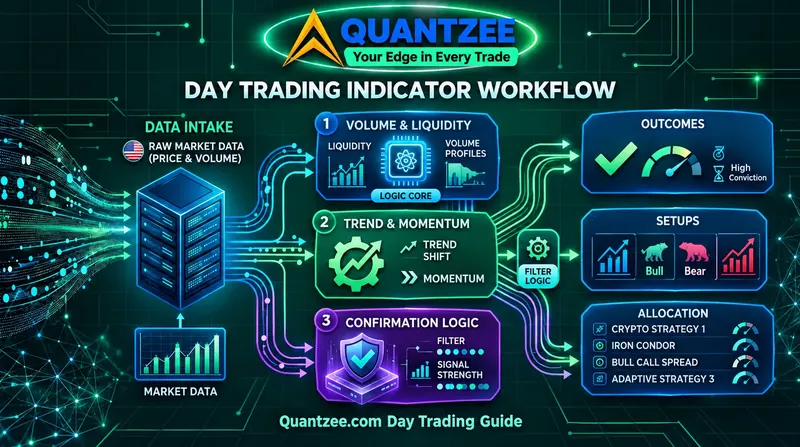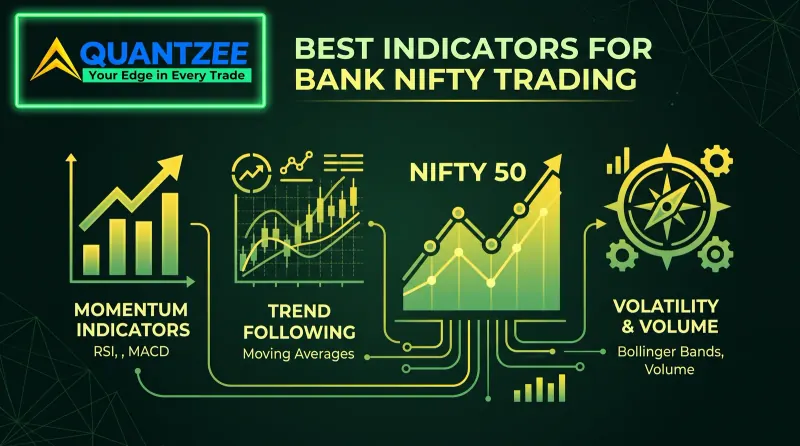
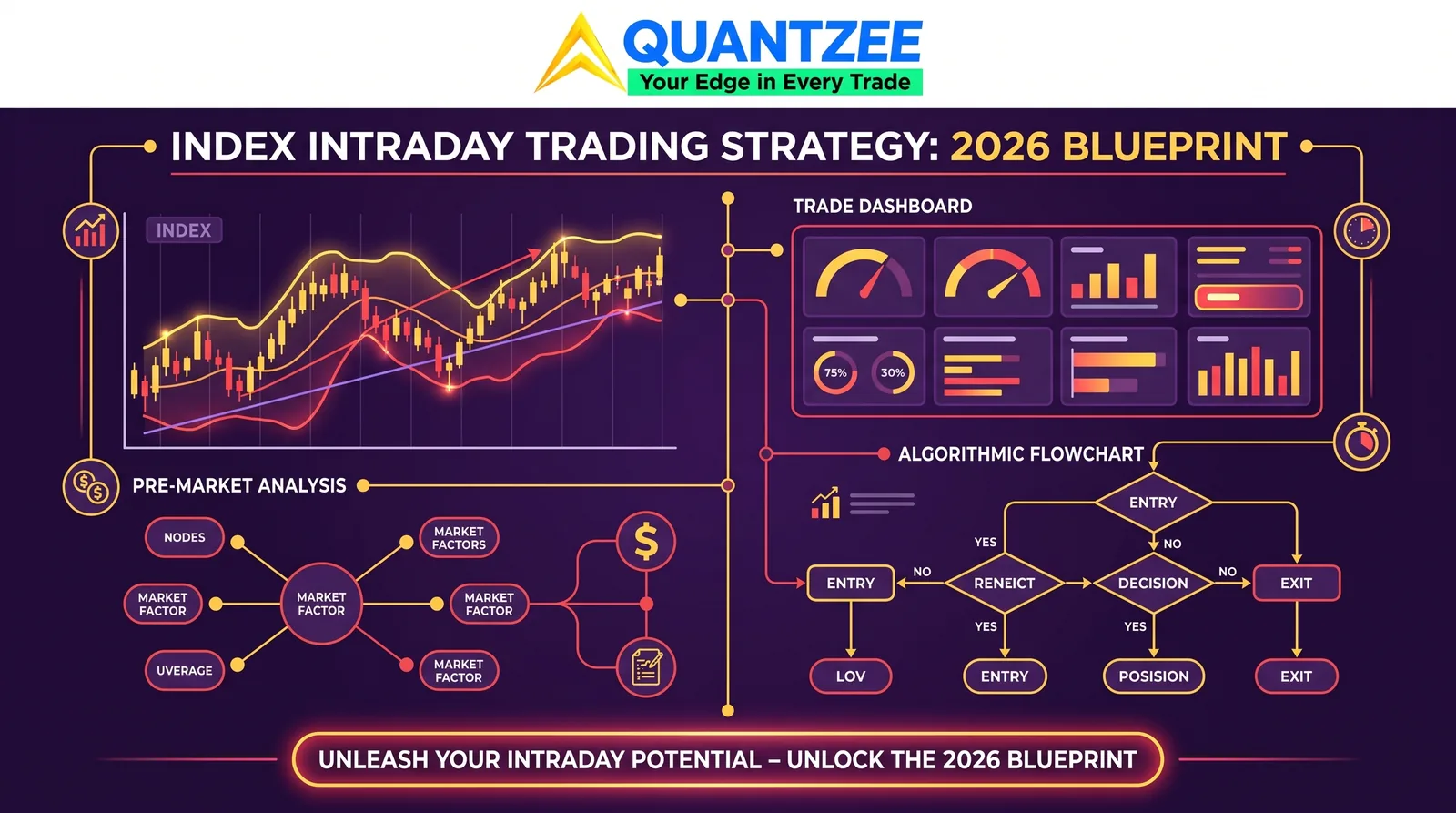
An index intraday trading strategy, as the name suggests, is a purely intraday approach to trading an index. If you want to learn how to trade an index for intraday only and want to remove the overnight risk, then this is the right place for you. Intraday trading is all about opening and closing a position within the same day and making money by taking advantage of short-term trends as well as swings. In this guide we will take you through all the details like the basics, advanced indicators, risk management and what to look for in a broker.
About the Author — Rajeev Gupta: Over 15 years of active trading across global indices, forex (EUR/USD, GBP/USD, USD majors), and crypto (BTC/USD) — with experience spanning structured option selling on weekly expiries, directional option buying during high-IV events, and long-term equity positions — I built Quantzee to close a gap I observed firsthand: analytical tools available to retail traders simply did not keep pace with what institutional desks were using. Every indicator in the Quantzee suite is stress-tested across multiple market regimes, derived from this same research background. This guide reflects that experience, presented for educational purposes only — not investment advice.
⚡ Key Takeaways
- Index intraday trading eliminates overnight risk — all positions close before the session ends, giving you exposure to index moves without carrying event risk through the night
- Index trading provides built-in diversification: one contract bundles many large-cap companies, so a single stock's bad day does not define your trade
- Core indicator stack: 9/21 EMA crossover for trend direction, RSI below 30/above 70 for extremes, VWAP as an institutional daily reference line, and ATR for stop sizing (1 ATR stop, 2 ATR target)
- Risk rule: never risk more than 0.5% of capital per trade, with a 2% daily stop limit — these limits preserve capital during the learning phase and prevent one bad session from becoming unrecoverable
What Is an “Index Intraday Trading Strategy”?
In simple words, an index intraday trading strategy — or you can also call it an index intraday trading system — is frequently buying and selling (or vice versa) an index within the same day, or its related instruments like call and put options. You decide:
- When to enter and exit. Your entry and exit can be decided using a specific backtested method or simply by using an indicator on TradingView.
- How much to risk. A safe rule is to risk only 1–2% of your deployed capital on any single day, or 0.5% of capital in a single trade.
- Which indicators to trust. We’ll dive into those soon and show some ideas and you can then do your own backtesting.
- How big your position should be. That can be calculated by dividing the per-trade risk amount by the stop-loss distance.
And yes, before going live, you should backtest the signals generated by your strategy on historical data and then paper trade for some days — because knowing your strategy works on real market moves is half the battle.
Why Is Trading an Index on Intraday Better?
Instead of trading individual stocks, index trading bundles many large companies into one instrument. The reasons we suggest it:
- Built-in diversification. One stock’s bad day might be balanced by others doing well — that’s why a single stock can easily fall or rise 10% in a day but a broad index rarely does.
- Liquid and smooth. Most major indices are highly liquid, which reduces your slippage while you enter and exit.
- Lower margins. Exchanges typically require less margin for an index position than for an equivalent single-stock position, since index volatility is generally lower than individual stock volatility.
- Easy macro play. News like central bank policy decisions or global cues often move the whole index, not just one stock.
- Safer micro exposure. Small news events on individual stocks tend to move that stock sharply, but rarely move the whole index by the same magnitude.
You can typically choose from:
- Index futures: Standard leveraged contracts, with leverage varying by exchange and index.
- Index options: Defined-risk plays if you’re bullish or bearish.
- Related benchmarks or higher-beta indices: Same ideas applied to a different underlying, often at a different contract size.
Why Many Traders Like Intraday Trading
- Zero overnight risk. The position is closed before the session ends and you can have a sound sleep.
- Leverage: Take higher positions with lower margins, smaller capital.
- Limited movement. The percentage movement in a broad index is limited and so is the risk, compared to single stocks.
- Competitive flat-fee brokerages. Many platforms charge a flat per-trade fee, so frequent trading doesn’t kill your profits — check what’s available in your market.
Think of your trading account as a small business. Track every detail, cut costs, and keep improving.
Why Index Intraday Trading Attracts Traders
- Massive liquidity. Millions of contracts trade daily on major index futures and options, so you can easily find liquidity.
- Tighter spreads. The spread between bid and ask is typically low, meaning lower slippage.
- Balanced volatility. Enough movement for opportunity, but not the wild single-stock swings you’d see from an earnings surprise.
- Tech-friendly. Easy to automate or run high-frequency approaches with APIs provided by most brokers.
Remember: smoother trends, clearer patterns, and plenty of quick setups make index trading one of the most accessible markets for day traders globally.
Beginner Indicators for Index Intraday Trading Setup
| Indicator | Why It Helps | How to Use It |
|---|---|---|
| 9 & 21 EMA | Shows short-term trend of the index | Buy when 9 EMA crosses above 21 EMA; vice versa. |
| Bollinger Bands | Spots volatility squeezes and breakouts | Go long/short on band expansion; fade extremes. |
| RSI | Suggests overbought/oversold levels of the index | Buy below 30, sell above 70 — combine with price action. |
| VWAP | Gives the volume-weighted average price | Look for longs above VWAP, shorts below. |
| MACD (12,26,9) | Best indicator to detect a shift in trend | Entry on MACD line crossing the signal line. |
| ATR (14) | Measures volatility of the index by calculating high-low range | Use ATR ×1 as SL distance, ATR ×2 as TP. |
| SuperTrend | Trailing SL and trend decider | Follow the trend until SuperTrend changes direction. |
| Volume Profile | Pinpoints key price levels where the action is happening | Trade bounces or breakouts around high-volume nodes. |
Summing It Up Together
An example of a trading system: you see the price above the 21 EMA, RSI is moving above 50, and the MACD just gave you a bullish crossover — volume’s also above average. That’s a buy signal. Put your stop-loss 1 ATR below your entry and target 2 ATR above.
Disclaimer: Quantzee indicators are analytical software tools designed to assist your own analysis. This content is for educational purposes only and does not constitute investment advice. Do your own research. Trading involves risk of capital loss. Quantzee is not a registered investment advisor in any jurisdiction. Analytical software, not investment advice.
Balancing Risks & Rewards
Making money in the stock market is not risk-free. An index-based intraday setup has its own risks and rewards.
Upsides of using this strategy:
- Bigger gains with leverage, as margin requirements are lower than single-stock equivalents.
- You can take smaller profits on high-volume trades due to lower margins.
- Multiple opportunities per day, as an index has two-way movement irrespective of individual stocks.
Downsides:
- Proper backtesting and paper trading is a must.
- Losses if you don’t train yourself with your strategy.
Your Quick Guide:
- Never risk more than 0.5% per trade.
- Set a daily loss limit of a maximum of 2% and stop trading after that.
- Keep a trading journal — review your best and worst days to spot patterns.
Why Technical Analysis Works in Intraday Index Trading
- Rules over rumors: You set aside your emotions from trading and follow your rule book.
- Precision: Technical indicators are precise and fast.
- Backtestable: Complete historical data is available for backtesting.
- Automatable: You can also generate signals from TradingView and automate your strategy.
Extra Edge in Trading: Trade multiple indicators across multiple indices so your risk is further diversified.
What to Look For in a Broker for Index Intraday Trading
Broker offerings and fee structures vary significantly by country and exchange. When comparing brokers for index intraday trading, look for:
| Consideration | Why It Matters |
|---|---|
| Flat or low per-order brokerage | Keeps frequent trading cost-effective |
| Fast, reliable order execution | Slippage on entries/exits directly affects intraday P&L |
| TradingView / API connectivity | Enables webhook alerts and automation |
| Mobile and desktop platforms | Needed for active intraday position management |
| Regulatory standing in your jurisdiction | Confirm the broker is properly licensed where you trade |
Hint: Try a demo account or small live trades to test order speed and reliability before going all-in.
Extra Activities
- Economic Calendar: Always keep track of scheduled macro events like central bank meetings, as they can give sudden movements against your indicator setup.
- Mindset Hacks: Always be patient while doing intraday trading — an impatient mind can never make consistent money in the markets.
- Tools & Data Feeds: Use quality, paid charting tools like TradingView for error-free and timely signals. Do your research before putting money into them.
- Taxes & Regulations: Always check your contract notes on a regular basis for applicable transaction taxes and reporting rules in your jurisdiction, and factor them into your profit calculations, as they can eat into trading profits.
Trading Journal: a must for every trader — log every trade to build discipline and find your mistakes.
Final Steps Before Trading
Trading an index intraday isn’t a magic wand that generates insane profits — rather, it’s all about having a clear plan, the right tools, and the discipline to stick to your rules. Here’s your checklist:
- Define your intraday setup: Timeframes, indicators, risk per trade.
- Backtest thoroughly: At least 2–3 years of data.
- Paper-trade: Build confidence without risking capital by paper trading for a few weeks.
- Start small: Risk only what you can afford to lose and will never hamper your emotions.
- Refine continuously: Keep a journal, review, and adapt as markets evolve.
Now, why wait? Open a demo account with your chosen broker, set up your charts, and get ready to trade your first index intraday setup — tomorrow’s session awaits!
Happy trading and stay disciplined!
Explore Quantzee Indicators
For index intraday traders who want adaptive signals built in, Quantzee’s AI-powered trading indicator suite is purpose-built for fast index setups:
- AI Adaptive Quant Toolkit — scalper preset for fast intraday setups
View all indicators · See pricing
Related Articles
- Best Indicators for Index Options Trading (2026 Guide) — complete pillar guide covering SuperTrend Pro+, MACD Pro+, AI Adaptive Quant Toolkit and full options/futures strategy frameworks
- Why Quantzee is the Best Indicator Provider
- Complete Guide to Trading Indicators & Signals