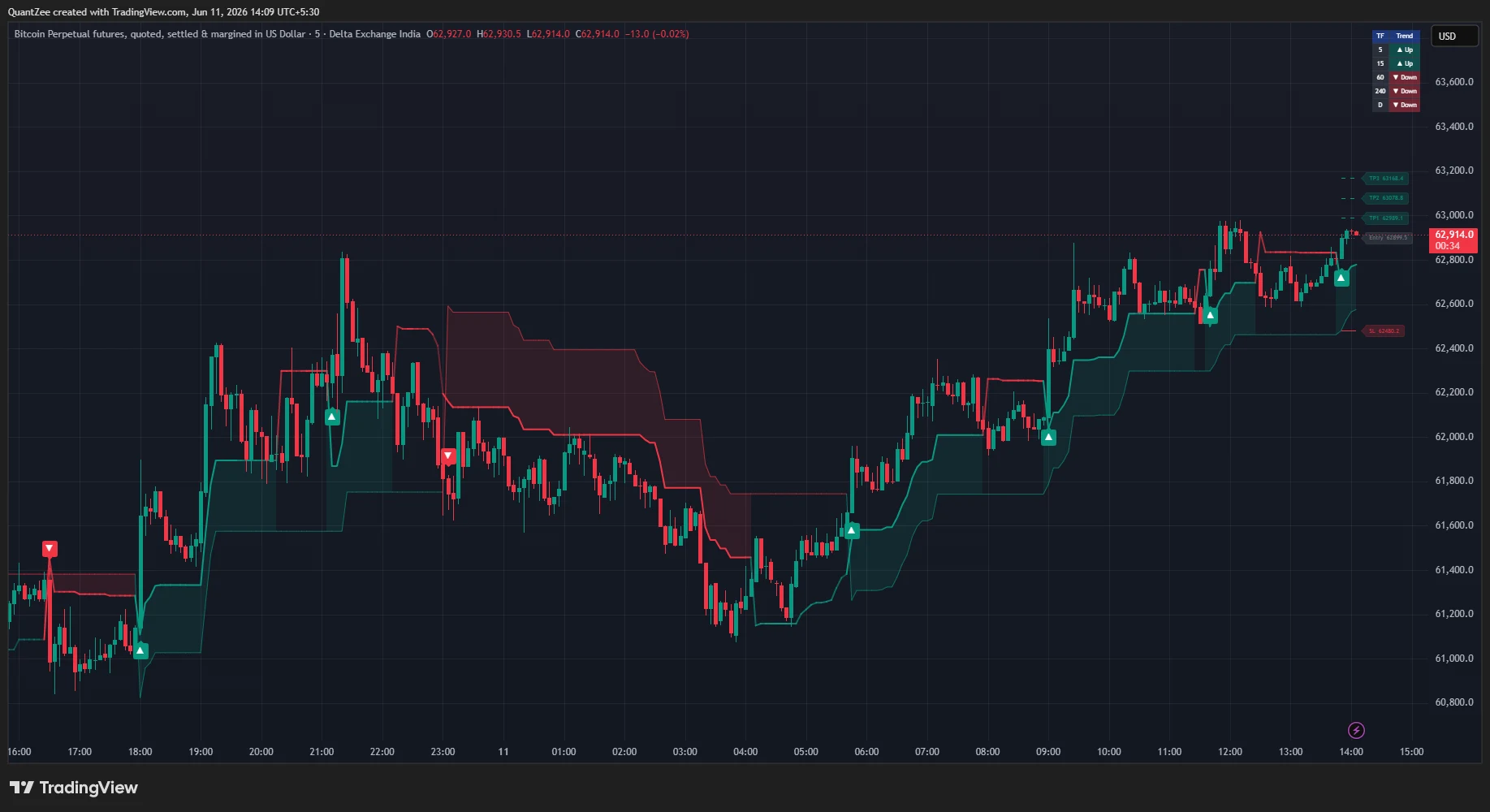

A friend messages you a screenshot. Green dots, red dots, a money-flow wave at the bottom, and a caption: “Market Cipher called this top perfectly.” You watch a few YouTube clips. The chart looks like a video game. And then you see the price: roughly $600 for a year of access.
That is the moment most traders pause. Not because $600 is impossible, but because nobody wants to spend it and then realise three weeks later that the dots were never the edge they looked like.
This post is not a feature tour. It is the question underneath the feature tour: in 2026, is Market Cipher actually worth the money, or are you paying for the aesthetic and the community more than the results? Let’s go through it the way you’d think it through before any real purchase.
⚡ Key Takeaways
- Market Cipher costs approximately $600/year — Quantzee's full AI suite is $9.99/month ($120/year), a 5x difference in annual subscription cost for a comparable indicator suite
- Quantzee offers 3 free indicators — EMA Ribbon Pro+, Bollinger Bands Pro+, VWAP Pro+ — to test non-repainting signal quality before committing to any paid tool
- The real cost of Market Cipher exceeds the $600 invoice: add weeks of learning curve, signal fatigue from a busy indicator chart, and opportunity cost of capital locked into one ecosystem
- A large part of Market Cipher's perceived value is the community (Discord, Telegram) — if you would not pay for the indicators without the chatroom, be honest that you are partly buying the chatroom
- Non-repainting is the first test for any indicator — Market Cipher's "confirmation on close" design means signals can appear and change before a candle closes; always run Bar Replay before subscribing
What you are actually buying
Market Cipher is a bundle of TradingView indicators. The two most talked-about pieces are the oscillator (the “B” with its colored dots and the green money-flow band) and the SR/DBSI components that mark support, resistance, and divergence conditions. You also get access to a members area and a community where setups get shared.
That last part matters more than people admit. A large share of Market Cipher’s value, for many subscribers, is social: the Telegram and Discord chatter, the shared trade ideas, the sense that you are inside a room where things happen. Strip that away and you are left with a set of indicators that, like all indicators, are interpretations of price and volume you could partly reconstruct from standard tools.
So the honest framing is this. You are buying three things at once: a polished indicator suite, a learning curve, and a community. The price is the same whether or not you use all three.
The real cost, beyond the sticker
The headline number is the annual fee, in the region of $600 depending on the tier and any promo. But the sticker price is rarely the real cost of a trading tool.
- Time to competence. The oscillator is not plug-and-play. New users routinely spend weeks learning which dot combinations to trust and which to ignore. That ramp is a cost, paid in hours and in early mistakes.
- Signal fatigue. A busy indicator prints a lot. On a fast chart you will see dots and crosses constantly, and the temptation to act on every one is real. Overtrading on a paid tool is a quiet, recurring tax.
- Opportunity cost. Six hundred dollars locked into one ecosystem is six hundred dollars you did not put toward a different tool, a data subscription, or simply your trading account.
None of this makes Market Cipher a bad product. It makes it a product whose true cost is higher than the invoice, which is exactly the kind of thing worth naming before you commit. For a side-by-side on pricing tiers and what each unlocks, our full Market Cipher review goes deeper than this piece does.
Who it tends to suit
Two kinds of traders get the most out of it.
The first is the discretionary chart reader who already has a process and wants a confluence layer. If you trade structure and you treat the oscillator as one vote among several, the suite can sharpen entries and flag divergences you might otherwise miss.
The second is the trader who genuinely values community. If shared ideas, accountability, and a steady stream of setups keep you engaged and learning, the membership has value that has nothing to do with the lines on the chart.
Who tends to be disappointed
The trader looking for a signal that tells them exactly when to buy and sell, with no judgement required, almost always ends up frustrated. Market Cipher is not that. The dots are inputs, not instructions, and treating them as instructions is the fastest way to lose money and conclude the tool “doesn’t work.”
Beginners with no chart-reading foundation are the other group at risk. Handed a busy oscillator before they understand trend, structure, and risk, they tend to chase every signal. The tool did not fail them; the sequence did.
How to judge any indicator before you pay
This is the part that outlasts any single product. Whether it is Market Cipher or anything else, run the purchase through four checks:
- Does it repaint? An indicator that redraws its signals after the fact will always look brilliant in screenshots and betray you in real time. Non-repainting behaviour is non-negotiable. This is exactly why our own AI indicator suite is built to lock signals once printed.
- Can you backtest your read of it? If you cannot define a rule and check it against history, you are buying vibes.
- What is the all-in cost? Add the fee, the learning time, and the overtrading risk, then compare against the realistic edge.
- Is the community a feature or a crutch? If you would not pay for the tool without the chatroom, be honest that you are buying a chatroom.
Investopedia has a clear primer on how technical indicators are meant to be used as confirmation rather than standalone signals, and it is a useful sanity check before any purchase like this.
A note on alternatives
Market Cipher is not the only well-built suite, and for many traders it is not the best value. If your main draw is clean, non-repainting signals across crypto, forex, and stocks rather than the community, it is worth comparing it against newer AI-driven tools. Our Market Cipher alternative breakdown lays out where a modern suite pulls ahead on price, multi-market coverage, and signal transparency, and our roundup of the best TradingView indicators for 2026 puts several options side by side.
So, is it worth it?
Here is the honest answer. Market Cipher is worth it for the trader who already reads charts, wants a confluence layer, and genuinely uses the community. For that person, $600 a year can be reasonable. It is not worth it for the trader hoping to buy a shortcut around learning, or the one who will treat every dot as a command. For them, the same money is better spent on education and a simpler, non-repainting tool.
The product is real. The hype is also real. Your job is to separate the two before the invoice, not after.