
Table of Contents
- Crypto Trading in Australia: The 2026 Context
- Which Crypto Trading Style Suits Your Australian Lifestyle?
- Why Standard Indicator Settings Fail on Crypto
- The Best Technical Indicators for Crypto Trading in Australia
- Exclusive Indicators: What Every Australian Trader Is Missing
- The Quantzee AI Indicator Suite
- Risk Management for Australian Crypto Traders
- Common Mistakes Australian Crypto Traders Make
Australia has one of the highest crypto ownership rates in the world. As of 2026, 31% of Australian adults own or have owned cryptocurrency—roughly 6.2 million people. Bitcoin is trading in the range of $90,000–$110,000 AUD. Ethereum, Solana, and a broad range of altcoins see active daily trading on Australian exchanges. Spot crypto ETFs are now listed on the ASX, and over 15% of SMSFs hold some crypto allocation.
Yet if you search for a crypto indicator guide online, you find the same generic result: a numbered list of RSI, MACD, Bollinger Bands, and Moving Averages explained in two paragraphs each, tested on EUR/USD or a US equity, with zero connection to what makes crypto trading in Australia genuinely different.
Crypto is not forex. It’s not ASX stocks. It trades 24/7 with no closing bell. It’s 3–5× more volatile than most asset classes. It responds to on-chain data, regulatory news, and global sentiment shifts in ways that traditional indicators weren’t designed to handle. And in Australia in 2026, the regulatory environment, AUSTRAC, ASIC Digital Asset Platform licensing, ATO real-time data matching adds a layer of context no offshore guide addresses.
This guide is different. It covers every major technical indicator with crypto-specific settings and context, plus the tools that competing guides completely miss: the Fear and Greed Index, on-chain indicators, and the Fibonacci Pivot Points. It explains how to read charts correctly, which trading style suits your lifestyle, and how Australia’s 2026 regulatory environment affects every decision you make.
⚡ Key Takeaways
- Crypto's 24/7 operation and 3–30% daily volatility requires purpose-built settings: RSI 75/25 thresholds (not 70/30), Bollinger Bands at 2.5 standard deviations, and faster MACD (6, 13, 5) on 1-hour and 4-hour charts
- Swing trading on the 4-hour and daily charts is the most practical style for most Australian retail traders — only 30–60 minutes per day, a manageable number of signals, and enough time for trades to develop
- On-chain indicators (exchange inflows/outflows, NVT ratio, long-term holder behavior) reveal Bitcoin supply and demand dynamics no price-based indicator can replicate — available free on Glassnode and CryptoQuant
- The Crypto Fear and Greed Index is a free daily sentiment filter: Extreme Fear (0–25) often marks buying opportunities; Extreme Greed (75–100) signals tighten stops and reduce new longs
- Quantzee's AI Adaptive Quant Toolkit and AI TrendPulse are designed for 24/7 markets with adaptive parameters that recalibrate to overnight BTC moves; the Quantzee suite's non-repainting architecture lets you test signal quality before subscribing
Crypto Trading in Australia: The 2026 Context
AUSTRAC, ASIC and the Digital Asset Platform Licence
Australian crypto exchanges must now be registered with AUSTRAC as Digital Currency Exchange (DCE) providers, and hold a Digital Asset Platform (DAP) licence under the 2025 regulatory framework overseen by ASIC (Australian Securities and Investments Commission).
What this means practically:
- Only use AUSTRAC-registered, DAP-licensed exchanges. Verify before depositing.
- The Travel Rule (active March 2026) requires exchanges to share sender/receiver identity data on transactions above $1,000 AUD, identical to how banks operate.
- User funds must be held in segregated accounts entirely separate from exchange operating capital.
- All licensed platforms are covered by AFCA (Australian Financial Complaints Authority) for dispute resolution.
The ATO: Every Trade Is Now Tracked
The ATO now receives real-time data feeds from all DAP-licensed exchanges. Every trade, swap, staking reward, and payment is automatically matched to your Tax File Number.
The most important tax rules for Australian crypto traders:
| Transaction | Tax treatment | Key rule |
|---|---|---|
| Selling crypto for AUD | Capital Gains Tax (CGT) | Hold 12+ months → 50% CGT discount |
| Crypto-to-crypto swap | CGT event – disposal | Calculate AUD gain/loss at time of swap |
| Staking / yield rewards | Ordinary income | AUD value at time of receipt |
| Receiving crypto as payment | Ordinary income | Fair market AUD value when received |
| Transfer between own wallets | Not a taxable event | Gas/transfer fees are disposals |
| {: .tax-table} |
Crypto vs ASX Stocks vs Forex: Why Different Indicators Apply
| Feature | ASX Stocks | Forex | Crypto |
|---|---|---|---|
| Trading hours | 10am-4pm AEST weekdays | 24/5 Mon-Fri | 24/7, 365 days |
| Typical daily volatility | 0.5-1.5% | 0.3-1% | 3-10% BTC, 5-30% altcoins |
| Volume data quality | Centralised, reliable | OTC tick volume only | Exchange-specific + on-chain |
| VWAP reset | Market open (10am AEST) | N/A or midnight UTC | Midnight UTC |
| Unique indicators | VWAP, earnings calendars | COT reports, central bank calendars | Fear & Greed, on-chain, funding rates |
| {: .crypto-comparison} |
Which Crypto Trading Style Suits Your Australian Lifestyle?
Before building your indicator stack, you need to understand which trading style fits your time availability, risk tolerance, and goals. The right indicators for a scalper are different from those for a swing trader. Choosing indicators before choosing your style is backwards.
| Style | Hold time | Time needed | Best indicators | Who it suits |
|---|---|---|---|---|
| Scalping | Seconds-minutes | Full-time attention | Stochastic RSI, ATR, Volume | Very high risk tolerance, full-time traders |
| Day trading | Minutes-hours | Several hours/day | RSI, MACD, Bollinger, VWAP, ADX | Active traders, moderate-high risk tolerance |
| Swing trading | Days-weeks | 30–60 mins/day | EMA, MACD, Fibonacci, AI TrendPulse | Part-time traders, moderate risk tolerance |
| Position trading | Weeks-months | 30 mins/week | 200-day SMA, weekly pivots, OBV | Long-term holders, lower time commitment |
| HODLing | Months-years | Minimal | 200-day SMA, Fear & Greed Index | Conservative investors, lowest time commitment |
For most Australian retail crypto traders—those trading around a full-time job—swing trading on the 4-hour and daily charts is the most practical approach. It requires only 30–60 minutes per day, generates a manageable number of signals, and gives trades enough time to work without requiring constant screen monitoring.
Why Standard Indicator Settings Fail on Crypto And How to Fix Them
The Volatility Problem
Indicator settings calibrated for a market that moves 0.5-1% per day will misfire constantly on Bitcoin, which regularly moves 3-8% daily. Every oscillator will show ‘extreme’ readings constantly. Every Bollinger Band touch will look like a reversal. The result is indicator overload and constant false signals.
The Session-Less Market Problem
Session-dependent indicators like VWAP and Pivot Points need recalibration. VWAP resets at midnight UTC on crypto, not at a stock market open. Pivot Points calculated from ‘yesterday’s session’ need to use the 24-hour UTC period. Weekend trading is fully active on crypto, meaning there is no Sunday open gap logic to apply.
The Volume Reality
Crypto volume is fragmented across dozens of exchanges globally. The volume on your TradingView chart is exchange-specific, not total market volume. On-chain volume—actual blockchain transaction data—is a separate, more fundamental layer that traditional indicators don’t access.
The Best Technical Indicators for Crypto Trading in Australia
Here is every major crypto trading indicator with the adjustments Australian traders need to make for crypto’s 24/7, high-volatility environment.
Ichimoku Cloud
The Ichimoku Cloud combines five lines and a shaded cloud into a single indicator that simultaneously shows trend direction, momentum, and support/resistance levels. Independent backtesting has shown Ichimoku outperforming every other standalone indicator on the daily chart over 5-year periods.
The components:
- Tenkan-sen (Conversion Line): Midpoint of the last 9 periods. Price crossing above it is a bullish signal.
- Kijun-sen (Base Line): Midpoint of the last 26 periods. Acts as dynamic support/resistance.
- Senkou Span A & B (The Cloud): Price above the cloud = bullish. Below = bearish. Inside the cloud = neutral or choppy conditions, avoid new positions.
- Chikou Span (Lagging Span): Current close plotted 26 periods back. Used to confirm trend direction.
Crypto application: Bitcoin pullbacks to the cloud top in an established uptrend are high-probability long entries. The cloud itself provides both a visual bias and a dynamic stop-loss level. TK crosses (Tenkan-sen crossing above Kijun-sen) above the cloud are among the cleanest trend continuation signals available on Bitcoin’s daily chart.
Moving Averages: SMA and EMA
Moving averages smooth out price volatility by calculating the average price over a defined number of periods, creating a continuously updating trend line. There are two types:
- SMA (Simple Moving Average): Equal weight to all periods. Slower, cleaner. Best for identifying big-picture trend direction and major support/resistance zones.
- EMA (Exponential Moving Average): More weight on recent prices. Reacts faster. Better for intraday signal generation and dynamic support levels.
Crypto limitation: Moving averages are lagging by design. In crypto’s fast-moving markets, a 50-day EMA crossover can confirm a trend that’s already 20% into the move. Use them for bias and context, not as precision entry tools.
RSI (Relative Strength Index)
RSI measures the speed and magnitude of recent price changes on a 0-100 scale. It was developed by J. Welles Wilder and is the most widely used momentum indicator in crypto trading.
How RSI works: It compares the average gains to average losses over 14 periods (default). A reading above 70 signals overbought conditions. Below 30 signals oversold. In practice, crypto requires adjusted thresholds.
- Standard (RSI 14) – use 75/25, not 70/30: Bitcoin’s higher baseline volatility means the standard 70/30 generates too many signals in both directions. 75/25 identifies genuinely extreme conditions.
- RSI (7) for faster signals: Shorter period, more responsive. Better for 1-hour crypto charts where momentum shifts quickly.
- Bull trend behaviour: During Bitcoin bull markets, RSI stays above 50 consistently and resolves ‘overbought’ readings through sideways consolidation. Shorting RSI overbought in a bull trend is one of the costliest mistakes in crypto trading.
- Divergence – RSI’s most powerful application: Bitcoin printing new highs while RSI makes lower highs = bearish divergence = early warning of trend exhaustion. This pattern has appeared before every major Bitcoin top.
Example: Bitcoin reaches $108,000 AUD. RSI on the daily chart reads 71. Two weeks later Bitcoin makes a new high at $112,000 AUD, but RSI only reaches 68. This lower RSI high despite higher price is classic bearish divergence, a signal to tighten stops or reduce position size, even if the trend appears intact.
Bollinger Bands
Bollinger Bands place two standard deviation bands around a 20-period moving average. They expand in high volatility and contract in low volatility, dynamically adapting to market conditions in a way that makes them well-suited to crypto.
- The Bollinger Squeeze: Bands narrowing to their tightest point signals low-volatility buildup, the conditions that historically precede explosive directional moves on Bitcoin and Ethereum. The direction of the break after the squeeze determines your trade direction.
- The Band Walk: During strong crypto bull markets, Bitcoin ‘walks’ the upper Bollinger Band touching and closing near it repeatedly without reverting to the mean. This is the single most dangerous pattern for mean-reversion traders. Don’t fade a band walk. Hold with a trailing stop until MACD or RSI shows clear divergence.
- Range mode (ranging market): Flat bands + price oscillating between them = trade reversals. Touch the upper band with RSI overbought = short toward the middle band. Touch the lower band with RSI oversold = long toward the middle band.
- Adjusted settings: Consider 2.5 standard deviations instead of the default 2.0 to reduce false signal frequency during crypto’s higher-volatility conditions.
Example: Bull Trap using Bollinger Bands. Bitcoin breaks above the upper Bollinger Band on low volume. The bands are already wide from recent volatility. Without high-volume confirmation, this break is likely a bull trap — price will revert to the middle band rather than sustaining the breakout. Volume confirmation is essential before acting on a Bollinger breakout.
MACD (Moving Average Convergence Divergence)
MACD shows the relationship between a 12-period and 26-period EMA, with a 9-period signal line. It combines trend direction and momentum strength in one tool, making it one of the most information-dense standard indicators available.
- Zero line cross: MACD above zero = fast EMA above slow EMA = bullish bias. A reliable macro directional filter.
- Signal line cross: MACD crossing above the signal line = buy signal. Below = sell signal. Most reliable on the 4-hour and daily charts during trending conditions.
- Histogram expansion: Growing bars = strengthening momentum. The ideal environment for holding or adding to a trend trade.
- Histogram divergence: Bitcoin at a new high but MACD histogram lower than the previous high = momentum is weakening. The most reliable macro warning signal for major cycle tops.
- Faster settings for crypto: Standard (12, 26, 9) works on daily charts. Consider (6, 13, 5) for 1-hour and 4-hour crypto charts, more responsive to crypto’s quicker momentum shifts.
Fibonacci Retracement
Fibonacci retracement draws horizontal levels at key ratios (23.6%, 38.2%, 50%, 61.8%, 78.6%) between a significant high and low, identifying where pullbacks are likely to pause or reverse before the original trend resumes. In crypto, Fibonacci levels carry more weight than in most other markets because they are used by millions of participants globally, creating self-fulfilling reactions.
- 61.8% – the golden ratio: The most respected Fibonacci level in crypto. Bitcoin pullbacks to 61.8% of a major rally are historically high-probability long entries within an established bull cycle. This level has held during every significant Bitcoin correction within a bull market.
- 38.2% – the shallow retracement: If BTC only pulls back to 38.2%, it signals exceptional trend strength — buyers are stepping in early and the uptrend has strong conviction.
- 78.6% – the deep retracement: The final defence before the previous swing low is challenged. Used by traders who believe the trend is still intact despite a significant pullback.
- Extensions (1.272× and 1.618×): Project where the next leg of a rally may end. Used for setting take-profit targets on BTC and ETH swing trades.
Post-RBA / post-news application: After any sharp AUD-affecting news event or major on-chain catalyst moves Bitcoin, drawing Fibonacci from the start of the move to its peak identifies the pullback zones where the trend is most likely to resume, giving traders who missed the initial move a structured re-entry framework.
Stochastic Oscillator
The Stochastic Oscillator compares a closing price to the high-low range over a specified period on a 0-100 scale. It consists of two lines: %K (the main line) and %D (a moving average of %K). When %K crosses above %D in oversold territory (below 20), it’s a bullish signal. When %K crosses below %D in overbought territory (above 80), it’s bearish.
The Stochastic reacts faster than RSI, making it better suited to shorter timeframes and the rapid momentum shifts of crypto markets. Stochastic RSI—which applies the Stochastic calculation to RSI values rather than price—is even faster and is the preferred oscillator for intraday crypto entries on the 1-hour and 4-hour charts.
ADX (Average Directional Index)
ADX measures trend strength on a 0-100 scale without indicating direction. It answers the most important question before applying any directional indicator: is this market actually trending right now, or is it ranging?
- ADX below 20: Ranging market. Use oscillators and mean-reversion tools. Avoid EMA crossovers and MACD.
- ADX 20–25, rising: Trend developing. Begin watching for directional breakout confirmation.
- ADX above 25: Confirmed trend. EMA crossovers, MACD, SuperTrend Pro+, trailing stops work reliably.
- ADX above 40 on crypto: Extreme trend strength. Bitcoin in this state is not the time to look for tops. Trail your stop and let the trend run until ADX begins declining.
Pairing ADX with +DI/-DI lines: When +DI crosses above -DI alongside rising ADX above 20, it confirms a bullish trend. This three-component confirmation is one of the cleanest trend signals available on Bitcoin’s 4-hour chart.
ATR (Average True Range)
ATR measures how much a crypto asset moves on average over a defined period. It doesn’t indicate direction, it indicates volatility. On Bitcoin, where daily ATR regularly runs $2,500-$5,000 AUD, ATR is the most practically important indicator for Australian traders who need to size positions and set stops correctly.
- Stop loss formula: Set stops at 1.5-2× daily ATR. This gives trades room to breathe without being unreasonably wide.
- Position sizing formula: Dollar risk per trade ÷ ATR stop distance = number of coins. Never trade altcoins at the same position size as Bitcoin. Altcoin with a 20% daily ATR requires a position 10× smaller than Bitcoin at the same risk tolerance.
Session transition signal: Rising ATR mid-session often signals a transition from consolidation to trending conditions, your cue to switch from range-mode indicators to trend-mode indicators.
Fibonacci Pivot Points
Fibonacci Pivot Points combine the standard pivot calculation (previous period’s high, low, close) with Fibonacci ratios to project the most likely support and resistance levels for the current period. They provide more granular level detail than standard pivot points, identifying zones where price reversals are statistically more probable.
- Central Pivot (P): Average of previous period’s high, low, and close. Price above P = bullish session bias. Below P = bearish session bias.
- R1/R2/R3 (resistance levels): Calculated upward from P using Fibonacci ratios. R1 is the first target for long trades; R2 and R3 are extended targets for stronger moves.
- S1/S2/S3 (support levels): Calculated downward from P. S1 is the first support for short trades; S2 and S3 for extended bearish moves.
Crypto application: Bitcoin frequently reacts precisely at daily and weekly Fibonacci Pivot levels, especially when these levels coincide with Fibonacci retracement zones from larger swing moves. The convergence of a Fibonacci Pivot level and a 61.8% Fibonacci retracement creates a high-probability ‘confluence zone’ that many institutional desks actively trade.
Parabolic SAR
Parabolic SAR plots dots above or below price to indicate trend direction and automatically adjusting stop-loss levels. Dots below price = bullish trend. Dots above price = bearish trend. As the trend continues, the dots accelerate toward price automatically tightening the trailing stop.
- Best use on crypto: Strong trending conditions, commodity-driven BTC moves, post-breakout altcoin runs. The automatic trailing stop mechanism is valuable for traders who struggle to exit winning positions.
- Accelerating factor: The default acceleration factor (0.02) tightens stops faster the longer a trend continues. In crypto’s explosive moves, some traders reduce this to 0.01 to give trends more room to breathe.
Critical limitation: In ranging or sideways crypto markets, Parabolic SAR flips above and below price constantly, generating a stream of losing signals. Only use Parabolic SAR when ADX confirms a trend is in play (above 25). Never use it as a standalone entry signal in choppy conditions.
Exclusive Indicators: What Every Australian Trader Is Missing
These are the tools that no standard indicator guide mentions yet they’re among the most powerful inputs available to crypto traders. None of them exist for ASX stocks or forex. All are freely accessible and relevant to Australian traders in 2026.
The Fear and Greed Index
The Crypto Fear and Greed Index measures overall market sentiment on a 0-100 scale. Extreme Fear (0-25) typically occurs near market bottoms when panic selling has driven prices to oversold levels. Extreme Greed (75-100) typically occurs near market tops when FOMO is driving unsustainable buying.
| Score | Sentiment | What it means | Trader action |
|---|---|---|---|
| 0-25 | Extreme Fear | Market is panic-selling. Often near bottoms. | Look for long entries – be greedy when others are fearful |
| 25-45 | Fear | Sellers in control, risk-off sentiment | Wait for stabilisation before entering longs |
| 45-55 | Neutral | No strong directional sentiment bias | Follow indicator signals, no sentiment override |
| 55-75 | Greed | Buyers in control, risk-on sentiment | Trend-following signals have higher conviction |
| 75-100 | Extreme Greed | FOMO buying. Often near tops. | Tighten stops. Reduce new longs. Consider partial exits. |
| {: .fear-greed} |
How Australian traders use the Fear and Greed Index: It functions as a sentiment filter rather than a trade signal. When you’re considering a long entry and the index reads Extreme Greed (85+), that’s a warning to reduce size or wait for the next pullback. When the index reads Extreme Fear (20 or below) and your technical indicators show an oversold setup at key support, the Fear and Greed Index is your confirmation that the setup has a higher probability of being a genuine bottom.
Australian context: Check the Fear and Greed Index every morning alongside your chart analysis. It takes ten seconds and provides macro sentiment context that no price-based indicator can replicate. Available free at alternative.me/crypto/fear-and-greed-index/
On-Chain Indicators: The Data No Price Chart Shows
On-chain indicators analyse actual blockchain transaction data, the movement of coins between wallets, exchange inflows and outflows, miner behaviour, and holder activity. This layer of analysis is completely unavailable for ASX stocks or forex, and it provides insights into Bitcoin’s supply and demand dynamics that no price-based indicator can replicate.
- Exchange inflows/outflows: When large amounts of Bitcoin move into exchanges, it signals potential selling pressure, holders are moving coins to where they can be sold. When Bitcoin flows out of exchanges (into cold wallets), it signals long-term holding supply is being removed from the market, a bullish signal.
- NVT Ratio (Network Value to Transactions): Compares Bitcoin’s market capitalisation to its on-chain transaction volume similar to a P/E ratio for Bitcoin. High NVT = price is high relative to actual network usage (potentially overvalued). Low NVT = price is low relative to genuine on-chain activity (potentially undervalued).
- Active addresses: The number of unique addresses sending or receiving Bitcoin in a given period. Rising active addresses alongside rising price confirms genuine adoption is driving the move, not just speculation. Falling active addresses during a price rally is a warning signal.
- Long-term holder behaviour: When long-term Bitcoin holders (wallets that haven’t moved coins for 1+ years) begin selling, it historically signals the late stages of a bull market. When long-term holders accumulate during price weakness, it’s a bullish on-chain signal.
Where to access on-chain data: Glassnode and CryptoQuant are the most comprehensive platforms for on-chain indicators. Both offer free tiers with sufficient data for individual Australian traders. CoinMetrics provides good free data for NVT and active address metrics.
The Quantzee AI Indicator Suite: Built for Crypto’s 24/7 Volatility
Every standard indicator discussed above has a fundamental limitation: fixed parameters. Crypto’s 24/7 operation, regime-switching behaviour, and extreme volatility require tools that adapt in real time. This is precisely what the Quantzee AI trading indicator suite delivers—purpose-built, non-repainting, AI-powered indicators that work across every crypto pair on TradingView.
AI Adaptive Quant Toolkit
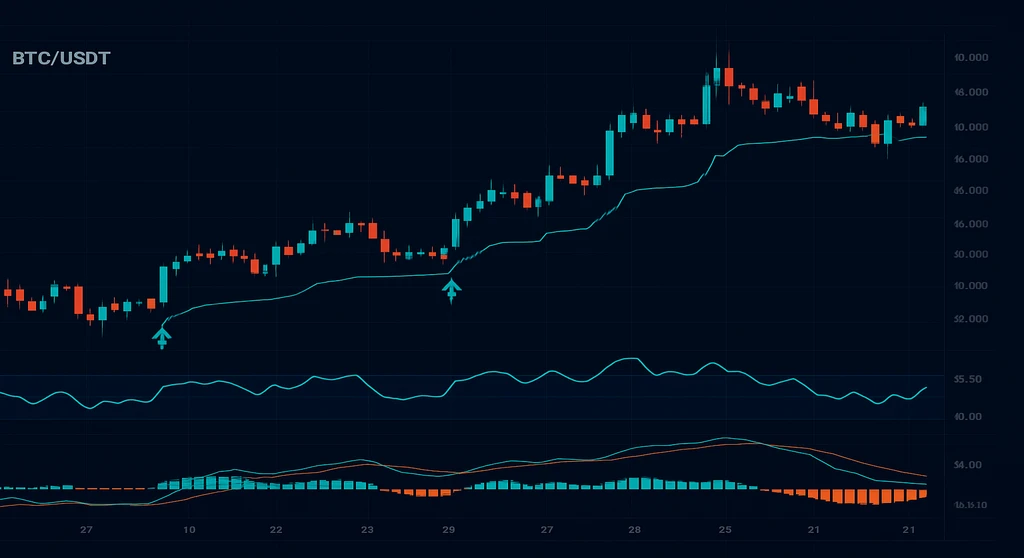
The AI Adaptive Quant Toolkit is Quantzee’s most comprehensive single indicator. It uses proprietary AI to combine adaptive signals, dynamic overlays, and real-time analytics into a unified decision-making framework, self-adjusting to changing market conditions and delivering high-probability buy/sell signals, trend reversal alerts, and market structure insights simultaneously.
- Complete unified analysis: Synthesises trend direction, momentum strength, and market structure into one signal output. Instead of manually checking RSI, then MACD, then your levels, you receive one high-conviction signal that reflects all inputs at once.
- 24/7 alert integration: Set TradingView alerts on AI Adaptive Quant Toolkit signals and be notified whenever a high-conviction setup forms including at 3am AEST when Bitcoin makes a decisive move off a key level.
- Non-repainting, the non-negotiable: The signal on the live candle is the signal on the historical chart. No retroactive shifting or disappearing signals.
Best for Australian crypto traders: The ideal starting point and primary signal layer. Deploy on the 4-hour chart for BTC and ETH. Every trade you take should have a confirming signal from this toolkit.
Adaptive AI Oscillation Engine
An advanced, self-adjusting oscillator combining momentum, liquidity, and volume intelligence. Unlike RSI or Stochastic, it dynamically adapts to volatility and sentiment, mapping smart money flow, divergence, and reversal points in real time. It interprets market psychology and provides adaptive, colour-coded insights for trend continuation, range trading, and volatility management.
- Dynamic thresholds: Overbought/oversold levels adjust to current volatility conditions, identifying genuine extremes in quiet consolidation while avoiding constant false signals during explosive trending phases.
- Smart money flow mapping: Tracks institutional-scale volume flow into and out of a position, the kind of signal that RSI and Stochastic completely miss. Smart money divergence from price is one of the earliest reversal signals available.
- Automatic divergence detection: Flags divergences between oscillator momentum and price action automatically earlier and more reliably than manual RSI divergence spotting.
Best use: Entry timing tool. Once AI TrendPulse establishes your directional bias, use the Oscillation Engine to time the specific entry longs when it signals oversold in a bullish environment, shorts when overbought in a bearish one.
AI TrendPulse
A complete trend-intelligence framework that blends momentum, volatility, and adaptive logic to detect prevailing market direction, assess trend strength, and alert traders to early signs of reversals. Outputs a clear directional bias, bullish or bearish with visual signals overlaid directly on your chart.
- Earlier signals: Trend changes are identified earlier than EMA crossovers or MACD signal line crosses. On crypto, being a few hours early means entering at $95,000 AUD instead of $102,000 AUD on Bitcoin.
- Trend strength assessment: Not just direction, how strong is the conviction? A weak bullish signal in choppy conditions warrants smaller size. A strong signal in a momentum-driven rally warrants full size.
- Early reversal detection: Specifically designed to catch trend exhaustion before it fully appears on the chart, preventing the loss of accumulated gains by staying in too long.
Best use: Daily and 4-hour BTC/ETH charts for macro bias. When daily and 4-hour both agree (dual timeframe alignment), that is your highest-conviction trading environment.
Core two-indicator setup: AI TrendPulse (direction) + Adaptive AI Oscillation Engine (timing). These two tools together replace the function of four to six standard indicators.
Risk Management for Australian Crypto Traders
Technical indicators tell you when to enter. Risk management determines whether you survive long enough to collect the winnings. In crypto’s extreme volatility environment, sound risk management isn’t optional, it’s the difference between a trading career and an account blown in two months.
The Four Pillars of Crypto Risk Management
1. Position Sizing (1–2% Rule)
Never risk more than 1-2% of your total trading capital on any single trade.
- Account: $10,000 AUD → Maximum loss per trade: $100-$200 AUD
- This rule sounds conservative until you’ve experienced a 10-trade losing streak (which happens to every trader)
- With 2% sizing: a 10-trade losing streak costs you 18% of your account
- With 10% sizing: the same streak wipes you out
2. Stop-Loss Orders (Non-Negotiable)
Every trade needs a stop-loss set at entry. The stop should be placed at the level where your trade thesis is invalidated, not at an arbitrary dollar amount below entry.
3. Portfolio Diversification
Don’t allocate your entire crypto budget to a single coin. Spread across:
- Bitcoin (most stable) — 60%
- Ethereum — 30%
- Higher-risk altcoins — 10%
(Adjust the ratio to your risk tolerance)
4. Emotional Discipline
The most overlooked risk management tool.
- Create a trading plan before you trade
- Define entry criteria, stop level, and target in advance
- Execute the plan without deviation
- Keep a trading journal—review every trade weekly
Fear and greed drive the two costliest mistakes in crypto: exiting winning trades too early (fear) and holding losing trades too long (hope).
Common Mistakes Australian Crypto Traders Make
Mistake #1: Using Repainting Indicators
The danger: A repainting indicator looks perfect on historical charts but changes or removes signals after candles close, making live trading unreliable.
The reality: Most free TradingView crypto signal indicators repaint.
How to avoid it: Test every tool by watching it live for several sessions before trading it. All Quantzee indicators are non-repainting by design—verified, not claimed.
Mistake #2: Stacking Duplicate Indicators
The problem: RSI + Stochastic + MACD on the same chart = the same signal three times. They all measure momentum.
The illusion: The extra confidence feels real but isn’t.
The solution: Build your stack deliberately:
- One trend tool
- One momentum tool
- One volatility tool
- One level tool
The Quantzee suite is structured around this principle.
Mistake #3: Ignoring Volume
Price tells you what happened. Volume tells you whether it matters.
- Bitcoin breakout on low volume = bull trap waiting to happen
- Reversal at support on huge volume = genuine bottom
Volume confirmation is the single step most retail traders skip—and it’s the step that separates high-probability entries from coin-flip trades.
Mistake #4: Using Default RSI Settings on Crypto
The origin: RSI 70/30 was calibrated for equity markets that move 0.5-1% per day.
The problem: Bitcoin moves 3–8% daily. Default settings generate signals every few hours—most are noise.
The fix: Adjust to 75/25 on 4-hour and daily charts.
Mistake #5: Ignoring the ATO
The reality: Every trade is now automatically matched to your TFN via real-time exchange data feeds. Every crypto-to-crypto swap is a taxable event.
The risk: Failure to keep accurate records from day one creates serious compliance risk.
The solution: Use CryptoTaxCalculator from your first trade.
Final Thoughts
Crypto trading in Australia in 2026 is more accessible, more regulated, and more competitive than ever.
- The ATO is watching every trade in real time
- Bitcoin at $90,000–$110,000 AUD means poor timing costs more
- A 24/7 market with 3–30% daily volatility demands purpose-built tools, not retrofitted stock/forex logic with default settings
The foundation remains the same: understand the market structure (Dow Theory, support/resistance, candlestick patterns), apply the right indicators for your trading style, and confirm every entry with volume.
The standard tools—RSI, MACD, Bollinger Bands, Fibonacci, Ichimoku—are still essential. But use them with crypto-specific adjustments, not default settings from a stock trading course.
Then go deeper. The Fear and Greed Index, on-chain exchange flows, and funding rates provide a layer of insight that price-based indicators cannot replicate. They tell you not just what price is doing but why—and whether the participants behind the move are smart money or retail FOMO.
And for the complete AI-powered system—non-repainting, self-adapting tools that work seamlessly together on every crypto pair in TradingView—the Quantzee suite is available at quantzee.com/indicators.
FAQs:
1. Is crypto trading legal in Australia?
Yes, fully legal. Cryptocurrency is classified as a CGT asset by the ATO. Exchanges must be AUSTRAC-registered and DAP-licensed. The ATO receives real-time data from all licensed exchanges and every disposal event gets reported.
2. What is the best indicator for crypto trading in Australia in 2026?
For most Australian traders, especially the beginners, the strongest starting point is the Quantzee AI Adaptive Quant Toolkit as it synthesises trend, momentum, and market structure into one non-repainting signal that adapts to crypto’s changing volatility.
3. What trading style is best for Australian crypto traders?
Swing trading on the 4-hour and daily charts is the most practical for the majority of Australian retail traders who trade around work. It requires 30–60 minutes per day, generates a manageable number of signals, and gives trades enough time to work without requiring continuous screen monitoring.
Explore Quantzee Indicators
- Adaptive AI Oscillation Engine — momentum & liquidity for 24/7 crypto markets
- AI Adaptive Quant Toolkit — all-in-one signals for all asset classes
View all indicators · See pricing